

Growth at reasonable valuations | Investor Disc: Don't Buy or Sell based on my tweets. I'm biased.
Joined December 2018
- Tweets2.8K
- Following205
- Followers3.9K
- Likes2.4K







Pinned Tweet
Many retail investors try to study the real estate sector and give up because of the complex accounting followed by each player.
Some just look at the Screener P/E and call it expensive. Others argue that property prices are already too high and there is little scope for further appreciation.
But they often forget one thing. Real estate developers don't necessarily need property prices to keep rising to grow. They need to launch more projects, sell inventory and keep replenishing their pipeline.
And honestly, the balance sheets of several listed developers have become quite impressive. Tbh, too impressive to ignore.
I started looking at this sector after studying Raymond Realty and realised that many real estate developers are sitting on goldmines, both literally and in terms of future business opportunities.
Look at the presales numbers.
Across 12 major listed developers, annual presales grew from ₹73,679 Cr in FY23 to ₹1,61,800 Cr in FY26. That's a 30% CAGR over three years!
Collections have grown from ₹67,062 Cr in FY24 to ₹1,07,117 Cr in FY26.
Think about what this means. A significant amount of business is already getting booked, and the cash from these bookings flows in as construction progresses. These projects will eventually translate into recognized revenue and profits as they are completed.
Of course, bookings aren't the same as revenue or profit. Execution, cancellations and project economics matter. But the visibility into future business is much better than a simple trailing P&L might suggest.
Now let's talk about valuation. Before that, we need to understand how to actually value these businesses.
Under Ind AS 115, many developers recognize residential revenue only when the project is completed and possession is handed over. Meanwhile, launch costs, marketing expenses and overheads are incurred much earlier.
So a company can report strong presales but weak or even negative EBITDA today. And when handovers begin, reported revenue and profits can suddenly jump.
Looking at trailing P/E or EV/EBITDA in isolation can therefore be misleading.
I prefer looking at Core EV/Presales and Core EV/Embedded EBITDA, while also checking the land bank, sustainable project margins, debt and cash conversion. Embedded EBITDA is essentially current presales multiplied by a reasonable estimate of the margin the developer can retain over the project lifecycle.
Now look at how valuations have changed.
Before COVID, developers were often valued at 0.5 to 0.8 times NAV, with the market worried about debt, stalled projects and whether land would ever be monetised.
Then came the post COVID re-rating. Investors began valuing these companies as growth franchises rather than just land banks. Some leading developers traded at 6 to 11.5 times Core EV/Presales and 20 to 35 times Core EV/Embedded EBITDA.
Today, after the correction and a few years of strong growth, the 12 company cohort in my analysis trades at around 3.2 times FY26 Core EV/Presales and 11 times Core EV/Embedded EBITDA.
Read that again.
Presales have compounded at 30% while valuation multiples have compressed substantially from their peak.
This is what makes the sector interesting to me. You don't necessarily need another massive expansion in property prices or valuation multiples. Continued growth in bookings, timely execution and conversion of the existing pipeline into cash can itself create value.
The balance sheets have also improved significantly across several leading players. Customer advances help fund construction, while lower leverage reduces the risk that used to destroy shareholder value in the previous cycle.
But this is not a blanket bullish call on every developer.
A company with a valuable legacy land bank and high margins deserves to be valued differently from one that has to share most of its profits with landowners. A developer growing bookings rapidly but burning cash also deserves more scrutiny than one converting collections into free cash flow.
This is why Raymond Realty caught my attention. Its legacy Thane land and JDA pipeline offer years of development potential, but the real test is how efficiently it can convert that potential into profits and cash.
The opportunity, in my view, is to find companies where the market is still looking at today's reported earnings while the underlying business is building tomorrow's revenue.
Everyone talks about expensive property prices. Far fewer seem to be talking about the growth in presales, the visibility of future deliveries and the valuation compression that has already happened.

Sammaan Capital:
While going through Arihant Capital's report, I found the estimates interesting.
A comparison of management's five-year plan with Arihant's estimates:
PAT (₹ Cr)
| Year | Management| Arihant Base case
| FY27 | 1,400 | 1,499
| FY28 | 3,200 | 2,095
| FY29 | 4,500 | 3,068
| FY30 | 5,600 | 4,489
Arihant's base case is meaningfully below management's PAT guidance from FY28 onwards.
Now comes the interesting part: the legacy written-off pool.
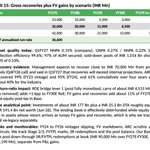
Management expects around ₹7,000 Cr of recoveries from provided pools.
Arihant has modelled ₹6,950 Cr of recoveries + fair-value gains in its base case and ₹10,600 Cr in its bull case.
Their base-case legacy contribution to PAT/book value is already substantial, but there is room for upside if recoveries surprise.
FY28 could be the inflection year as the core business turns profitable and starts contributing meaningfully.
Arihant's FY29 adjusted book value is ₹179/share. If dividends are retained, this could approach ₹193/share.
And every additional ₹1,000 Cr of recovery could potentially add around ₹6/share to book value, according to the report.
What makes this interesting is that even Arihant's base case leaves room for management to outperform on business growth and profitability.
The next few quarters could be extremely interesting.
At current valuations, the risk-reward deserves serious attention.
Now look at the book value opportunity.
Arihant's FY29 base-case adjusted book value is ₹179/share.
If the company retains the dividends instead of distributing them, this could rise to approximately ₹193/share.
And this is without assuming any upside beyond their base-case recovery estimates.
The current valuation looks extremely tempting. The risk-reward appears compelling.
The next few quarters could be very interesting. The transition from a stressed HFC to a profitable lending franchise is what makes this story worth tracking.

Nifty Realty is showing good strength.
Avoid developers with significant exposure to Gurgaon.
MMR, Hyderabad and Bengaluru continue to remain healthy markets.
Focus on two key metrics: Pre-sales growth and collections.
Raymond Realty remains my favourite pick in the sector.

1
7
835
Vaibhav Joshi retweeted

Most expensive words in investing are 'dont focus on valuations in xx sector'
Vaibhav Joshi retweeted

Jefferies raised India weight by another 1 point to 15% (benchmark 13.3%), funded by a 1-point cut to Taiwan. This is the second raise in last three weeks, adding 3 percentage points in total.
5 Nov: India up 2 points to 14%
19 Nov: India up another 1 point to 15%
My outlook on some of the sectors I track:
1. Smaller Banks, NBFCs & MFIs
As FIIs continue buying large banks, I believe the focus could gradually shift towards smaller banks, NBFCs and MFIs. Once large banks start trading beyond 3x P/B, investors may begin looking at players delivering 16–20% ROE but still trading at 1–1.5x P/B. I expect some of that money to trickle down.
2. Realty
I feel the real estate sector could do well. Valuations are attractive, balance sheets are relatively clean, and as the Indian economy grows, the demand for real estate will remain intact.
I don't expect land prices to rise rapidly this time around. Ideally, this cycle should be driven by genuine end-user demand rather than speculative activity.
3. Chemicals
There could be selective opportunities in the chemical space where valuations have become reasonable. Stock picking will be important here.
4. Capital Goods & EMS
Valuations in capital goods are again on the higher side, and the same holds true for several EMS players. I would be selective rather than chasing the entire theme.
5. Hospitals & Diagnostics
These businesses should continue doing well operationally. However, valuations have already rerated significantly, so from here, most of the returns might come from earnings growth rather than further multiple expansion.
6. Capital Markets
The sector still looks reasonably interesting, but I don't expect the same kind of euphoria we witnessed in BSE and other market-related stocks during the previous rally.
7. Defence & Precision Engineering
These themes have already matured to a large extent. The easy money might have been made, and future returns will increasingly depend on execution and earnings delivery.
8. CDMO
I feel the CDMO theme could be entering the last phase of its cycle. One needs to be particularly careful about valuations and growth expectations.
9. Gold Retailers
I remain positive on organised gold retailers. There is still a long runway for the organised sector to capture market share, especially given the questionable and opaque practices prevalent among several unorganised players.
Any meaningful short-term correction could provide a good accumulation opportunity.
10. Cables
Sentiment in the cable sector has taken a hit because of concerns around the AI infrastructure theme losing steam.
However, a large part of the demand for cables is domestic and driven by power infrastructure, renewables and industrial capex.
We may not see significant valuation rerating from here, but earnings growth could remain healthy. Power capex doesn't seem to be peaking yet. As India's manufacturing activity picks up, the need for reliable power infrastructure will only increase.
I believe the recent weakness is more of a temporary sentiment-driven blip than a structural slowdown.
11. IT Services
I still don't find the IT services sector particularly attractive. GCCs are expanding rapidly and increasingly building capabilities in-house. I believe this could eat into a meaningful portion of the incremental growth opportunity for traditional IT services companies.
Overall, I would rather focus on sectors where valuations are reasonable, balance sheets are healthy and earnings growth has room to surprise, instead of chasing themes that have already seen significant rerating.
It's mid-November, and management seems fairly confident, which suggests that the pain hasn't been significant so far.
With crude oil and commodity prices cooling off, inflation should also start easing in the coming quarters.
Muthoot Microfin is expecting to Exceed the full year guidance and close the year with a PAT of more than ₹420–430 crore, potentially delivering its highest-ever annual profit.
The market is extremely pessimistic about the microfinance sector right now.
My gut says it's time to look at this as a contrarian opportunity. Let's play this one against the crowd.

CORPORATE RADAR |
Q2 नतीजों के लिए क्या रहे अहम ट्रिगर्स?
फेस्टिव सीजन में कैसी रही लोन ग्रोथ?
आगे कैसी रह सकती है एसेट क्वालिटी?
माइक्रो फाइनेंस को लेकर क्या है आउटलुक?
क्या है Muthoot Microfin के फ्यूचर प्लान?
Muthoot Microfin के CEO सदफ सईद से खास बातचीत
#MuthootMicrofin #MuthootMicrofinShare #Q2Results #Q2FY27 #LoanGrowth #AssetQuality #Microfinance #MicrofinanceSector
@Sadafsayeed @poojat_0211
9
851
FIIs are in no mood to stop

#FundFlow | FIIs Net Buy ₹10,308.42 Cr While DIIs Net Sell ₹4,859.80 Cr In Equities Today (Provisional)

16
1,128
Looks like Anthropic was the last nail in the coffin of AI trade.

BREAKING: Anthropic stock, $ANT, extends losses to -10% in premarket trading, now down -25% from its post-IPO high.
The stock is now 5% away from its IPO price of $83/share.

2
6
725
For everyone feeling FOMO watching the Nifty rally:
Have some patience.
FIIs were in a hurry to cover their shorts, so the initial flow of money was concentrated in F&O stocks and large, liquid index constituents.
As this rally matures, FII and DII money should gradually start rotating into stocks where valuations are attractive and future growth prospects remain intact.
So hang in there. The stocks you've picked haven't lost their potential. Their turn will come. It's just a matter of time.

FIIs are unstoppable now 😂
Interesting will be to see when will DII deploy their cash.
#FundFlow | FIIs Net Buy ₹7,411.41 Cr While DIIs Net Sell ₹1,356.57 Cr In Equities Today (Provisional)

This time, CreditAccess has been caught in the crossfire.
Other players have relatively lower exposure to Maharashtra and Karnataka, but for CreditAccess, these two states together account for nearly 50% of its loan book.
While its strong underwriting standards and proven track record should help it navigate the situation, the market is worried about one key risk: What if the impact of the drought worsens and starts affecting collections more severely?
Its better to play the MFI recovery via Satin , Arman and Muthoot microfin.
Q3 will decide fate of credit access grameen.

CreditAccess Grameen Back to Three Digit Levels!
Stock is trading almost at similar levels to where it traded pre COVID! (Feb'20)
Historical Median P/B: ~3.2x
Peak P/B: ~5x
Current P/B: ~1.8x
FY27E P/B: ~1.6x (lowest ever)
Management has upgraded its FY27 RoA guidance to 5.2-5.8% & RoE guidance to 21-24%, while maintaining 20-25% AUM growth expectations
Are we getting closer to the bottom, or is the street pricing in another round of stress?

To everyone who says valuations don't matter:
In trading, that might hold true.
But if you're investing with a medium to long-term horizon, always remember one golden rule:
Never overpay for growth.
Even a great business can turn into a poor investment if you buy it at the wrong valuation.

What happened with V2 Retail is a classic example of when stocks are priced for perfect execution, they are one disappointment away from getting punished.
Management reduced the SSG guidance and that was the main concern.
SSG slowing down doesn’t mean revenue growth will immediately slow down, they may still do 50% revenue growth this year.
But to keep opening new stores and sustain high growth, they need healthy SSG. If SSG remains weak, they will have to rely more on new store additions, making growth more capital intensive and eventually impacting returns.
Always remember:
Buy with a decent margin of safety.

1
14
1,587
Budget could be positive for Microfinance sector 🤞.
CGFMU scheme is already renewed and fees reduced is by 25 bps.
hoping some more positive things from the budget.
📢 Budget Wishlist: Capital Market & BFSI Stakeholders Meet FM! 💰
🔹 LTCG Tax Cuts & Lower STT Rates Discussed
🔹 MFs Push For Tax Parity Between Debt & Equity Funds
🔹 Insurance Commission Reforms On The Table
🔹 Stakeholders Seek Dedicated Fund For Microfinance Sector
👀 What Could Make It To Budget 2027?
#Budget2027 #Markets #BFSI #MutualFunds

7
787
Vaibhav Joshi retweeted

RAYMODN REALTY : POST PREF PROMOTER HOLDING increased : infused 409 crore
watchout :
Mahim 3 Acres pre-launch converting into confirmed bookings : Nov–Dec 2026(expected time of booking)


Another big positive for listed jewellery players.
The unorganised sector still accounts for nearly ~60% of the market, and trust remains a major concern.
BIS hallmarking alone doesn't eliminate the risk of malpractice.
In contrast, listed organised players have their reputation, brand and long-term customer relationships at stake, giving them far stronger incentives to maintain transparency.
Mis-selling and quality-related malpractices are not new in the unorganised segment. Some players have historically resorted to such practices to earn extra margins.
The structural tailwinds for organised jewellery retailers remain very strong.


Get ready to see some inventory losses from unhedged gold players.
Kalyan is 100% Hedged
P N gadgil was 80% Hedged
Senco , shringar mangalsutra , lalitha had significant inventory unhedged.
If you're buying smaller Gold Jewellery players, make sure to check how much of their profits in Q3 and Q4 last year came from inventory gains.
Companies sitting on large unhedged gold inventory can surprise you, and not necessarily in a good way.
Don't extrapolate those earnings blindly into your projections.

Well, I definitely missed out on a few hot themes this year.
But sometimes, focusing on finding good businesses at reasonable valuations can be just as rewarding, if not more.
Not every opportunity needs to be part of the hottest theme.

1/ Ever heard of an NBFC that grew its loan book by 105% in a single year while keeping NPAs at literal ZERO? 🚀
Meet SG Finserve ($SGFIN). A hidden gem disrupting India's $530B MSME credit gap.
Here is the deep-dive investment thesis. 🧵👇 #Investing #StockMarketIndia

13
672

The Realty theme is looking pretty solid 🔥
Could be a good time to accumulate, with several players trading at historically low valuations.
My preference is for developers with:
• Strong pre-sales-to-collections conversion.
• A proven track record of execution.
• A habit of delivering projects ahead of RERA timelines.
In real estate, execution matters as much as sales momentum.
2
22
1,581