
Georgia Tech
Atlanta, GA
Joined June 2025
- Tweets42
- Following125
- Followers209
- Likes266


Pinned Tweet
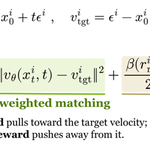
Simple, efficient, scalable diffusion RL without likelihood ratios?
Meet RVM: Reward-based Velocity Matching
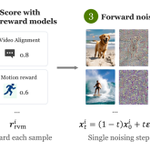
🎯 Rewards directly in velocity space
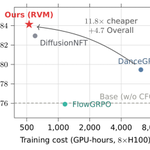
⚡ Cheap video fine-tuning
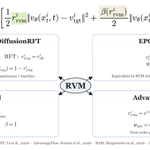
🧩 Unifies recent objectives
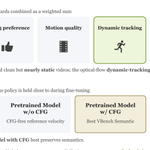
🎬 Fixes the static-video problem by dynamic motion reward
How it works 🧵
Jaemoo Choi retweeted

introducing MDraft, an simple plug in on-policy distillation scheme to improve parallel draft for speculative decoding. Built on DFlash, minimal training overhead, same inference, consistent improvement, led by @pmolodyk 🔥

Excited to share our work, MDraft! 🚀
We present a new observation that leads to a new training objective, substantially strengthening the drafter and substantially improves draft acceptance rates!
[1/8] Can we improve parallel drafters with on-policy distillation?
Introducing MDraft: on-policy distillation for diffusion drafters.
At T=1, mean acceptance length vs. DFlash:
• Qwen3-4B: +11.9%
• Qwen3-8B: +13.4%
Same inference, just swap the drafter checkpoint! 🧵

16
651
Jaemoo Choi retweeted

Parallel Decoding Distillation (PDD) is taking off 🛫
We’ve only released PDD end of July and it’s already adopted in:
- Alibaba’s MiniMax H3: huggingface.co/alibaba-pai/M…
- WorldPlay2’s causal distillation: worldplay2.github.io/
- FastVideo’s FastH3 Omni: haoailab.com/blogs/fastvideo…
- NVIDIA’s large language continuous diffusion model: arxiv.org/pdf/2610.02665
- Amazon’s generative forecasting model: arxiv.org/abs/2610.22358
- NVIDIA’s & MSR’s extensions to parametric student trajectories: alan-lanfeng.github.io/PTD & arxiv.org/pdf/2610.18472
We’ll be open-sourcing our implementation soon - stay tuned!

Having worked with many distillation methods for accelerating diffusion & flow models, I’m still blown away by the simplicity of Parallel Decoding Distillation (PDD).
1️⃣ State-of-the-art quality and diversity with variable NFE
2️⃣ First to scale trajectory-distillation to few-step video generation
PDD is about as cheap and simple as it gets:
🎯single, regression-based MSE loss using 1 student & 1 detached teacher forward
❌NO data required
❌NO adversarial loss or alternating training
❌NO JVP or finite-difference approx.
❌NO additional time-embedding or trainable models (e.g. fake score, discriminator)
❌NO stabilization tricks (e.g. normalization, clipping, warm-up)
Jaemoo Choi retweeted

Teacher forcing + DMD works great for fast, few-step #autoregressive video.
How about #LongVideo, where the scene must keep evolving?
Can a teacher that only saw 5s clips supervise what happens at later frames... and how? 🤔
Meet
LongTake arxiv.org/abs/2609.38562
🧵
[7/8] 🎬 A surprising lesson about rewarding motion:
VideoAlign + HPSv3 favor clean but nearly static videos. An optical-flow dynamic-tracking reward restores motion:
Dynamic Degree 5.56 → 75.00
VBench Overall 80.39 → 84.13.

1
2
480
[8/8] Check out our project page for more info!
🌐 Project page: jaemoo-choi.github.io/RVM
📄 Paper: arxiv.org/abs/2608.23664
💻 Code coming soon.
Joint work with @WeiGuo01, @YuchenZhu_ZYC, @ArashVahdat, @MoleiTaoMath , @julberner and @YongxinChen1 (Georgia Tech & NVIDIA).
5
489
Jaemoo Choi retweeted

Your latent world model can see the goal. But it can't tell how far away it is.
TEMPO adds a learned steps-to-goal map to the planner's cost. No retraining, no rewards.
LeWM: 36% → 99% on TwoRoom, with gains across multiple environments. 🧵👇
Jaemoo Choi retweeted

Excited to share my work during summer internship at NVIDIA! We build the first large-scale continuous dLLM, reaching comparable and even better performance compared with masked dLLM trained under aligned budgets, and discover interesting properties its continuous dynamics!

💫 Large Language Continuous Diffusion Models
Presenting Sigma, the first large-scale (3B/8B) continuous diffusion LM (dLM) trained with likelihood.
📈 Comparable with discrete dLMs and AR on math and coding
🎛️ Enables meaningful study of inference-time interventions
Jointly led with Wei Guo (@WeiGuo01), Jean-Marie Lemercier (@jm_lemercier), Simon Welker (@_cobalamin)
Team: @YongganFu @mmkamani7 Sajad Norouzi @julberner @tomasgeffner @karsten_kreis @YongxinChen1 @MoleiTaoMath @jwthickstun @PavloMolchanov Ante Jukic @ArashVahdat @MardaniMorteza
Jaemoo Choi retweeted

🌟FLARE is accepted to #NeurIPS2026 🥳🥳
Check out a full-stack recipe for building strong and fast diffusion LLM with hybrid attention with FLARE🔥
📑Paper: arxiv.org/pdf/2606.01774

Finally wrapped up my work at @AdobeResearch, and excited to share FLARE: Diffusion for Hybrid Language Model🔥
Hybrid attention is having a moment.
Recent releases such as Qwen3.8 and Kimi K3 reinforce a compelling direction for efficient LLMs: combine linear attention with periodic full attention. Bounded recurrent states make long-context processing economical, while full-attention layers retain direct global interaction.
With FLARE, we asked whether this increasingly important architecture could also support diffusion-style multi-token generation—without rebuilding the model from scratch or giving up the capabilities of its pretrained checkpoint.
FLARE transfers Qwen3.5 hybrid-attention checkpoints into diffusion language models with a cheap budget of around 10B training tokens. We release FLARE-2B, FLARE-4B, and FLARE-9B.
The key is to train two complementary views of each document: a clean causal stream that preserves next-token behavior, and a noisy block-bidirectional stream that learns diffusion denoising. The resulting checkpoint supports two inference paths:
> AR-Trust verifies parallel drafts through the clean causal stream
> Diffusion-Trust denoises multiple tokens within an active block
Making this transfer work revealed a broader lesson: conversion quality depends on more than the diffusion objective.
First, transfer data sets the capability ceiling. Under the same source checkpoint and token budget, changing the balance of reasoning traces, mathematics, code, and instruction-following data reshaped which capabilities survived conversion. A data mixture that helped one capability could hurt another; the best overall transfer came from preserving coverage across them.
Second, the clean stream is what anchors the converted model to its source behavior. Clean causal context recovered most of the loss from diffusion-only training, and retaining next-token prediction closed much of the remaining gap. Meanwhile, training across partially completed noisy blocks preserved the flexibility needed for Diffusion-Trust decoding.
Hybrid diffusion is also a systems problem. During training, small blocks multiply the number of recurrent-state boundaries that would otherwise be materialized in GPU memory. We developed a fused two-stream route that keeps chunk computation Tensor-Core friendly, stores only strided checkpoints in HBM, and reconstructs boundary states in registers. This makes small-block training substantially more practical and brings its efficiency closer to conventional causal training.
Inference requires a different form of state discipline. Paged KV cache and recurrent GDN state must remain synchronized while tokens are still provisional. Our SGLang-based stack commits state at the accepted offset for AR-Trust, keeps denoising rounds read-only for Diffusion-Trust, and updates the causal state only after a block becomes final.
Across reasoning, knowledge, instruction following, and coding evaluations, FLARE models preserve a strong capability profile while enabling diffusion-style multi-token generation. With the optimized serving stack, FLARE reaches up to 4.8× higher decoding throughput in our evaluation setup.
Everything is open now: the training code, the inference stack, and the FLARE checkpoints.
We hope FLARE makes it easier to explore diffusion-style generation on modern hybrid backbones. Try the models, reproduce the results, or use the code to build fast language models of your own. We’re excited to see where the community takes it.
This was joint work with @ChongjianG30781, @HaoTan5, @Xu_Arthas, @ZhuWanrong, Jason Kuen, @koustavagoswami, @YongxinChen1, @MoleiTaoMath, and more importantly, with support from my beloved mentors Jiuxiang @ethan_jxgu and Jing @Jingorz at Adobe Research.
📄 Paper: arxiv.org/abs/2606.01774
🌐 Website: tokflare.github.io
💻 Training & inference: github.com/yuchen-zhu-zyc/FL…
🤗 Checkpoints: huggingface.co/collections/y…
Jaemoo Choi retweeted
#ICML2026 has started and unfortunately I will miss the great conference this time🥹, but hopefully you won't miss our work on diffusion LLMs and RL, including one spotlight🌟
While not in Seoul, feel free to DM for if you want to chat these topics online!
More info 👇

Jaemoo Choi retweeted

If you're in ICML🇰🇷, come checkout #FAS—a natural (yet w/ nontrivial math 🧐) extension of #Adjoint #Sampling to #functional space for sampling irregular time series such as transition paths.
🗓️ Jul 8 (Wed), 5:00–6:45 PM KST
📍Hall A #3408
Great work by Byoungwoo @bw__park 🫡!

📢#Adjoint #Sampling is a new Diffusion Sampler for Boltzmann distribution that
- Grounded on stochastic control
- Enjoy scalable matching objective
- Extremely efficient in energy NFE
- Does NOT require/estimate target data
Checkout @aaronjhavens talk on Monday #FPI workshop!
Jaemoo Choi retweeted
check out our ICML papers, ranging from diffusion models, to diffusion LLMs, to diffusion sampler. Come to our posters to talk to us @WeiGuo01 @JaemooChoi

I'll be in Seoul next week for ICML to present the following papers:
DASBS: arxiv.org/abs/2602.08243
DMPO (spotlight): arxiv.org/abs/2510.08233
Rethinking diffusion RL: arxiv.org/abs/2602.04663
MetaDNS: arxiv.org/abs/2605.21722
Please don't hesitate to reach out if you're interested!

Jaemoo Choi retweeted
If you are interested in RL for diffusion models, come to our ICML poster. @JaemooChoi @WeiGuo01 @YuchenZhu_ZYC will explain to you a scalable strategy for DMs RL finetuning.

How to scale RL for diffusion models is challenging. In this work led by @YuchenZhu_ZYC @JaemooChoi we investigated various design choices of RL tailored for diffusion models. We found out that the key is how likelihood is estimated.