

Making woody perennials skip adolescence. Molecular biologist. Founder @Florachronos. Scale AI. Author. PhD Molecular Bioscience and Bioengineering. E-RYT 500.
FL; NY; SF; Honolulu
Joined January 2024
- Tweets487
- Following232
- Followers87
- Likes86








Reposting with a heavy heart

Yesterday, I watched Naza.
I did not go to learn what had happened in Gaza. I am from there. I am one of the victims of this war, one of its witnesses, and one of those who have paid a price that will not end when the war does.
I did not need a film to tell me how entire neighborhoods were wiped away, how residential buildings were bombed with the people still inside them, or how families were forced to leave their homes without knowing where they were supposed to go.
Nor did I need anyone to tell me about the famine. I lived through it twice, with all its humiliations, down to the smallest detail. Or about the starving people who were killed while trying to reach what were so absurdly called “food distribution centers.”
I know all of this.
I was there.
Read the whole Thread below :
#Naza @yuval_abraham
3
66
Who is responsible for these @openclaw messages? 😂
🦞 OpenClaw 2026.9.6 (eb377ac) — Half butler, half debugger, full crustacean.
🦞 OpenClaw 2026.9.6 (eb377ac) — I've survived more breaking changes than your last three relationships.
2
33

I'm back in NY for Tech Week and it's like slipping into an old shoe.
jamesrgates.substack.com/p/s…
1
92

Biomedical AI has the same structure. A high value SOTA clinical genomics model has a valuation story that depends on assumptions about regulatory clearance, liability, and use cases that aren't resolved. Less sexy 'laundromat' applications like pipeline automation, data annotation, QC on output, wet lab assay validation — have unit economics that make sense right now. Less press. More cash.

OpenAI: Valued at $852+ billion, will lose $14 billion this year
My Laundromat: Bought for $100k, nets $67k per year
1
115
Alright, X algorithm, I admit, you’ve won this battle, for now… As a geriatric millennial, I must admit, this platform confounds me, and yet, I see others my age succeeding (if metrics are to be believed). The LinkedIn style posts are a dead-end, OK. But even my dog pics honeytraps failed to gain traction.

69
Any bio founders? I see everyone talking about shipping a product and having customers and that’s cool for SaaS — but how does that work in this space?
1
62


Reproducibility within a system confirms one thing: the measurement was consistent. It does not confirm that the finding holds in a different tissue, a different patient population, or a different developmental context. These are different claims.
21
Reintroducing myself as the fully integrated version of me and introducing the company I am building
open.substack.com/pub/jamesr…
47
My doctoral dissertation started as a transcriptome study of Stevia rebaudiana — and became something stranger. Roughly a billion reads, sequenced across multiple plant tissues.
1
44
Alongside the expected expression data, we found viral sequences of all sorts: an active community inside the plant, some of it endogenous. There were so many remnants of ancient infections, integrated into the genome over evolutionary time. And there were so many active infections too, even in plants that were grown in tissue-culture.
1
37
Most genomics programs do not fail because the sequencing failed.
They fail because the research goal was never converted into a biological question specific enough to be answered by the assay chosen.
The data comes back technically clean and analytically useless.
It is the problem The Question Before the Tool is built around.
1
1
45

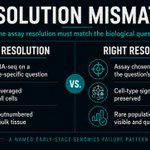
Resolution Mismatch is the second failure pattern in early-stage genomics programs.
Bulk RNA-seq averages gene expression across every cell in the sample. If your question requires cell-type-specific resolution, as with immune cell populations outnumbered across bulk tumor tissue, the signal you need is diluted by design.
The assay was not wrong. The resolution was wrong for the question.
It is the second of four failure patterns I document in The Question Before the Tool.

1
11,897
Platform Allegiance is the most expensive failure pattern in early-stage genomics programs.
It looks like this: a team selects Illumina short-read sequencing, Nanopore, or 10x Chromium because it is what they know, what the core facility offers, or what the last company used. The biological question gets built around the platform rather than the platform being selected to answer the question.
The cost is not the sequencing run. It is the months spent trying to interpret data that cannot answer what the program actually needed to know.
It is one of four failure patterns I document in The Question Before the Tool.

78