

New Theoretical Economics papers from https://nitter.cf/t.co/jz2fmjEfyj: contract theory, decision theory, game theory. Thank you to arXiv for use of its open access interoperability.
- Tweets3.1K
- Following7
- Followers631
- Likes0





ALT We propose a simple model of training an agent with an endogenous bias. A principal chooses in which states to train the agent and what actions to prescribe in these states. In response, the agent updates their bias and then acts optimally given their new bias in untrained states, while following their training in trained states. The agent chooses their new bias to minimize a weighted average of their loss under their initial and final biases. Training can thus generalize to untrained states via the agent's bias updating. We characterize optimal training, which involves over-correction in trained states and generalization-aware (non-greedy) selection of training states. If only a small share of states can be trained, greedy state selection is approximately optimal, but over-correction remains essential. If any bias function is possible, or if the principal evaluates training robustly over bias functions that admit the possibility of full alignment, the value of training generalization

ALT Strategy-proofness is the traditional standard for predictable behavior, yet participants often fail to play dominant strategies. Most existing simplicity concepts attribute these failures to the cost of contingent reasoning, which they lower by comparing the worst case of the dominant strategy with the best case of an alternative. I argue that there is another approach, one that makes more use of the structure of the strategy set, which I formalize as a neighbor relation. Comparing neighboring strategies can reduce the need for contingent reasoning, and, even with a single contingency, it can simplify the search through the strategy set. I introduce a new simplicity criterion: a mechanism is local improvement solvable under a neighbor relation if repeatedly moving to an improving neighbor always reaches a dominant strategy. Strategy-proofness is the criterion under the coarsest relation, and many classical mechanisms satisfy it under finer ones. In extensive-form mechanisms without du

ALT We study a multiplayer communication coordination game in which privately informed agents communicate through a social network and choose their optimal actions while balancing them against their own bliss points and those of their neighbours. We show that equilibrium actions are convex combinations of the expected bliss points of all players, with weights determined by a degree-discounted Bonacich centrality measure. We also characterize when players report truthfully, over-report, or under-report their private information, and show that the incentive to misreport depends critically on the receiver's position in the network. A striking implication is that even under identical preferences, fully revealing communication may not be realized, and information transmission may remain coarse in a star network while becoming almost fully informative in a complete network. Finally, when biases are endogenously chosen, strategic responses to neighbours' biases are governed by their centralities,

ALT In a duopoly with captive and contested consumers, I characterize every pair of consumer and producer surplus that can arise under some market composition and some public segmentation, and construct a market that produces each pair. The set is lens-shaped. At any level of industry profit, consumers do worst when captive and contested consumers are perfectly separated and best in an unsegmented market in which the two firms have equally many captives. A market with unequal captive bases and some contested consumers cannot reach this upper frontier under any segmentation. Between Bertrand competition and monopoly, the frontier itself lies strictly below what consumers would get if everyone paid a single deterministic price yielding the same profit. Firms must randomize, and with downward-sloping demand the resulting price dispersion lowers consumer surplus.

ALT In this note, we consider social welfare functions on infinite utility streams and answer an open question posed in Asheim et al. (2021, Remark 1). There exists a real-valued representation of social welfare preferences that satisfies monotonicity, stationarity, restricted dominance, and strong anonymity, hence also finite anonymity. Our social welfare function satisfies a stronger finite-rank sensitivity condition, Liminf-Restricted Dominance, in the sense of Asheim et al. (2022) and Asheim et al. (2025). Our construction shows that limited discontinuity is not redundant in Asheim et al. (2021, Proposition 2): once that diagonal continuity condition is dropped, even arbitrary-permutation invariance can coexist with stationarity and non-trivial sensitivity.

ALT Organizations choose team structures to intensify competition, yet their members may prefer to reorganize. We ask whether an architecture that maximizes aggregate effort can remain stable when contestants may form a replacement team from incumbent rosters. When a coalition draws from identical teams and reproduces their type, its members and the designer rank the reorganization in opposite directions: the coalition gains precisely when total effort falls. A strict effort optimum can therefore supply its own blocking certificate, while a stable optimum can survive only on a plateau where every reachable reorganization of this kind leaves effort unchanged. In a linear benchmark, we characterize stability against every feasible one-team reorganization and global effort maximization over every feasible partition. Except under pair capacity, the two regions do not overlap; with pair capacity, they meet only at one boundary. The ordering persists in a matched quadratic benchmark with strictl

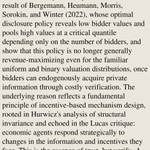
ALT We revisit the influential distribution-independent optimal disclosure result of Bergemann, Heumann, Morris, Sorokin, and Winter (2022), whose optimal disclosure policy reveals low bidder values and pools high values at a critical quantile depending only on the number of bidders, and show that this policy is no longer generally revenue-maximizing even for the familiar uniform and binary valuation distributions, once bidders can endogenously acquire private information through costly verification. The underlying reason reflects a fundamental principle of incentive-based mechanism design, rooted in Hurwicz's analysis of structural invariance and echoed in the Lucas critique: economic agents respond strategically to changes in the information and incentives they face. This is the essence of trust, but verify. A change in disclosure policy may leave the underlying economic primitives unchanged while altering bidders' verification decisions and the resulting equilibrium information structur

ALT I axiomatize Berk-Nash equilibrium in decision problems with possibly misspecified models. I specify how a rule–which selects a set of action-belief pairs in a problem–ought to compare a correct forecast with an incorrect one, react to the removal of models, and accommodate additional observations that do not distinguish among the models. Together with axioms concerning attitudes toward randomization and payoffs, and a pair of regularity conditions, these axioms characterize Berk-Nash equilibrium.

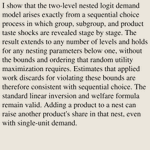
ALT I show that the two-level nested logit demand model arises exactly from a sequential choice process in which group, subgroup, and product taste shocks are revealed stage by stage. The result extends to any number of levels and holds for any nesting parameters below one, without the bounds and ordering that random utility maximization requires. Estimates that applied work discards for violating these bounds are therefore consistent with sequential choice. The standard linear inversion and welfare formula remain valid. Adding a product to a nest can raise another product's share in that nest, even with single-unit demand.

ALT When allocating indivisible goods, the maximum Nash welfare rule is known to be the unique welfarist rule satisfying envy-freeness up to one good. We strengthen this characterization by showing that envy-freeness up to one good can be replaced by substantially weaker fairness requirements: envy-freeness up to k goods or proportionality up to k goods, for any fixed k. Our characterization holds even for profiles with identical goods.

ALT We introduce a mediator to a communication setting with verifiable (hard) evidence and characterize precisely when mediation can induce every obedient outcome–every type-contingent distribution of actions that the receiver is willing to follow–including the outcome that delivers the sender's commitment (Bayesian persuasion) payoff. For both type-independent and general preferences, it is necessary for each type to have a message he alone can send. This is also sufficient for type-independent preferences, whereas the general case also requires a particular alignment of the types' utilities. We also rank evidence structures by the distributions of actions conditional on the sender's type that they can induce at (mediated) equilibrium, through garbling conditions analogous to Blackwell's comparison of experiments.

ALT I study the optimality of selling K heterogeneous objects to a buyer with private values through a quantity menu: the seller posts a price for each number of objects, and the buyer chooses a quantity, pays its price, and selects any objects up to that quantity. I propose a pricing method that aggregates critical values for second differences of quantity values (the highest values attainable at each quantity). Critical values can be determined separately when each second difference's conditional inverse-hazard ratio depends only on that difference. For additive values, I show that the resulting menu is optimal among all incentive-compatible and individually rational mechanisms under explicit distributional and support conditions, including ex ante symmetry across object labels. A separate result applies the same pricing method to obtain an optimal menu for nonadditive bundle values without ex ante symmetry, assuming free disposal, independence between the quantity-value vector and the v

ALT Variation in grading standards across instructors who teach the same students is evidence of a moral hazard problem, whether or not grades are inflated. The optimal standard is the same for every section of a course, yet grades vary widely across sections. We present a principal-agent model in which instructors who know the optimal standard still depart from it, leniently or harshly, depending on their incentives. Penalizing deviations from the department average leaves the average unchanged but compresses grading variance, which raises student welfare. Disclosing the same information to students instead increases grading variance.

ALT We study the steady states of games played recurrently within large anonymous populations of players who receive partial ex-post feedback about the play of their opponents. Departing from the classical Bayesian account, players do not trust their conjectures as a correct description of the strategic environment but consider them as approximations of a reality that is only partially modeled and partially observed. We introduce games with feedback and uncertainty attitudes, in which the normal-form structure is enriched with a profile of feedback functions and, for each player, a preference functional that encodes aversion to misspecification and to ambiguity. The induced misspecification sensitive criterion contains the variational, maxmin, and smooth-ambiguity evaluations as special cases and collapses to expected utility when beliefs are unambiguous and the player is neutral to misspecification. The appropriate steady-state notion for such games is the Self-Confirming Equilibrium unde

ALT We study sharp bounds on equilibrium behavior in Bayesian games when players may make mistakes. Under strategic complementarities, the set of behavioral perfect equilibria has a largest and a smallest element, both in pure strategies. We ask when these bounds are monotone and how they depend on the way mistakes are made. For monotone supermodular games, we consider limits of equilibria under increasing perturbations, in the sense that conditional tremble distributions have full support and increase stochastically with type. We show that the largest and smallest perfect equilibria exist, which are pure and monotone. Under the general perfection notion, the extremal perfect equilibria continue to be monotone in the setting with finite actions. With infinite actions, the extremal perfect equilibria can be nonmonotone, and the set of perfect monotone equilibria can even lack extrema.

ALT Convexity of preferences is a pervasive assumption in economic analysis, so it is important to understand how this property is revealed in data. In this paper, we develop a method to test for convexity given partial preference information in the form of weak and strict incomplete orders. We characterize the pairs that can be extended to convex preferences and provide an efficient algorithm to verify this property. Requiring the convex preference to align with an order that satisfies independence, such as the Euclidean order or stochastic dominance, does not complicate the test. We apply our results to consumer demand, choice under risk and uncertainty, and preferences over information, and establish conditions under which upper semicontinuity or continuity can also be obtained. We identify environments in which convexity imposes no additional restrictions beyond rationality, extending Afriat-type results to infinite data and co-convex budgets and establishing a convex version of exact

ALT This paper revisits the consumer search and price competition model of Wolinsky (1986). Suppose that the market has a finite number of firms, and the match value distribution function and survival function are both log-concave. Then, there is a unique symmetric pure-strategy equilibrium price with active consumer search. Two applications are discussed.

ALT Generative AI can lower the cost of producing polished application materials without improving applicants' abilities to do the job. We study an employer who observes qualifications and work history, summarized by observable quality, but must infer other job-relevant attributes from reports that applicants can manipulate at costs that depend on privately known manipulation ability. The employer commits to a hiring rule under a capacity constraint, and we evaluate rules by match value net of applicants' manipulation costs. We show that, as manipulation ability becomes increasingly dispersed among applicants with the same observable quality, socially optimal hiring converges to selection on observable quality alone, a phenomenon we call strategic feature collapse. To capture the remaining welfare gain from reports, we construct a simple dual-track mechanism that directly admits applicants with high observable quality and offers some otherwise excluded applicants a report-based route to ad

ALT Sustaining efficient trade under private information requires external subsidies. Although a designer cannot avoid deficits on average, they can control exposure. We characterize efficient and truthful mechanisms that minimize the worst-case deficit in markets with many buyers and sellers, under interim participation. This problem is dual to maximizing expected trade surplus under correlation ambiguity, with constraints on submarkets with one agent removed. In bilateral trade, the best deficit ceiling is the competitive surplus in a benchmark continuum market, achieved by a "competitive pivot mechanism". In larger markets, optimal mechanisms are characterized in terms of worst-case residual welfare contributions, but solutions exhibit a complex combinatorial structure. We obtain explicit guarantees under natural participation charge restrictions and establish how the best deficit excess decays as market thickens. Our duality characterization is general and extends to many mechanism des

ALT In a market in which any coalition can reach agreements, a stable outcome need not exist even when agents have substitutable preferences. We show how regulation can restore stability. If a regulator participates in every agreement, a setwise stable outcome exists when each ordinary agent's preference satisfies a condition weaker than substitutability, while the regulator's preference remains largely unrestricted. An alternative existence result allows ordinary agents to have arbitrary preferences while requiring the regulator to support each agent's profitable contract deletions. Our results apply to matching markets involving regulated activities.