
Sociologist and demographer. Social inequality | public opinion | polarization. Latest book: Why We Disagree about Inequality: Social Justice vs. Social Order
Joined January 2012
- Tweets622
- Following175
- Followers1K
- Likes1.3K




Pinned Tweet
I’m happy to announce a new book: Why We Disagree about Inequality: Social Justice vs. Social Order, with Eric Silver and @irakresh (1/5) amazon.com/Why-We-Disagree-a…
John Iceland retweeted

New in @Theory_Society: why have sinking birthrates become a polarized issue?
@JohnIceland traces it to two competing moral frameworks, and finds only one dominates demographers’ thinking on the topic.
Check out the article here (open access!): link.springer.com/article/10…

1/5
I'm pleased to share that my paper, "Why has low fertility become a polarized issue?" has been published in @Theory_Society
Why do conservatives increasingly view low fertility as a crisis, while progressives tend to be less concerned? 🧵
4/5
When rapid population growth was considered a crisis, demographers helped lead efforts to reduce fertility. Now that sustained low fertility threatens population decline, the discipline has been more reluctant to sound the alarm. Why the asymmetry?
5/5
Low fertility poses challenges for economic growth, public finances, and family networks—concerns more aligned with Social Order than Social Justice.
Recognizing these moral differences can foster more constructive debate.
link.springer.com/article/10…
1
5
149
Somewhat of a counterpoint to the piece I shared a couple of days ago—and also well worth a read: “Was there ever a time when people were not panicking about population?” by @imkahloon
I’ll share more of my own thoughts on this issue before too long (in progress).

Is the birth-rate panic overblown? Population projections may look dire, but previous waves of concern about birth rates offer a different lesson, @imkahloon argues. theatlantic.com/ideas/2026/0…

1
76
Worth a read: “As of 2026, humanity is likely below replacement fertility. That has never happened before, not in wars or pandemics. But the real surprise is that the fall has been concentrated in low- and middle-income countries and among poorer and less educated
women.”

Last week I posted a new paper with Patrick Norrick: “Terra Incognita: The Economics of a Shrinking World.”
We chose the title deliberately. No society in history has experienced the fertility levels now seen in South Korea, China, Thailand, Colombia, Chile, and many other countries. Our knowledge of the causes (and of the economic consequences) remains far more limited than most public discussion acknowledges. Much of what we write is, at best, educated conjecture.
The paper also struggles against a space limit. We wrote 20,000 words, far from the 250,000 or so we would need to address some issues in more detail (if I had the time and resources to hide away for a year, I could do that, but not now). That means some ideas are only sketched.
Nonetheless, we emphasize several important points.
First, fertility has fallen very fast everywhere: rich and poor countries, east and west, north and south, conservative and liberal societies, religious and non-religious societies (with the exception of the Jewish population of Israel; fertility has also collapsed among the Muslim population within the pre-1967 borders), you name it. Even in sub-Saharan Africa we see fast and unprecedented drops in fertility (alas, from a high initial level).
Second, and this is really interesting, the fertility collapse has been concentrated in poor and lower-middle-income countries much more than in rich countries. By now, income per capita and fertility are positively correlated within OECD countries. We conjecture this will hold globally in a few decades.
Third, and related to the second point, the fertility collapse has been concentrated among poor and lower-middle-income women within countries. In countries such as the U.S., the rich and highly educated now have more children than the poor and less educated.
Fourth, we document why we do not understand the data from the U.N. World Population Prospects. See, for example, Tables A.1 and A.2.
Fifth, we explain why some proposed mechanisms struggle when confronted with the data.
A more subtle point is at work here. Many commentators do not seem to understand the difference between proximate causes and ultimate causes. Yes, births might have gone down because fewer women are in long-run relationships. That is the proximate cause. But you need to explain why fewer women are in long-run relationships (the ultimate cause), and saying that they spend more years in school, to take one example, does not get us very far. Why do they spend more years in school? Once you start down the whole chain of reasoning, things become much harder than they seem.
The paper can be found here:
sas.upenn.edu/~jesusfv/Demog…
Comments always welcome!

123


Worth a read: "The study of people has a people problem." wsj.com/us-news/education/is… via @WSJ

One of history’s great coincidences: John Adams and Thomas Jefferson both died on July 4, 1826, the 50th anniversary of the Declaration of Independence. Adams’ reported last words: “Thomas Jefferson survives,” not knowing Jefferson had died just hours earlier.
2
4
247
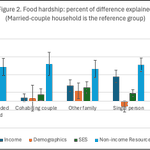
New paper out with J Cho: "Material Hardship Among Affluent and Poor Households in the United States." Affluent households still report material hardship. What explains how much less of it they experience compared to poor households? The answer depends on the type of hardship. 🧵
1
6
169
One consistent predictor of hardship in both affluent and poor households: having a disabled household member. Economic vulnerability from disability matters across the income distribution.
1
2
64
Bottom line: hardship isn't one thing, and its causes aren't either. Income, wealth, and household characteristics each matter—but their relative importance depends on which hardship you're looking at. Here's our open-access paper link.springer.com/article/10…

How Japan Lost 3 Million People in Five Years: "The shrinking population is already constraining Japan's economic growth, putting pressures on its health care system and causing labor shortages." nytimes.com/interactive/2026…

1
74