

Building infrastructure to help companies become AI-native.
Canada
Joined November 2023
- Tweets467
- Following181
- Followers397
- Likes4.3K




[Should companies hire their own AI engineers or work with an external implementation firm?]
*** The case for hiring internally:
You own the talent, the knowledge stays within the company, and your engineers develop an increasingly deep understanding of your systems, processes, and people. They can continuously improve what's been built without relying on an outside party.
We recently spoke with the head of AI at a large logistics company that's actively looking to hire engineers who think more like entrepreneurs than traditional developers. Makes complete sense. If you're planning to deploy AI across dozens of workflows over the next several years, building that capability internally can be a very worthwhile investment.
But there are a few things worth considering.
> First, hiring an AI engineer doesn't necessarily mean you've hired someone who knows how to implement AI in a business. There's a pretty meaningful difference between building an agent and figuring out which workflows to automate, understanding how those workflows operate, integrating with legacy systems, managing exceptions, and getting employees to actually rely on what you've built.
> Second, the economics depend heavily on how much work you have. Hiring two or three capable engineers can easily become a several-hundred-thousand-dollar annual commitment once you account for salaries, benefits, recruiting, and management. That's perfectly reasonable if you have a sustained pipeline of valuable projects. Less so if you have three workflows you want automated and no clear idea what comes next.
> Third, your first AI hire is arguably the hardest one to get right. You need someone capable of making architectural decisions, evaluating models and tools, handling integrations, and understanding business processes, often without much technical guidance internally.
*** The case for working with an external firm:
You're effectively buying experience, execution capacity, and access to people who've already encountered some of the problems you're likely to face.
One manufacturer we've been speaking with runs a lot of its operations through an older on-premise ERP, spreadsheets, macros, and engineering documents. Implementing AI there involves much more than writing code. You need to understand the corners where information and context is stored, how different systems interact, which processes depend on undocumented logic, and what can safely be automated. An external team that's dealt with similar environments may be able to get to production considerably faster than a company hiring its first engineer and figuring everything out from scratch.
There's also flexibility. You can bring in specialized expertise for a few months without committing to a permanent team, and expand or reduce that involvement as your needs change. Of course, outsourcing has its own drawbacks. External teams can be expensive, may never develop the same institutional knowledge as employees, and can create serious dependencies if the customer doesn't own the code, documentation, infrastructure, and ability to maintain what's been deployed.
If you're a large organization with a clear, ongoing pipeline of AI projects, strong technical leadership, and the resources to recruit and retain good engineers, building internally makes a lot of sense. We recently spoke to a CFO of an eldercare facility company who has their own internal AI team, as well as is engaging with third party firms to speed up deployment of their AI backlog.
If you're earlier in your transformation, don't yet know which workflows are worth automating, or need specialized expertise across several systems, working with an experienced implementation partner may be the more economical starting point.
Would love to hear how more thoughts on this -
8
16
904
It seems pretty obvious to me that one of the biggest bottlenecks to mass AI adoption is simply getting the technology deployed across businesses at scale.
Of course there are constraints around compute, GPUs, energy, data centers, research, etc., but there's an enormous amount of work to be done just getting AI integrated into how businesses operate. And much of that work will require specialized engineers and consultants for years to come. The way I see it, the biggest economical category of all time.
Who should own AI transformation inside a company? The CEO, COO, CFO, CIO, or individual department heads? The more interesting question is which parts of the transformation should be centralized, and which should be owned by the business.
I'd separate responsibilities into three layers:
1. Central AI/IT team: Own the technical foundation.
Security, governance, infrastructure, integrations, technical standards, and reusable components.
You don't want five departments independently building their own infrastructure, managing sensitive data, or establishing conflicting security policies.
_
2. Business departments: Own the problems and outcomes.
Finance, operations, sales, and other functions should identify opportunities, prioritize workflows, define requirements, and be accountable for the economic results.
The people closest to the work generally have the best understanding of its nuances, exceptions, and constraints.
_
3. Cross-functional deployment teams: Own execution.
Bring together the process owner, AI engineers, and IT/security to build, test, deploy, and continuously improve each implementation.
The business defines what success looks like. Engineering determines how to achieve it reliably. IT ensures it operates within the company's technical and security requirements.
This is effectively a federated model, and the appropriate structure will vary with company size and complexity. The underlying principle is fairly simple:
> Centralize what benefits from consistency and shared infrastructure.
> Decentralize what requires domain expertise and accountability for results.
The mistake is assuming that because AI is a technology, the entire transformation should belong to the technology department.

Spoke to the COO of a $75M materials distributor who's still running on a painfully slow, outdated ERP, but has no intention of migrating to a modern one. He'd rather layer AI agents on top of his existing systems.
Two reasons, according to him:
1. ERPs will be obsolete in five years.
2. He can't be bothered retraining his staff on a new system. Too much business disruption.
Josh retweeted

By the way, it’s still prohibitively expensive to do the change management necessary to get the productivity gains from AI in many, if not most, enterprise settings
I actually don’t think the vast majority of retrofits are fundamentally tractable. even as the models get better
Systems level changes have to happen on human time, which in some sense is good news for us all, but presents particular challenges for introducing this technology to existing organizations
Deriving the general shape of the AI native company, we should expect to take decades, not unlike electricity especially since some of the binding constraints that need to be lifted also move on human time, but at the level of electoral politics

It's remarkable how much business software is just a place for employees to record work they've already done.
2
4
427
> The main bottleneck to AI adoption in the enterprise is context. Models are getting smarter, but they still don't understand how individual companies actually operate.
> Brian Armstrong and Coinbase are already talking about the importance of a company brain. AI becomes much more useful when it understands an organization's accumulated knowledge.
> Every enterprise AI deployment is constrained by the quality of discovery. You can't automate a workflow you don't properly understand.
> We’re seeing this first hand.
> That's why we're building an autonomous discovery module. The goal is to gather operational context with far less interruption to the team.
> Notion has an opportunity to become the context layer for enterprise agents. Where AI systems learn how those companies function.
> The opportunity is enormous, but not guaranteed. Microsoft, Google, and other platforms have distribution and access to operational data.
Read more:

GTM play of the day: delivering fresh Timmy’s donuts to prospective clients’ offices. How can you say no ??

3
9
412
Josh retweeted

A large food importer and distributor relied on manual, experience-driven procurement. Buyers juggled a dozen external factors, inventory, sales history, demand forecasts, lead times, and shipping to decide what and when to buy.
An AI procurement agent now automates the entire workflow. It analyzes inventory, historical sales, forecasts, and constraints daily to decide when to place orders, what to buy, and how to configure incoming containers.
Engineers spent one week on-site to learn the process, then one week to build, test, and deploy the agent into daily operations.
Just shared on ai receipts by Josh Cons at Arx Intelligence (@Joshcons0).
aireceipts.work/r/recs1G0yNJ…

Josh retweeted

being good at twitter (aka comms) is essential to the job description of a startup CEO in 2026
We're so focused on how much money AI can save enterprises that we're overlooking how much more money it can help them make.
Consider a distributor doing $100M in revenue -
Automating 10 hours of accounting work each week is useful. But improving purchasing decisions, reducing stockouts, optimizing freight, or recovering revenue lost to customer deductions could be worth millions. And none of that requires replacing employees or ripping out existing systems.
It requires making the systems and people already in place better at what they do.
Measure the ROI on AI can and should be done by looking into:
a. Dollars created
b. Hours saved
(In that order ^)
The most valuable AI workflows may be the ones that save the least amount of employee time.
A procurement team member might spend 30 minutes preparing a purchase order, but that decision could determine whether the company writes off $100,000 in inventory three months later. Measuring the ROI in hours saved misses almost the entire opportunity. We’ve seen this exact scenario play out in our early design partner engagements …
We just deployed an AI procurement agent for a food distributor. What made the engagement interesting was that the company's president had already been using AI extensively to inform purchasing decisions, but the procurement process itself remained largely manual.
BACKGROUND:
He's non-technical, runs a busy operation, and had taken it upon himself to connect Claude with the company's historical sales data, Excel worksheets, and SAP records. He was using that information to generate purchasing recommendations for his team, who had historically relied heavily on experience and anecdotal judgment.
THE CHALLENGE:
The challenge was that procurement in food distribution involves considerably more than forecasting demand. For every SKU, the team needs to account for historical sales, seasonal demand fluctuations, current inventory, shelf life, supplier lead times, and projected sales. And because much of their inventory arrives in shipping containers from suppliers around the world, purchasing decisions must also account for how to fill those containers economically.
These variables are interdependent. Ordering more of one product might improve container utilization but increase the likelihood of liquidation as expiration dates approach. Ordering less might preserve working capital but create stockouts or require more expensive shipments later. A product with relatively modest historical sales might warrant a larger order ahead of a seasonal demand spike.
The consequences of getting these decisions wrong were material. The business was regularly liquidating five to six figures' worth of inventory each month as products approached expiration. Meanwhile, the president was spending his own time analyzing data and preparing recommendations to compensate for gaps in the existing process.
OUR WORK:
We spent a week in their office with the procurement team, mapping the workflow from beginning to end and identifying the information and decision criteria involved at each step. The resulting agent evaluates the relevant purchasing variables daily, determines whether a purchase order should be proposed, and, when appropriate, recommends what to order and how to allocate products across a container. The procurement team reviews the recommendation, makes any necessary adjustments, and approves it before the agent submits the PO to the supplier.
The immediate operational benefit is roughly a day of procurement work that can be taken off the team's plate. But the more consequential opportunity is improving the quality and consistency of the purchasing decisions themselves.
If the system can reduce unnecessary inventory accumulation, avoid preventable stockouts, and improve container utilization, the financial impact can extend well beyond the labor involved in preparing purchase orders. Those outcomes will need to be measured over subsequent purchasing cycles.
One of the more interesting things we're learning through these deployments is that the cost of executing a business process and the economic consequences of the decisions within it can be vastly different. In this case, generating and submitting a purchase order is relatively straightforward. Determining the right purchase order, across hundreds of interacting constraints, is where much of the value sits.
And that's an important distinction when evaluating where AI can create meaningful economic value inside an enterprise.
4
10
1,248
Every company will have a Head of AI within 24 months.
> A $90m national nonprofit engaged an AI transformation partner to automate its back-office finance operations with custom agents. They're using finance as a pilot, with plans to expand into events and campaigns if successful.
> An elementary and high school are exploring custom AI modules to better serve students through more personalized learning and support (may or may not be powered by our team).
> A 1,500-person logistics company with a large internal engineering team has spent the last 18 months transitioning from software-first to AI-first. They have 4 people dedicated to AI transformation, are building MCP servers to connect their existing systems, and are even reconsidering software they built just 12–18 months ago.
> Over the last 6 weeks, we've spoken with a few dozen mid-market and enterprise companies scoping larger AI transformations, starting with custom agents to automate repeatable work across departments.
What's becoming clear is that this isn't something companies can delegate to an employee who happens to be good with ChatGPT. Someone needs to own the roadmap, understand the workflows, decide what gets built versus bought, and oversee deployments across the organization.
It's a matter of a couple of years before every organization either has its own internal AI team or engages a third party to act as one.
1
7
466
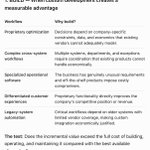
A meaningful portion of the custom AI workflows being sold to enterprises today will become obsolete long before the contracts they're attached to expire. Enterprises are being deceived by their vendors.
We recently had a conversation with a distributor of outdoor winter apparel about improving their procurement process. It's a highly seasonal business, where purchasing decisions depend on historical sales, fashion trends, inventory levels, supplier lead times, and, perhaps most importantly, the weather.
A colder winter generally means stronger demand. A warmer winter can leave the business holding substantial amounts of seasonal inventory that eventually needs to be liquidated at a discount. And because purchasing decisions are made well ahead of the season, the business is effectively committing capital against a forecast that may prove incorrect months later.
We discussed building a procurement agent that could incorporate these variables, continuously reassess demand projections, and help the team make better purchasing decisions.
The potential economic value was straightforward: fewer avoidable stockouts, less excess inventory, and reduced end-of-season liquidation.
But something else happened during the conversation that I found considerably more interesting.
_
The operator had recently connected their legacy ERP to ChatGPT, giving him the ability to retrieve and analyze information that previously required navigating an outdated system or asking someone on his team to prepare a report.
That relatively simple change opened up an entirely new set of possibilities in his mind.
As we discussed procurement, he began identifying other workflows across the business that could potentially be automated. Some were interesting opportunities for custom development. Others were tasks that existing AI tools could already handle reasonably well. And a few were capabilities that I suspect will become standard features of general-purpose AI products within the next several months.
This creates an interesting problem for enterprises investing in AI transformation.
> The market is moving quickly enough that the useful life of certain custom implementations may be considerably shorter than the procurement cycles and multiyear contracts through which they're being sold.
> A workflow that requires custom engineering today might be available through a standard model subscription six months from now. That doesn't necessarily make the original implementation a bad investment. If it creates sufficient economic value during that period, the investment can still be justified.
> But it changes the calculation considerably. I think enterprise AI investments increasingly need to be evaluated across three categories:
1. Build: Workflows that are sufficiently specific to the business, require meaningful integration across systems, and create enough economic value to justify custom development and ongoing maintenance.
2. Buy: Capabilities that existing software providers already deliver effectively, where custom development would add complexity without a corresponding economic advantage.
3. Wait: Capabilities that aren't yet reliable or readily available, but are likely to become commoditized quickly enough that the expected benefit of building them today doesn't justify the investment.
The third category is particularly important because it requires an implementation partner to occasionally recommend doing nothing. And that's not always an easy recommendation to make when your business earns revenue from implementations.
6
19
1,602
In conversation, an AI leader mentioned that “AI implementation in the enterprise, as a service” is a short-lived commercial opportunity.
(Respectfully disagree)
That would only be true if every single enterprise builds an in-house AI team. Nothing to do with how good the models (more precisely, the ease of building workflows) of the big labs become.


