


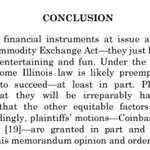


The judges who think we’re wrong can’t even agree with each other on why. Today’s splintered decision in the Fourth Circuit, which includes three separate contradictory opinions, is just the latest example. There is no unified, coherent legal argument against prediction markets. But amidst all the confusion in today's ruling, Judge Benjamin said it best:
“The special rule’s authority over gaming necessarily means that there can be event contracts around gaming. Based on the special rule and the above colloquy, it’s the CFTC’s responsibility to differentiate swaps used for gaming from those which can be used for legitimate risk avoidance. Just because the CFTC isn’t exercising discretion to the degree Maryland would like under the CEA, doesn’t mean that sports-related contracts don’t qualify as swaps.”
Earlier today, @Kalshi filed for a preliminary injunction against the State of Louisiana for its unlawful attempt to stop Kalshi from operating in the state. The operation of federally-regulated exchanges is the exclusive province of the federal government. Full stop.
People benefit from free and fair markets. From Wall Street to New Orleans, Kalshi has been hit with anticompetitive litigation designed to take that choice away from them.
The gaming industry is dead-set on a future where it can use predatory tactics like banning winners and using AI to target its own customers to maximize their losses. We’re proud to fight against that future.
Jovy Dedaj retweeted

Tarek predicted 5 month ago that Citadel would sue Kalshi.
In this interview from June, @mansourtarek_ explains exactly why stock perps are a big threat to Wall Street.
Now Citadel, CME, Cboe and Nasdaq are suing him to stop Kalshi from offering perps.
Here is why.
1 - THEY FEAR LOSING RETAIL
Citadel executes ~35% of US-listed retail volume and make money by trading against their orders. Stock perps threaten to redirect that activity.
If someone trades an Apple perp on Kalshi instead of Apple shares, Citadel loses.
Their own court filing explicitly admit to it:
- “Cboe and Citadel Securities lose transactions and revenue they cannot later recover.”
- “Kalshi's offering is designed to draw away CME’s customers who currently trade futures.”
2 - PERPS GENERATE LESS FEES
So why wouldn't Citadel just offer Perps themselve ?
Because traditional futures have an expiry date. To keep your exposure you need to close you old position and open a new ones. Those additional transactions generate fees.
Perps don’t expire, removing those fees entirely.
The interview passage where Tarek highlights this Perps over Futures advantage is even cited by CME in the lawsuit.
That's why the Citadel camp is asking to reclassify Perps as security-based swaps:
1) Citadel wins - Perps are SEC regulated, retails can't trade them, they keep trading future on their exchange.
2) Kalshi wins - Perps are CFTC regulated, retail can trade them over more expensive futures, Kalshi receive their order flow.
It's all about who gets to farm retail.
Jovy Dedaj retweeted

Casino-style gambling products are not derivatives. Today, the @CFTC is providing clarity regarding the limits of our remit by codifying the exclusion of casino-style gambling products from the “swap” definition just as we have done with respect to other products historically regulated by the states.

.@CFTC Issues Interim Final Rule Excluding Certain Activity from the Definition of Swap: cftc.gov/PressRoom/PressRele…

Jovy Dedaj retweeted

What type of people are successful on Kalshi?
We commissioned an independent third party to study our top traders. Here’s what they found:
Top traders are not limited to privileged or financial backgrounds.
-79% went to public school
-They are over 2x as likely to have worked retail or service jobs than on Wall Street
-65% are self-taught
The majority of top traders: :
-Actively seek out primary documents for research
-Actively seek out conflicting sources to challenge their beliefs
-Outperform the public on numeracy tests
The findings echo the foundational work of Philip Tetlock: the best forecasters are not subject matter experts. They tend to be otherwise-ordinary people who are intellectually humble, willing to do research, and think probabilistically instead of emotionally.

Today’s decision by a federal court in Chicago - the birthplace of the American derivatives markets - speaks for itself. Judge Pacold does a great job of cutting through the noise and framing the issues in a way everyone can understand: some interest groups and industries feel a certain way about novel event contracts because “they happen to be … entertaining and fun.” But that’s not a legal basis to challenge their propriety. The CFTC gets to decide what’s a swap, not 50 different state gaming commissions. @Kalshi applauds this decision.

Jovy Dedaj retweeted

We just submitted a regulatory filing to introduce margin on a subset of long-dated prediction markets. This will not apply to sports, culture, and a few other categories.
We are very excited to be taking what we believe is our most important step toward institutional adoption so far.
Capital efficiency has been the biggest bottleneck for institutions, and margin is the single most requested feature. Fully collateralizing long-dated contracts ties up substantial capital for months or years, making participation impractical for many institutions. It is very difficult for a large institutional market to develop without margin.
Margin addresses that problem by reducing capital requirements, subject to strict risk standards.
Some important characteristics of our proposal:
• Margin applies only to a narrow set of categories, excluding sports and culture.
• It is geared toward institutions and subject to strict eligibility requirements.
• The risk methodology is modeled on approaches used by established clearinghouses and tested over decades. It incorporates conservative safeguards around volatility, liquidity, concentration, and event risks, as well as measures to limit sharp increases in margin requirements during market stress.
The goal is a better trading experience for users. Greater capital efficiency enables more institutional participation, bringing deeper liquidity and better pricing. That makes our markets more attractive to more traders, whose participation further strengthens liquidity and improves the experience for everyone.

Jovy Dedaj retweeted

Margin trading is common in all financial markets.
Some important features:
- This is geared for institutional clients.
- It is a way to reduce cost of capital for long dated markets and introduce efficiency.
- It is not for a number of categories including sports and culture.

Jovy Dedaj retweeted
Ahead of today’s US Open final, we took out full-page ads in The Wall Street Journal, The New York Times, and The Washington Post.
The idea is simple: competition makes things better.
Five-time US Open champion Pete Sampras didn’t become a legend competing alone. He needed someone on the other side of the net. Someone who saw the point differently. Who challenged every shot. Who made him earn every win.
At 17, Sampras made his US Open debut and lost in the first round. Two years later, he beat Ivan Lendl, John McEnroe, and Andre Agassi to become the youngest men’s US Open champion ever.
In 1992, he returned to the final and lost to Stefan Edberg. The loss made Sampras “obsessed with being the best.” He trained harder and won the US Open again the next year.
At each step along the way, the competition got better, and Sampras had to get better with it.
That’s what open competition does. It exposes weaknesses, rewards what works, and forces everyone to keep improving. Over time, the best rise to the top, and the level of the entire game gets better.
But that only works when competition is truly open. Anyone can compete. Everyone plays by the same rules. Everyone can see the score and how the game is being played. And no one gets punished for being too successful.
The strongest financial markets are built on the same principles of competition. Anyone can participate. Everyone trades under the same rules. Prices and activity are transparent for everyone to see. And no one is limited simply because they’re too successful.
On a financial exchange, people bring different information, beliefs, and views of what something is worth, then put money behind those views.
That competition drives price discovery. When traders are right, they’re rewarded with more resources to put behind their views. Positions get bigger. The stakes get higher. Better information is rewarded, worse information is punished, and thousands of competing views are distilled into a single market price.
That price is useful to everyone, not just the people trading. It becomes a real-time signal of what the market collectively believes, helping us better understand what is happening and what is likely to happen next.
Competition breeds legends. And better market prices.

Jovy Dedaj retweeted


🚨SEC CLEARS KALSHI, BITNOMIAL AND COINBASE FOR SECURITY-FUTURES STATUS!
The SEC on Sept. 8 acknowledged that KalshiEX and Bitnomial Exchange registered as national securities exchanges under Section 6(g).
Wires said Coinbase Derivatives got the same receipt.
The filing only covers security futures, so these venues are not becoming stock exchanges like Nasdaq.
It is the paperwork they need if they want to list stock-linked contracts in the U.S., still under CFTC rules as well.
Jovy Dedaj retweeted

Tomorrow is @BCFootball’s Red Bandana Game on ESPN2.
I don’t think there’s a better 14 minutes of TV that ESPN has ever done.
I watch this once a year.
Jovy Dedaj retweeted

In the @BostonGlobe ➡️ Welles Crowther '99 was posthumously awarded the Presidential Medal of Freedom. He will be honored on Friday during @BCFootball’s Red Bandanna Game. The Globe highlights what to expect at Alumni Stadium. 🏈
bit.ly/MOF_BG090626

“Irreparable harm” isn't “irreparable” if it’s business as usual for everyone else except @Kalshi. For that reason, we sent these letters to the Washington and Michigan Attorneys General with a simple message: you can't demand emergency injunctive relief against one prediction market and tolerate the same conduct from the rest.


Jovy Dedaj retweeted

A Claude diagram of "Schwartz's Paradox", the contradiction at the heart of the Ninth Circuit opinion on sports event contracts:


The Ninth Circuit agreed with the Third Circuit on a fundamental point: federal law prevents states from regulating the trading on a federally licensed exchange, like @Kalshi. But today’s Ninth Circuit decision rests, in large part, on an incorrect interpretation of the CEA’s Special Rule. Congress specifically contemplated event contracts involving “gaming” and gave the CFTC—not the states—the power to prohibit them if they are contrary to the public interest. The CFTC is working to clarify those regulations, and we look forward to their proposed rulemaking and further review of today’s decision.
Connecticut just filed this lawsuit to shutdown @Kalshi immediately, but they're okay with other prediction markets operating there in the meantime. This is the latest in a line of arbitrary and inconsistent enforcement by the states, which shows this has nothing to do with consumer protection. If it did, the states would be seeking the same relief across the board. This unequal treatment is exactly why federal oversight is necessary.

Jovy Dedaj retweeted

Kalshi went above and beyond to geofence Nevada as requested. We hired a state-approved vendor and updated Nevada every step of the way, with no response. Instead of engaging, they falsified information (breaking federal law) to hunt for a loophole and manufacture another legal grievance. We addressed it within hours, but they ran to court anyway.
This is not the behavior of a regulator trying to protect consumers - it is a vindictive waste of taxpayer dollars at the bidding of casinos.

Prediction market operator Kalshi hits back at Nevada regulator over geofencing fine reut.rs/4zjx9LN reut.rs/4zjx9LN

Federal law requires federal oversight of federal exchanges. Plain and simple.

New York intends to make event contract derivatives waste away under its iron curtain of state gaming laws before the courts issue final rulings. The @CFTC is required by law to ensure order in the derivatives markets, and that is what we’ve done today.
Read more: cftc.gov/PressRoom/PressRele…
