
PhD Candidate at NYU & LAAS-CNRS - Robotics, Reinforcement Learning, Deep Learning
New York
Joined February 2018
- Tweets35
- Following108
- Followers96
- Likes114


Joseph Amigo retweeted

CoRL has become the place to be if you are interested in robotics. There's no robotics without intelligence -- robots will never scale without scalable learning for problems like contact-rich mobile manipulation -- and so we've seen this academic conference become so essential IMO. Looking forward to meeting people there

CoRL is now sold out. We have an incredible program lined up. Can't wait to see y'all in Austin next week!
corl.org/program

ALT Conference on Robot Learning 2026
Joseph Amigo retweeted

Today, I'm excited to finally introduce MABEL — our fully open-source, mobile bimanual robot! 🤖🦾
$8K in parts. Just 2 weeks from parts to a fully tested robot.
And we're open-sourcing EVERYTHING: hardware, firmware, teleop pipeline, controllers, learning pipelines, and digital twin simulation.
Built by us at @nyuniversity and @UofTRobotics in 3 months, started in a tiny NYC studio apartment 🗽🍕
Our goal is simple: make capable, full-stack robotics accessible to everyone. 🚀
🧵👇
(1/7)


Joseph Amigo retweeted

I think your claim conflicts with both SuperMimic and DMO, @Jsphamigo.
In SuperMimic, we have an ablation showing that APG is better with the common standard whole-body tracking setup.
DMO has a more interesting setup. It has the same env/task as RWM (quadrupedal locomotion without reference motions). But for sampling and gradients, it does the exact opposite of RWM: the forward rollout uses simulation, but the backward pass uses the first-order gradients from a learned network.
Indeed, we might need to run more controlled experiments.
Joseph Amigo retweeted
Just realized that we didn’t discuss the DMO in our paper! The DMO provided lots of insight when we were working at SuperMimic. It tells us how powerful a first-order gradient is by construction, which can complete the only missing term in the 2x2 ablation grid. That is
{PPO, APG}x{sim, WM}.

Great to see first-order gradients through learned world models scale to whole-body tracking. Congrats @qiayuanliao et al.! 👏
We explored a related, decoupled variant in DMO (CoRL '25): forward in the real simulator, backward through a learned model. machines-in-motion.github.io…
Great to see first-order gradients through learned world models scale to whole-body tracking. Congrats @qiayuanliao et al.! 👏
We explored a related, decoupled variant in DMO (CoRL '25): forward in the real simulator, backward through a learned model. machines-in-motion.github.io…

We found a way to scale humanoid control that reduces GPU-hours by more than 1000×.
Across 129,514 motions, SuperMimic surpasses the state of the art (128 GPUs, 7 days) with 1 GPU in 3 hours.
Project: supermimic.github.io
Demo: supermimic.github.io/demo/


Joseph Amigo retweeted

It’s great to see growing interest in MBRL. Last year in RWM, we demonstrated that policies trained entirely in world-model imagination transfer zero-shot to the real world.
Sometimes, ideas are ahead of their time. Glad to see this direction getting the recognition it deserves.

🧠Model-Based RL shows promises but has seen limited success in real-world robotics.
🌎Introducing Robotic World Model, a black-box end-to-end neural dynamics model that bridges this gap, where policies are trained purely in imagination.
@NeurIPSConf
🎯sites.google.com/view/roboti…
Joseph Amigo retweeted

🤖 Ever wondered if you can train end-to-end humanoid policies entirely within a differentiable simulator?
🥁 Introducing 𝗕𝘂𝗻𝗱𝗹𝗲𝗱 𝗖𝗼𝗻𝘁𝗮𝗰𝘁 𝗚𝗿𝗮𝗱𝗶𝗲𝗻𝘁𝘀 (𝗕𝗖𝗚)
🌐: bundledcontactgradients.gith…
📄: arxiv.org/abs/2609.30951
🧵👇
Joseph Amigo retweeted
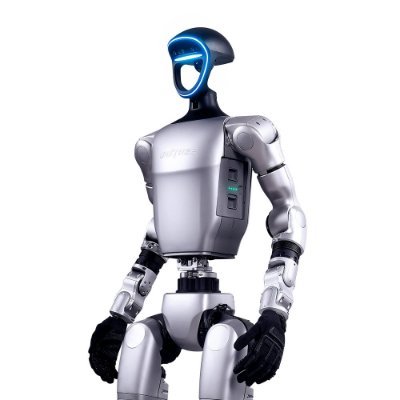
Unitree Breakthrough: The World’s First Real-Time World Model-Driven Fully Autonomous Humanoid Robot Combat🥊
UnifoLM-X2-1.0 breaks through world-action foundation models' bottlenecks in instant planning, decision-making, and dynamic interactive execution, achieve high dynamics, strong interaction, real-time prediction and planning of the future, achieve fully autonomous combat for humanoid robots. This validates the fundamental feasibility of large-scale deployment of world model-driven humanoid robots.
Joseph Amigo retweeted
Come checkout my lab mates great work on using world model for RL policy! They trained their interactive video model completely from scratch - the best I have ever tried.
coupled-global-local-wm-rl.p…


Reinforcement learning has unlocked tremendous gains in broader AI and humanoid robot whole body control, but still has yet to deliver strong results for robot manipulation due to the difficulty of capturing tasks in an accurate simulation; one way to fix this is to create complex environments with learned world models. But learning fully within world models is often intractable as powerful world models are computationally too expensive.
Instead, @Jsphamigo and @Rk4342R propose to break the problem down: into a large-scale world model that can generate forward trajectories, and a lightweight, low-dimensional latent-space model which can approximate local dynamics of a problem, without needing to back-propagate through a heavy global model. What this means: you can do reinforcement learning in this coupled local-global world model, and learn contact rich skills for a robot.
To learn more, watch Episode #101 of RoboPapers, with @micoolcho and @DJiafei!
Joseph Amigo retweeted

Clever split, but the local model still needs feeding. Contact dynamics come from real contact hours, so the bottleneck moves from simulator fidelity to collecting messy physical data.
Joseph Amigo retweeted

Super cool! Agree this is the tractable path. Contact dynamics are high frequency and short range, so paying for resolution only where the fingers touch is where the compute should go.
Joseph Amigo retweeted

Reinforcement learning has unlocked tremendous gains in broader AI and humanoid robot whole body control, but still has yet to deliver strong results for robot manipulation due to the difficulty of capturing tasks in an accurate simulation; one way to fix this is to create complex environments with learned world models. But learning fully within world models is often intractable as powerful world models are computationally too expensive.
Instead, @Jsphamigo and @Rk4342R propose to break the problem down: into a large-scale world model that can generate forward trajectories, and a lightweight, low-dimensional latent-space model which can approximate local dynamics of a problem, without needing to back-propagate through a heavy global model. What this means: you can do reinforcement learning in this coupled local-global world model, and learn contact rich skills for a robot.
To learn more, watch Episode #101 of RoboPapers, with @micoolcho and @DJiafei!
Joseph Amigo retweeted
Learn more
Project page: coupled-global-local-wm-rl.p…
ArXiV: arxiv.org/abs/2602.06219
This on substack: robopapers.substack.com/p/ep…
Joseph Amigo retweeted
Learn contact-rich humanoid manipulation policies, purely within a world model. This is usually not tractable, because you need a very large model to get the contact dynamics right -- instead, @Jsphamigo @Rk4342R couple a large global model with a local model. Very cool work on @RoboPapers ->
Reinforcement learning has unlocked tremendous gains in broader AI and humanoid robot whole body control, but still has yet to deliver strong results for robot manipulation due to the difficulty of capturing tasks in an accurate simulation; one way to fix this is to create complex environments with learned world models. But learning fully within world models is often intractable as powerful world models are computationally too expensive.
Instead, @Jsphamigo and @Rk4342R propose to break the problem down: into a large-scale world model that can generate forward trajectories, and a lightweight, low-dimensional latent-space model which can approximate local dynamics of a problem, without needing to back-propagate through a heavy global model. What this means: you can do reinforcement learning in this coupled local-global world model, and learn contact rich skills for a robot.
To learn more, watch Episode #101 of RoboPapers, with @micoolcho and @DJiafei!

Joseph Amigo retweeted
Full episode dropping soon!
Geeking out with @Jsphamigo @Rk4342R on Coupled local and global world models coupled-global-local-wm-rl.p…
Co-hosted by @micoolcho @DJiafei
Joseph Amigo retweeted
Full episode dropping soon!
Geeking out with @Jsphamigo @Rk4342R on Coupled local and global world models coupled-global-local-wm-rl.p…
Co-hosted by @micoolcho @DJiafei
Introducing our new work DMO: Decoupled Model-based policy Optimization! First-order gradient RL that unrolls trajectories with high-fidelity sims & computes gradients via learned models.
Paper & demos: machines-in-motion.github.io…
#CoRL2025 w/ @Rk4342R
