

Chairman of the Juche Idea Study Center in Italy General Secretary of KFA – Italy
Italia
Joined February 2016
- Tweets4K
- Following1K
- Followers3K
- Likes61.5K




🇮🇹 Alaricus Rex 🇰🇵 retweeted

简中区大佬Dzy做的手机版GTA 6
dzyai.online
兄弟们来吃点细糠
GPT-6.2Astra做了6个小时做出来
讲真的我觉得玩的还凑合😳😳
🇮🇹 Alaricus Rex 🇰🇵 retweeted
Mastering destiny by “drawing on the objective laws” (Kim Jong Il) is a materialistic concept based on the reflection of those laws in man’s consciousness. This is why, as Thomas Stock pointed out, you can find such ideas in other socialist countries that did not adopt Juche:

🇮🇹 Alaricus Rex 🇰🇵 retweeted
1) Of course communism is not mentioned as often as socialism, because the former is a long-term goal set for no sooner than the 2050s-60s while the latter is the present socio-economic system of the country. There is nothing mysterious about that and the two cannot be set against each other, for they are two stages of the same mode of production.
As Chairman Kim Jong Il put it: “Socialism and communism differ from each other in their degree of development and maturity, but they are the same type of society that rests upon common politico-economic and ideological foundations. Socialism, a low stage of communism, has communist characters as its essential features; so the course of further developing and perfecting socialism is immediately the course of building communism.” (Selected Works, vol. 10, Foreign Languages Publishing House, Pyongyang 1999, p. 91)
Communism is the perfection of socialism that maximizes systemic coherence by giving full play to the might of collectivism while overcoming transitional elements.
2) “My response to this is that these are also characteristics of a socialist society…”
Distribution according to people’s needs is a specific feature of communist society, whereas under socialism wealth is distributed to each according to his work. President Kim Il Sung explained it countless times: “The socialist society is where the people work according to their ability and get distributions according to the amount of work they have done, whereas the communist society is where the people work according to their ability and get distributions according to their needs.” (Works, vol. 44, Foreign Languages Publishing House, Pyongyang 1999, p. 132)
As for public ownership, under the present socialist system ownership is divided between the state and individual cooperatives and the private sideline economy still exists. This will change with communism, as the great leader said: “Some hold that the transition to communist society can be achieved while the cooperative economy is retained, and even go so far as to say that we could go over to communism even if the private economy had been left intact. This is entirely incorrect. (…) there is no doubt that, in order to attain communism, the country’s economy must anyway be unified under a single form of ownership–ownership by all the people–and that, accordingly, cooperative ownership will have to be converted into ownership by all the people.” (Works, vol. 16, Foreign Languages Publishing House, Pyongyang 1984, p. 461)
That’s why I talked about the undivided sway of all-people (state) ownership.
3) “The successful housing construction in the Hwasong area took place as part of the five-year plan for socialist construction. What is communist about that?”
You should ask Marshal Kim Jong Un who, in his report to the 9th Party Congress, clearly said: “Every year, a great number of modern dwelling houses for the working people were built at the state expense in urban and rural areas to invariably enforce the communist policy.”
Why did he call it a “communist policy”? Because, even though social wealth is not abundant yet and it is not possible to readily meet everyone’s demands, the allocation of houses free of charge to all people (instead of their sale to those who can afford them with their earnings from labour) is an embryonic form of the future communist distribution according to needs. As the great leader said in a recently reprinted speech: “Only when different kinds of communist policies are carried out and gradually expanded and developed to perfection can socialist society develop into communist society, where all people lead a happy life equally.” (Works, vol. 39, Foreign Languages Publishing House, Pyongyang 1995, p. 181)
4) “What would the Korean people need a fortress for to protect themselves in a society where all people are socially equal, so that envy and resentment no longer exist?”
This question is reminiscent of the mechanist views of Trotsky, who believed that communism or even just socialism would make a country automatically secured against any external or domestic threat.
President Kim Il Sung held more realistic opinions: “Even if communism was attained in one country or certain areas, that society would not be free from the menace of imperialism and the resistance of internal enemies who conspire with external enemies, because the world revolution has not yet been accomplished and capitalism and imperialism continue to exist.” (Works, vol. 21, Foreign Languages Publishing House, Pyongyang 1985, p. 239)
5) “A communist world…”
Wait, who ever talked about a communist world? :D All my points stem from the idea of President Kim Il Sung (and Stalin) that “Communism can be built even in one country.” (Works, vol. 22, Foreign Languages Publishing House, Pyongyang 1992, p. 342)
This perspective was echoed recently: “Our people will surely bring about a bright future of Juche Korea, with the revolutionary ideology of the respected General Secretary as the guideline, and enter ahead of others the communist society, dreamed and desired by mankind for centuries.” (Rodong Sinmun, 11 April 2025)
The DPRK will be the first country in history to build communism, “ahead of others” and leaving the world far behind. Hostile countries will be seized with hatred and envy—as well as with fear that their population may find out the truth about Korea—and will keep trying to isolate, sabotage, infiltrate and threaten it. Therefore, nukes, strategic alliances with Russia and China, and the strongest state and army, will still be much needed for a very long time, making a “communist world without wars” the most remote possibility that isn’t even worth taking into account.
The “fictional Star Trek scenario” exists just in the simplified Western notions about communism you cling to. Please notice that I am not saying that you approve of those notions: Western liberals like their fantasy version of communism, while you obviously dislike it; but you refer to it as if it was a truthful picture of what communism is, instead of familiarizing yourself with the Juche theory of communism that is far more scientific, realistic and detailed. If you read the works of President Kim Il Sung, Chairman Kim Jong Il and Marshal Kim Jong Un on the subject, all groundless “contradictions” you get lost in will melt away before your eyes like snow in the sun.
For example, let’s consider your view that “A communist world, on the other hand, is unipolar, not multipolar”, setting aside its unlikelihood for a moment.
Compare it to the words of President Kim Il Sung: “Even when communism has emerged victorious throughout the world, the Koreans will live in Korea. Even when communism has become a reality everywhere, the Koreans will not need to abandon their land of three thousand ri with beautiful mountains and clear rivers and go to live in cold Siberia or in the wilderness of Manchuria nor will they go across the Korea Strait to live in Japan or America. The Korean communists must build a paradise in the land of Korea. To this end, we must establish Juche thoroughly in accordance with the Party’s policy.” (Works, vol. 21, Foreign Languages Publishing House, Pyongyang 1985, p. 255)
As you can see, according to Kimilsungism-Kimjongilism, the DPRK will retain its national identity and independence even after the worldwide victory of communism. From this fact alone you can see that the Juche theory of communism is deeper than any Western caricature.
🇮🇹 Alaricus Rex 🇰🇵 retweeted
“At its core, communism is a stateless and borderless society.”
Wrong. You are clinging to an outdated definition of communism or, more precisely, to its simplified banalization by Western leftists, because you missed out on the theoretical activities of Marshal Kim Jong Un who newly elucidated the nature of communism.
On 17 July 2024 the Korean Association of Social Scientists published an entry on the Essence of Communist Society, which reads as follows: “The respected Comrade Kim Jong Un newly elucidated the essence of a communist society.
In a word, it is a society where independence of the popular masses is completely realized. In other words, it is a society in which all the people live a comfortable and harmonious life in good health and without any worries about food, clothing and housing and a genuine people’s society in which communist traits and virtues are displayed to the full so that they help and lead each other and share bitters and sweets all together.” (kass.org.kp/index.php/course…)
Notice how the issue of the state is not mentioned, because the essence of communism does not lie in statelessness but rather in the complete socialization of ownership and in the distribution according to people’s needs. Even in the classical Marxist-Leninist theory, the withering away of the state was just a superstructural inference, not a moral imperative.
Moreover, in his classical work The Historical Lesson in Building Socialism and the General Line of Our Party from 3 January 1992, Chairman Kim Jong Il clarified that the state will exist under communism: “The unified leading function of the socialist state should be further intensified as the building of socialism and communism progresses; this function will be needed in communist society as well. Therefore, socialist power will never wither away, and the matter of power will remain the most important matter not only at the stage of the socialist revolution but also during the whole historical period of socialist and communist construction.” (Selected Works, vol. 12, Foreign Languages Publishing House, Pyongyang 2008, p. 299)
As you can see, the alleged contradictions between communism and “geopolitical pragmatism” exist only in the fantasy of newbies who lack a proper study of Kimilsungism-Kimjongilism. Building communism will make the DPRK an even more impregnable fortress and, thus, strengthen relations with its allies.
Last but not least, you completely misinterpreted my quoted words. The “adjustment of propaganda language” I referred to is the much-talked-about disappearance of the term “communism” for some years. What did I mean by that phrasing? I meant that in those years DPRK theorists kept talking about communism even without naming it as such.
One example: “To capture the material fortress of socialism means that the entire people’s ownership of the means of production is established and that the productivity is developed so high as to realize the distribution according to the need.” (Fundamentals of Kimilsungism-Kimjongilism, Korean Association of Social Scientists, Pyongyang 2016, p. 102)
The term “communism” is not used here, but the undivided sway of all-people ownership and distribution according to needs are the definitional traits of a communist society.

🇮🇹 Alaricus Rex 🇰🇵 retweeted
The fulfillment of liberalism was the ideal of Bernstein—and every other revisionist since—who viewed equality as a means for the maximum expansion of individual freedom. But if we replace the notion of freedom with that of Chajusong, which sublates it, things get interesting.


🇮🇹 Alaricus Rex 🇰🇵 retweeted
I have to disagree for a number of reasons:
1) In 1952 and early 1953 the formulations about the sharpening of class struggle under socialism from 1937 were quoted with renewed vigor in the wake of investigations on the doctors’ plot and other similar cases, whose continuation would have led to major purges though not as massive as in the 1930s, while successors immediately stopped the investigation and rejected its theoretical basis in 1956.
2) In “Economic Problems of Socialism in the USSR”, Stalin outlined a path of development from socialism to communism based on the gradual restriction of money-commodity relations, whereas Khrushchev rather expanded them by selling farm machines to the kolkhozes and enabling direct contractual ties between enterprises. This marked the beginning of the right-wing tendency of “optimizing” the operation of the law of value under socialism to rationalize economic management instead of gradually overcoming it as a relic of capitalism.
3) Stalin kept a balanced budget and even accumulated huge gold reserves, prioritizing accumulation while strictly adhering to the principle of distribution based on the work done. Khrushchev instead raised procurement prices, wages and social consumption funds to achieve short-term material well-being, weakening financial discipline and incentives for work.
4) Khrushchev betted on nuclear forces alone and cancelled Stalin’s plans for expanding the conventional forces, with a large number of strategic bombers and warships, in the event of a third world war.
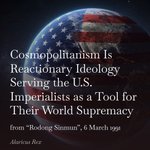
5) In the field of culture, the campaign against cosmopolitanism ceased and people like Solzhenitsyn were allowed to publish. I doubt this would have happened under Stalin.
🇮🇹 Alaricus Rex 🇰🇵 retweeted

Kim Il Sung on the transition from socialism to communism…
-----
A socialist society is the first phase of a communist society, but socialism should be distinguished from communism. True, we are striving for the ultimate goal of building a communist society which is ideal for mankind.
But communism can come into being only through socialism.
The transition from socialism to communism requires a further development of the productive forces, the production of goods in ever larger quantities and also communist remolding of people’s consciousness.
To make communism a reality goods must be abundant enough to fully gratify the desires of the people.
If products are to be very abundant, technology should be further developed and labor productivity raised still higher, so that it becomes possible to turn out an abundance of goods.
In a communist society production will be completely mechanized and automated, and the distinctions between skilled and unskilled labor, between mental and physical labor will also disappear.
Therefore, it will become possible then to distribute goods equally to everybody according to his needs and his wishes.
In a socialist society, however, the productive forces have not yet developed to such a degree.
Since mechanization has not yet been fully realized, many distinctions still remain in labor, too. In the first place, the disparity between easy work and hard work is very great.
Plowing is harder than raising chickens, and working in the mine-pit is harder than surface work. It is also a fact that physical labor is harder than indoor clerical work.
If we were to distribute goods equally to everyone in spite of such differences, who would ever offer to do the hard work, who would acquire technical know-how, show creativity and take pains to produce more goods?
Production can develop rapidly only when there is a differentiation in distribution, because there is disparity in labor.
-----
From a speech Delivered at a General Membership Meeting of the Party Organization of Chongsan-ri, Kangso County, February 8, 1960


🇮🇹 Alaricus Rex 🇰🇵 retweeted
1) Ri Ki Song, top DPRK economist, to the Associated Press on 29 March 2010: “Markets will be removed in the future, by reducing their numbers step-by-step, while continuously expanding the planned supply through state-run commercial networks. This is our official position on markets. Now, markets are used as a subsidiary means to offer convenience in peoples’ daily lives.” (koreajoongangdaily.com/korea…)
The material basis for this step is the complete victory of socialism, which implies the disappearance of cooperative economy and sideline individual economy, and the development of productivity that makes both legal and illegal market activity superfluous and thus unprofitable: nitter.cf/JucheMaxing/status/206…
2) The DPRK did not release specific figures, but you can easily calculate: since there are two markets in each country and Korea has about 200 counties, we can assume 400 markets, nay 500 rounded up exist, and this is close to what appears from satellite images; since each market has a number of seats ranging from 600 to 2,000 based on the county population, we can see that from 500,000 to 1,000,000 people sell commodities at the markets, a tiny segment of the active population. And these are socialist working people, not independent producers; full-time merchants who failed to turn up at the workplace were targeted by cutting food rations and confiscation of profits and, even according to hostile estimates, have almost completely ceased to exist already before 2020.
3) Concluding speech by Kim Il Sung at the 12th plenary meeting of the Fourth Central Committee of the WPK, 15-17 November 1965: “As for the animal products and industrial crops produced by the collective economy of cooperative farms, the greater part should be purchased by the state, but part should be divided among the farmers. Farmers may consume them, or sell them to the purchasing agencies, or take them to the peasant market for sale. The peasants should not be compelled to sell them exclusively to the purchasing agencies, but should be allowed to sell them to whoever they wish. That is the way to stimulate production and increase output and to ease the people’s lives.” (Works, vol. 20, Foreign Languages Publishing House, Pyongyang 1984, p. 114)
It is basically a measure to prevent the phenomenon, observed in many other socialist countries, of enterprises intentionally underperforming and failing to achieve the plan targets in order not to be given higher targets the next time. If enterprises have the possibility of selling surplus production at higher prices after fulfilling the planned quotas, they will have a material incentive to work better and produce more instead of hiding reserves to deceive the state.
4) Yes, almost all factories are state-owned (few are cooperatives), and they can sell at the market up to 30% of the daily necessities they made by recycling their byproducts: alaricusrex96.substack.com/p…


🇮🇹 Alaricus Rex 🇰🇵 retweeted
The DPRK is communist and, as Kim Jong Un said, stands at the forefront of the world revolution, actively contributing to it by exterminating neo-Nazis and other NATO proxies from Ukraine.

🇮🇹 Alaricus Rex 🇰🇵 retweeted
In 1956-58 Kim Il Sung purged opponents of proletarian dictatorship, and those who escaped to China were revealed to be not just anti-Juche but full-fledged anti-communists:

🇮🇹 Alaricus Rex 🇰🇵 retweeted
🚜🇰🇵 Cosechadoras, drones, previsiones meteorológicas, fertilización de precisión y gestión científica del agua.
Corea del Norte avanza en la campaña agrícola de verano en varias regiones del país, cada vez más apoyada en la mecanización y la tecnología.
🇮🇹 Alaricus Rex 🇰🇵 retweeted
Qualifying the economic system of the USSR as “state capitalism” requires a rejection of Leninism, which clearly distinguishes “our present system” from state capitalism and refers to both state industry and collective farms as “socialist enterprises”: nitter.cf/JucheMaxing/status/206…


🇮🇹 Alaricus Rex 🇰🇵 retweeted
The DPRK recovered the same GDP level as before the Arduous March by the end of the Kim Jong Il era and more than doubled it under Kim Jong Un.


🇮🇹 Alaricus Rex 🇰🇵 retweeted
Leftcoms: “Stalin is an apostate for theorizing commodity production under socialism.”
Lenin: *argues that the exchange of commodities between state industry and cooperative farmers is “the only possible form of existence of socialist society” in a small-peasant country*

