

GWOTE Veteran and Author of The Painkiller Chronicles — Chrome guardian. Mothers & knights. Every last one. Sci-fi with soul. Book 1 now available on Amazon
TN
Joined March 2026
- Tweets298
- Following87
- Followers167
- Likes39



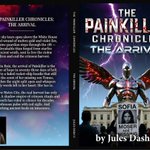
An eight-year-old girl ducks under the rope at the foot of a hundred marble steps and walks straight up to a waiting dragon-machine. Crowds line the street holding photographs of missing children. Her voice is small, but it carries:
"What's your bike called?"
The dragon-machine lowers its head until one amber eye is level with hers.
"Dragon-Machine. But my friends call me Hope."
She turns to the eight-foot chrome guardian walking up the steps alone—Painkiller—and asks about the sword locked across the beast's back.
"Wrathcleaver," he says, soft enough for the whole world to hear. "Forged the day heaven ran out of mercy."
Then he rests one gauntleted hand on her head for half a heartbeat, light as a blessing, and keeps climbing.
That's one of my favorite moments in Book 1 of The Painkiller Chronicles. Just a kid asking a machine its name, and getting an answer that sounds like hope.
What's a quiet naming moment from a book that stuck with you?
Book 1, The Arrival, is out in paperback here:
amazon.com/dp/B0H51R3K34

Six months after her eight-year-old son, Tomas, vanished from the park, Maria Ruiz walks out of her apartment at first light. She carries his photo in her hoodie pocket and a folded printout of missing-child lists she's kept the whole time.
At a barricade, a woman with a scarred face and a rifle on her back is handing out water and blankets to parents holding photographs. Maria holds up Tomas's picture. The woman studies her for a long moment, then nods toward a supply truck: "Then come. We've got room for one more mother."
The truck rolls out to a camp in an old factory lot. When Maria climbs down at dusk, a barefoot girl in a gray shirt far too big for her runs up and wraps her arms around Maria's legs. "You came for Tomas too?"
Maria kneels and holds her. "Yes."
That's one of my favorite moments in Book 1 of The Painkiller Chronicles. Maria has no powers and no plan. She just refuses to sit at home and wait. To me, that's what resilience looks like.
Who's a character from a book who never gave up on someone?
Book 1, The Arrival, is out in paperback here:
amazon.com/dp/B0H51R3K34
A seven-year-old girl, freed from a cage the night before, sweeps the floor of an underground hideout with a broom made of bound rags. She moves carefully, as if she's afraid the floor might remember the cages.
That's one of my favorite quiet moments in Book 1 of The Painkiller Chronicles. The rescued kids have been brought to a safehouse in an old subway vault, and nobody asks them to help. They just do. Small hands stack broken concrete into neat piles and pass tools down the line.
And whenever a child hesitates near a dark corner, Painkiller, the eight-foot chrome guardian who got them out, kneels down and rests a hand on a small shoulder until the trembling stops.
The big rescue scenes get the attention, but moments like this are the heart of the book for me: kids who've been through the worst, choosing to rebuild anyway.
What's a small, quiet moment from a book that stayed with you longer than the big action scenes?
Book 1, The Arrival, is out in paperback here:
amazon.com/dp/B0H51R3K34
A woman sits on the step of a supply truck at first light, a blanket around her shoulders. Hours earlier, four children were pulled out of an industrial lot the maps said was empty. The little girl she claimed finally slept. She didn't. "He took some of it. Not all. Enough that she slept. I didn't. I don't think I get to."
Day 6 of writing The Convoy, Book 2 of The Painkiller Chronicles. That moment is from Chapter 8 of my fifth draft. The whole chapter is told as a live news broadcast from the road, and some of the lines that hit hardest don't come from the heroes. They come from the parents. A father in the same chapter puts it plainly: "I don't need a name for it. I need my kid able to eat."
That's what this series is about for me: ordinary people trying to stay human next to something enormous. If you haven't started yet, Book 1, The Arrival, is out in paperback here:
amazon.com/dp/B0H51R3K34
A woman in pearls drops to her knees in the middle of midnight service and starts sobbing out names.
That's one of my favorite moments in Book 1 of The Painkiller Chronicles. The cathedral is packed with the city's most powerful people, the ones who have been funding the disappearance of children. Down in the crypts below their feet, those children are still waiting.
Then a stranger in chrome armor, the one the city calls Painkiller, offers every person in those pews one chance: "Repent. Confess. Free the innocent below."
What I love about writing that scene is that the turning point isn't a fight. It's one person deciding to tell the truth, then ten more, then hundreds.
If you like stories where good pushes back hard against evil, Book 1, The Arrival, is out in paperback here:
amazon.com/dp/B0H51R3K34
A moment from Book 1 of The Painkiller Chronicles.
Forty-seven children are locked in cages inside a warehouse on the docks. A stranger called Painkiller tears the doors open, one by one, and the kids spill out into the rainy night.
But the part that matters most to me happens across the city. Maria Ruiz is a mom whose eight-year-old son, Tomas, vanished from a playground six months ago. She's watching it live, and her heart jumps, because that could be her boy. She grabs her hoodie and heads out the door:
"They're fighting back. I have too."
That's what this book is about for me: ordinary people who refuse to give up.
If you'd like a paperback copy of The Arrival, it's here:
amazon.com/dp/B0H51R3K34
Jules Dash II
Day 5 of writing The Convoy, Book 2 of The Painkiller Chronicles.
One chapter in my fifth draft is told entirely as a live news
broadcast. Lira Kane, a reporter riding along with the convoy, goes on
the air from the back of a truck while a long line of buses and
families keeps rolling west through Ohio. Partway through, she reads
five posts from ordinary people watching it go by.
Two of them:
"Escort them through. Do not put my people in front of that column. I
have kids on these roads."
"Keep the road open. That is the job."
Every one is a different voice from a different county, and that's the
heart of this book for me: regular people deciding what to do when
something huge rolls past their front door.
She signs off the same way every time: "Stay with the road."
So here's my question for you: if a convoy like that came through your
town, would you stay home or go out and watch?
New here? Start with Book 1, The Arrival, in paperback:
amazon.com/dp/B0H51R3K34
A five-dollar hoodie from a discount bin, torn at the hem.
That's the hoodie Maria Ruiz never takes off in Book 1 of The
Painkiller Chronicles. Her eight-year-old son, Tomas, picked it out
for her last Mother's Day because it had a little spaceship stitched
over the heart. "For when we go to the stars together," he told her.
The tear didn't bother him one bit. "We'll fix it," he said. "Like how
astronauts fix their ships in space."
Now Tomas is missing, and that worn gray hoodie is what she holds onto.
I wrote this story about people like Maria: ordinary people who keep
going when the worst has happened, and what it looks like when someone
finally stands up for the missing kids.
Get the paperback here:
amazon.com/dp/B0H51R3K34
Day 4 of writing The Convoy, Book 2 of The Painkiller Chronicles.
I'm working through my fifth draft, and here's something from this
pass: one chapter from my last version didn't make it into this one as
its own chapter. The chapter after it simply moved up a number.
It's a strange feeling. You spend real time on a chapter, and then a
later draft shows you the story moves better without it standing on
its own.
Revising isn't only adding scenes. Sometimes it's letting go.
Readers, have you ever finished a book and thought, "That one chapter
could have gone"? Writers, what's the hardest thing you've ever cut?
New here? Start with Book 1, The Arrival, in paperback:
amazon.com/dp/B0H51R3K34
Quick question for you all: what makes you root for a hero? Is it how
strong they are, or the moment they show they care?
Here's why I ask. In Book 1 of The Painkiller Chronicles, Painkiller
is an eight-foot chrome guardian who arrives to stop the people who
are taking children. He's powerful, no question. But one of the
moments that defines him isn't a fight at all.
On the docks, right after stopping one of the kidnappers' enforcers,
he kneels down in front of a frightened little boy and asks where his
sister is. "You're safe," he tells him. "Name the monsters."
And when it comes to the people behind it all, his promise is short:
"Every last one."
That's what this story is about for me: good standing up to evil, and
people who refuse to give up on the ones they love.
So, strength or heart? Tell me in the comments.
Want to meet Painkiller? Grab the paperback here:
amazon.com/dp/B0H51R3K34
Day 3 of writing The Convoy.
Quick check-in on Book 2: 13 chapters are now through my fifth draft. That's the pass where the story stays the same and every sentence has to work harder.
The Convoy follows a long line of trucks, buses, and families pushing west across the country. In the newest chapter, they cross the Mississippi at St. Louis in daylight and stop at a fairground for the night. Some of the trucks won't survive the next leg, and the families riding in them are about to be left on the roadside.
Then three charter buses roll in. The drivers aren't soldiers. Their company pulled them off paying runs, covered the fuel, and offered to carry sixty people a bus. No charge.
Lira Kane, a reporter riding with the convoy, puts it this way: "The President told the country to close the door. Some people opened one anyway."
That's the heart of this series for me: ordinary people choosing to do good when nobody told them to.
Has someone ever opened a door for you when it really counted? I'd love to hear about it in the comments.
New here? Start with Book 1, The Arrival, in paperback:
amazon.com/dp/B0H51R3K34
Six months. Number 3,114.
That's what Maria Ruiz says when a stranger asks who she lost.
Maria is a mom in Book 1 of The Painkiller Chronicles. Her eight-year-old son, Tomas, vanished from a playground. On a website where parents of missing children gather, he's number 3,114 on a list that grows longer every day. She keeps that printout folded in her wallet, worn soft from handling, and she still wears the gray spaceship hoodie he picked out for her last Mother's Day.
If you've ever lost sight of your child in a crowded store for even ten seconds, you know that feeling. Maria lives inside it every single day. And when the world finally starts fighting back, she stops waiting and walks out the door to keep looking.
Nothing is scarier this October than a missing child. Read Maria's story and feel her pain, her sorrow, and her refusal to give up.
Grab the paperback here:
amazon.com/dp/B0H51R3K34
Halloween’s almost here. The costumes are cute.
The real darkness doesn’t need one.
In the shadowed streets of New Metro City, children vanish. Warehouses glow with red sigils the powerful ignore. Then the sky rips open above the White House and an eight-foot chrome warden steps through with one vow:
Every last one.
The Painkiller Chronicles: The Arrival — dark sci-fi, cosmic justice, and hope that shows up armed.
Read it: amazon.com/dp/B0H51R3K34
This Halloween, parents will walk their kids door to door, holding tight.
Maria Ruiz can't. Her son Tomas, 8, vanished from a playground. She keeps his school photo.
Feel her sorrow in Book 1 of The Painkiller Chronicles. Paperback
amazon.com/dp/B0H51R3K34
Day 1 of writing Book 2: The Convoy.
Book 2, chapters 4 through 7: The Forge, Voices from the Road, The Necessary Clearing, and The Road West.
If you like military sci-fi with a long road, political pressure, and characters who have to keep moving, this is the book I’m deep in right now.
Quick question for you: what keeps you turning pages in a road story — the fights, or the people in the trucks?
You can start with Book 1, The Arrival (paperback):
amazon.com/dp/B0H51R3K34
October's real monsters keep children in cages.
Chapter 5 of The Painkiller Chronicles: The Arrival, "The Warehouse Inferno." Painkiller crashes through the roof and drops eight handlers with his axe, Wrathcleaver. He tears open the cages and frees 47 children.
Then the reinforcements come: 12 hover-bikes, 20 elite troops, and 30 drones. He wipes out every one of them. Alone.
"They harvest the young like cattle. Wrathcleaver first."
If you want your military sci-fi brutal, fast, and with a heart that's worth fighting for, this is where it starts.
Get the paperback (the best way to support me directly):
amazon.com/dp/B0H51R3K34
Nothing scarier this October than a missing child.
When the sky tears open above the White House, Maria Ruiz is left with a pain and sorrow no one should ever carry. Her eight-year-old son, Tomas, vanished from a playground. She still wears the gray hoodie he picked out for her last Mother's Day and holds onto his school photo.
Read now and feel it with her.
The Painkiller Chronicles, Book 1: The Arrival — paperback available now:
amazon.com/dp/B0H51R3K34
This October, the monsters are real. And they take children.
Chapter 4 of The Painkiller Chronicles: The Arrival. On the Pier 41 docks, Painkiller tears an enforcer's arm off and crushes his helmeted skull. Then he kneels in front of the boy and asks where his sister is.
"You're safe… Name the monsters."
"Every last one."
One enforcer. One crushed skull. 47 children are breathing because of it. Pier 41 next.
If you like your military sci-fi hard-hitting and personal, start here.
Get the paperback (the best way to support me directly):
amazon.com/dp/B0H51R3K34