
London, Ontario
Joined November 2016
- Tweets7.7K
- Following1.9K
- Followers3K
- Likes18.9K
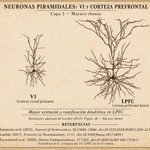



¿Sabías que, en primates, las neuronas piramidales de las capas 2/3 de la corteza prefrontal lateral pueden tener árboles dendríticos más del doble de grandes que los de V1? Más ramas y conexiones amplían sus posibilidades de integrar información. #Neuroscience

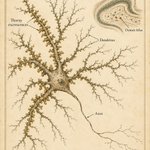
Meet the mossy cell: described by David Amaral in 1978, this excitatory neuron in the hippocampal dentate gyrus activates granule cells and recruits inhibition, helping pattern separation, the ability to distinguish between similar experiences. #Neuroscience

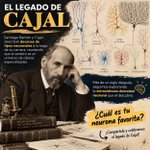
¡El universo neuronal de Cajal! Hace más de un siglo, Cajal describió decenas de tipos de neuronas, revelando una asombrosa diversidad de formas, conexiones y arquitecturas. Cada arquitectura, una posible función. ¿Cuántos tipos neuronales nos quedan por descubrir? #Neurociencia

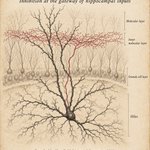
Meet HICAP cells! Described by Han, Buhl, Lörinczi & Somogyi in 1993, these inhibitory neurons in the dentate gyrus target granule-cell proximal dendrites where mossy-cell inputs arrive, a striking example of inhibition tailored to a specific input pathway. #Neuroscience

Uber interesting 👇

Happy to announce our latest discovery on the neural basis of episodic memory: the more stimulus specific representations in the amygdala are engaged, the more likely a strong memory is created (aka gain modulation). This was not the case in the HPC. nature.com/articles/s41593-0…

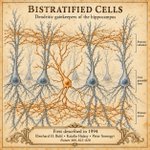
Meet the hippocampus’s dendritic gatekeepers: bistratified cells. First described by Buhl, Halasy & Somogyi in 1994, these inhibitory neurons target CA1 pyramidal dendrites in two layers, shaping incoming signals with precise timing during theta rhythms and ripples.#Neuroscience

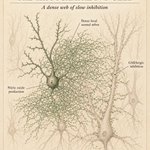
Meet the ivy cell: described by Fuentealba and colleagues in 2008, this hippocampal GABAergic neuron spreads a dense, ivy-like axonal web. It produces nitric oxide and delivers slow inhibition to pyramidal dendrites, regulating their excitability. #Neuroscience

What makes humans human? Apes, and particularly humans, are special when it comes to prefrontal cortex expansion "great ape and human prefrontal cortex expansion are non-allometrically derived features of cortical organization." Great read 👇med.upenn.edu/ngg/assets/use…
Meet the spherical bushy cell! Classified by Osen in 1969, these cochlear nucleus neurons are precision timekeepers. Giant endbulbs of Held deliver auditory input; inhibition sharpens spike timing, helping the brain locate sounds. #Neuroscience

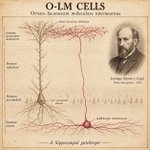
Meet the oriens–lacunosum moleculare (O-LM) cell! Described by Cajal, 1893, these GABAergic hippocampal interneurons inhibit distal dendrites of CA1 pyramidal cells. Inhibition acts as a selective gatekeeper: reducing entorhinal input and favoring signals from CA3. #Neuroscience

How does a neuron get its branches? Genes set the growth program; molecular cues guide it. Actin pushes new sprouts, microtubules support their growth, and neural activity helps refine the tree. A living architecture that shapes how the neuron computes. ncbi.nlm.nih.gov/books/NBK65…

Meet the cerebellum’s candelabrum cells! First described by Jeanne Lainé & Herbert Axelrad in 1994, these GABAergic neurons inhibit other inhibitory neurons, freeing Purkinje cells from inhibition. Named for their candleholder-like axonal branches. #Neuroscience

Meet the Meynert cell! Described by Theodor Meynert in 1867, these distinctive projection neurons in primate visual cortex send signals to area MT and the superior colliculus, linking early visual processing to circuits for motion perception and gaze control. #Neuroscience

Julio Martinez retweeted

Several schizophrenia symptoms linked to a single brain signal mcgill.ca/newsroom/channels/… via @mcgillu

Julio Martinez retweeted

Most neurons are excitatory, but some do the opposite and dampen the activity of other neurons.
In this visualization by our Electron Microscopy team, an axon (red) sneaks its way in between a satellite microglia (blue) and an inhibitory neuron (gray).
Meet CRH neurons: the hypothalamus’s stress alarm. They release corticotropin-releasing hormone, launching the hormonal cascade that raises cortisol. Wylie Vale and colleagues isolated CRH in 1981, revealing a molecular link between brain and body under stress. #Neuroscience

Julio Martinez retweeted

New issue of Neuron!
Cover art (Alex Wang) shows two halves of a Tang dynasty fish tally, representing depression and pain. Cai et al. reveal VTA to OFC dopamine circuits that gate both (cell.com/neuron/fulltext/S08…).
Check out the full issue: cell.com/neuron/current

Meet cerebrospinal fluid–contacting neurons (CSF-cNs), described by Kolmer (1921) and Agduhr (1922). These GABAergic spinal sensors contact fluid in the central canal. In zebrafish, they detect spinal bending through PKD2L1 channels, helping fine-tune swimming! #Neuroscience

Julio Martinez retweeted

COMING UP FAST!
📣 Register now for this year's New York Memory Hub conference.
Join the Memory Hub on October 29 & 30 for talks and discussion about all things learning and memory 🧠
Learn more and register here by October 25
👉 eventbrite.com/e/memory-hub-…


Meet the Renshaw cell: the spinal cord’s feedback brake. Named after Birdsey Renshaw, who demonstrated recurrent inhibition in 1941, these interneurons receive motor-neuron signals and send inhibition back, mainly through glycine, regulating motor output. #Neuroscience
