

Proof of Work is never found; rather, merely satisfied.
Atlas mnt
Joined February 2013
- Tweets3.6K
- Following820
- Followers619
- Likes10.5K




JusticeGate retweeted

Omarchy is forever free. There's no monetization scheme coming. I'm already rich and the Omacom Foundation is a well-founded nonprofit.
The only ulterior motive here is to make Linux win on the desktop and create the perfect, malleable computer for all to enjoy!
JusticeGate retweeted

Qwen3.8-27B has reportedly been compressed from 55.6GB to just 5.9GB, while retaining 98.2% of its aggregate benchmark performance.
That’s an 89.4% reduction in model size. The compressed version is more than nine times smaller than the original.
The result comes from Bonsai 2, a compression method developed by PrismML. The team reports that it improves on its previous generation, which retained approximately 95% of the original model’s benchmark performance.
Here are the reported figures:
Original model: 55.6GB
Bonsai 2 version: 5.9GB
Size reduction: 89.4%
Aggregate performance retained: 98.2%
Previous Bonsai generation: approximately 95% retention
Evaluation coverage: 20 benchmarks
The interesting question is how much of a 27B model’s capability can survive when its representation becomes this small.
1. The technology behind the compression
Bonsai 2 uses ternary quantization.
Traditional model weights can represent many different numerical values. Storing those values across billions of parameters requires considerable space.
Ternary quantization takes a more aggressive approach by mapping weights to just three possible states:
-1
0
+1
Scaling factors help preserve information about the magnitude of the original weights.
This allows the compressed model to use far fewer bits to represent its parameters.
The challenge is that model weights aren’t just numbers taking up storage. Their relationships encode the patterns and capabilities that allow a model to follow instructions, reason, write code and solve problems.
Reduce the precision too aggressively and useful information can disappear.
The goal is therefore not simply to make the model smaller. It’s to preserve as much of its learned behaviour as possible while reducing the storage required.
2. What improved with Bonsai 2?
PrismML reports that its previous Bonsai generation retained around 95% of Qwen3.8-27B’s aggregate benchmark performance.
Bonsai 2 reportedly raises that to 98.2% across 20 benchmarks.
The team also highlights improvements in:
Coding agents
Multimodal reasoning
Long-horizon tool use
These capabilities deserve attention because they involve more than getting a single answer right.
A coding agent, for example, may need to inspect an existing repository, understand dependencies, plan changes, edit several files, run tests, interpret errors and correct its implementation.
Weaknesses can accumulate across those steps. A model that performs well on isolated coding questions may still struggle to complete a longer development task.
That’s why performance on agent workflows is worth examining separately from aggregate benchmark retention.
3. What this could change for local AI
A 27B model typically requires substantial memory, which can make local deployment difficult on consumer hardware.
A 5.9GB compressed representation could lower the barrier to distributing and experimenting with a model of this size.
Potential applications include:
Running larger models on consumer GPUs with limited VRAM.
Testing 27B-class models on memory-constrained laptops.
Deploying models on edge devices.
Hosting more models within the same server memory budget.
Building local AI applications with less dependence on cloud APIs.
For developers experimenting with coding agents, this could make it easier to test more capable models without needing expensive hardware from the start.
4. One important distinction
The 5.9GB figure refers to the compressed model file, not the total memory needed for inference.
Running the model still requires memory for the KV cache, activations, inference buffers and other runtime overhead.
Actual requirements will also depend on context length, concurrency, the inference engine and hardware support for the compressed format.
The 98.2% figure needs similar care. It’s an aggregate across 20 benchmarks, not a guarantee that every individual task retains exactly 98.2% of the original model’s capability.

In anticipation of Qwen4-27B, here’s a look at what Qwen3.8-27B can already do.
AJ ran the Unsloth UD-Q4_K_M quant locally on an unlocked RTX 3090 using llama.cpp.
The task was to build a complete Three.js scene in a single turn. No harness, no external tools, no multi-agent workflow. Just one prompt and the model’s output.
The result is a floating island featuring:
A traditional pagoda and a castle.
A waterfall cascading into the clouds below.
Trees, a small village and surrounding scenery.
Distant birds moving across the sky.
Detailed lighting, shadows and atmospheric effects.
Fireflies illuminating the island at night.
The visual execution is what stands out. The scene has depth, carefully arranged elements, and lighting that helps bring the environment together. Even the fireflies add a nice touch to the atmosphere.
I used xhigh thinking, and the entire generation took approximately 50K tokens combined.
What’s particularly interesting is that this wasn’t produced through an elaborate coding-agent setup. Qwen3.8-27B handled the task in one shot, directly generating the Three.js scene.
If a 27B model running locally on a single RTX 3090 can produce results like this, Qwen4-27B is certainly worth watching.

JusticeGate retweeted

Open Source Must Win.
Art skill is live: github.com/0xSero/ascii-art
JusticeGate retweeted

RIP to everyone who spent years learning 3D in Blender 💀
Hi3D just released an open-source model that turns any object from a photo into a full 3D model.
It's trained on 2 million 3D assets, and in their technical report 90% of its models pass 3D-print slicing.
Just generate the base from a photo, refine the details with Opus 5.5 and you're done.
The barrier to 3D just disappeared, you can find more details in the article below:
🤝 Paid partnership


JusticeGate retweeted

Introducing 𝙻𝙵𝙼𝟹: our new generation of Liquid Foundation Models. With a new tri-hybrid architecture and new multimodal encoders, the LFM3 family is the ideal model suite for specialized intelligence.
> 6 model instances, across text, audio, vision, and omni modalities, generative and decision models.
> 𝙻𝙵𝙼𝟹-𝟷.𝟽𝙱: text, 256k context window.
> 𝙻𝙵𝙼𝟹-𝚅𝙻-𝟸𝙱: vision-language model with video-input support for spatial understanding
> 𝙻𝙵𝙼𝟹-𝙰𝚞𝚍𝚒𝚘-𝟸𝙱: tool calls, voice chat, reasoning in 18 languages.
> 𝙻𝙵𝙼𝟹-𝙾𝚖𝚗𝚒-𝟸𝙱: an omni model combines vision, audio, and language.
> 𝚍𝟷-𝟸𝙱 and 𝚍𝟷-𝙾𝚖𝚗𝚒-𝟸𝙱: decision models with typed outputs and calibrated probabilities in a single pass. Omni adds audio input.
> fine-tune on 1 GPU.
> a new tri-hybrid architecture
> architecture optimized for 14 processor classes across GPUs, CPUs, and NPUs.
> 𝙻𝙵𝙼𝟹-𝚅𝙻-𝟸𝙱 is a beast. It performs competitively with Gemma 4 12B (6x larger), and Gemini 3.5 Flash Lite, and GPT-5.6 Luna, with 1.9B parameters.
> 𝙻𝙵𝙼𝟹-𝟷.𝟽𝙱 is #1 on the Pareto frontier of device intelligence 𝚙𝚒𝚙𝚎𝚝𝚝𝚎.𝚕𝚒𝚚𝚞𝚒𝚍.𝚊𝚒
Every modality for specialized intelligence. Pick the one that fits your use case, customize it, and run it on-device.
1/ 🧵
JusticeGate retweeted

NVIDIA releases Nemotron-3.5-Bolt-E4B, a new model that runs locally on 6GB RAM. 💚
Bolt-E4B can run on edge devices like phones and delivers top-tier performance for its size. Trained on Gemma 4, it supports vision.
GGUF: huggingface.co/unsloth/NVIDI…
Guide: unsloth.ai/docs/models/nemot…


Available now: NVIDIA Nemotron 3.5 Bolt E4B 4GB ⚡️
Our newest small open model is built for local assistants, interactive characters and robots that can carry on a conversation and use tools to get things done.
Watch Reachy Mini chat and move, with Bolt handling conversation and NVIDIA Cosmos handling vision. Both models run locally on Jetson Orin Nano 8GB.
Learn more: research.nvidia.com/labs/nem…
JusticeGate retweeted

This is REA for objects.
You see something you like and you can print it starting from a picture or a description
github.com/mfranzon/print3d


JusticeGate retweeted

🚨🚨🚨 ALERTE SÉCURITÉ MAXIMALE ! Python est compromis.
🔸 Mettez immédiatement pip à la version 26.2.2 ou plus.
🔸 Dans chaque projet Python (chaque venv) : python -m pip install --upgrade pip
🔸 uv : uv self update (0.13.4 ou plus)
🔸 Mettez aussi à jour les certificats du système (apt / dnf upgrade ca-certificates) et vos images Docker
pip install est compromis.
L'autorité indienne eMudhra (emSign), qui signe les « passeports » prouvant qu'un site est bien celui qu'il prétend être, utilisait des clés secrètes ridiculement faibles : 8 clés, toutes inférieures à 256. L'une valait 4. Autrement dit, n'importe qui peut fabriquer un faux passeport valide pour n'importe quel site.
Le risque pour Python : quelqu'un sur ton réseau (wifi public, FAI, État) se fait passer pour pypi.org, et ton « pip install » télécharge un paquet piégé sans aucune alerte. Aucune attaque n'a été signalée pour l'instant, mais c'est trivial à faire.
Un paquet piégé peut installer n'importe quoi. Porte dérobée, virus, vol d'informations en tout genre.
La situation est terrifiante !
Rien que dans l'écosystème Python, chaque installation de CPython, chaque venv, uv, tout est exposé.
Et je ne vous parle même pas de npm, pnpm, yarn, Go, Rust.
Ma stratégie de sécurité 2026 : rester chez moi et ne me connecter à Internet que depuis un FAI de confiance.
C'est quand il y a de la mer qu'on reconnaît les vrais marins...

Readers added context they thought people might want to know
Ce n'est pas un bug Python mais une vulnérabilité des clés privées faibles des certificats intermédiaires eMudhra/emSign (d<256 dont une valant 4), exposant les bundles certifi/pip à des MITM TLS potentiels jusqu'aux mises à jour.
discuss.python.org/t/information-…
emudhra.we-have-a-problem.com
scotthelme.co.uk/eight-bits-of-…
github.com/advisories/GHS…
JusticeGate retweeted

Listen to what my Cohen-style Chamber Folk singer has done with this classic Bitcoin sea shanty by @BTCMinstrel... WARNING: you might pitty the no-coiners after this:
JusticeGate retweeted

Jailbreak Downloads page has been updated and reflects the latest released tools for iOS 26, iOS 18 and iOS 17 as well a the announced to be released iOS 27 untethered tool for iPhone 18 Pro.
✅ Jailbreak Downloads: idevicecentral.com/jailbreak…

JusticeGate retweeted

Turn Claude Code into your job-search assistant.
Clone this repo, fill in your profile, and it evaluates job opportunities, tailors your CV, writes cover letters and helps you prepare for interviews.
github.com/MadsLorentzen/ai-…


JusticeGate retweeted

iPhone 18 Pro jailbreak Untethered on iOS 27.0.1 live on stage at Hexacon.
Root access that persists across reboots on the latest public release.


JusticeGate retweeted

RUN UNCENSORED AI MODELS ON YOUR OWN PC FOR FREE
even low end PCs can run local AI models, including models for adult roleplay and 18+ writing
how to set it up
1. install Ollama
ollama.com/download
2. choose a model for your hardware
low VRAM: ollama.com/s1gnature/gemma4-…
8–12GB VRAM: huggingface.co/igorls/gemma-…
16GB+ VRAM: ollama.com/search?q=gemma-4-…
3. copy the run command from the model page and launch it in your terminal
prefer a visual interface?
lmstudio.ai/download

JusticeGate retweeted

this is the most DANGEROUS thing on internet today...
REA (Reverse Engineer Anything) - this open source MCP lets your AI agent reverse engineer any app, down to the binary
i gave Opus 5.5 one 49-line prompt and it turned into a reverse engineer that never guesses
paste it into Claude Code in an empty folder and it walks you through any app step by step ↓
step 0 → it remembers: progress saves to REA-TASK.md, so you can stop anytime and pick up where you left off
step 1 → it asks you 4 questions first: what to inspect, where it is, which one feature, and what you want at the end
step 2 → it installs REA for you: checks your Node version, runs npx rea-agents@latest setup and waits for your ok
step 3 → it picks the right route: Notion, Slack and Discord through app.asar, websites through Chrome, .exe and games through Ghidra or IDA, Android through JADX
step 4 → it investigates: traces the feature from your click to the final result
step 5 → it reports with proof: plain-English explanation, every step with file and line, confirmed vs inferred, what is still unknown
step 6 → it builds: a SPEC.md with no copied code, then your own version with tests until they pass
the prompt explains every move before it makes it, so you can use it even if you have never done reverse engineering in your life
full prompt is free in the image, copy it ↓


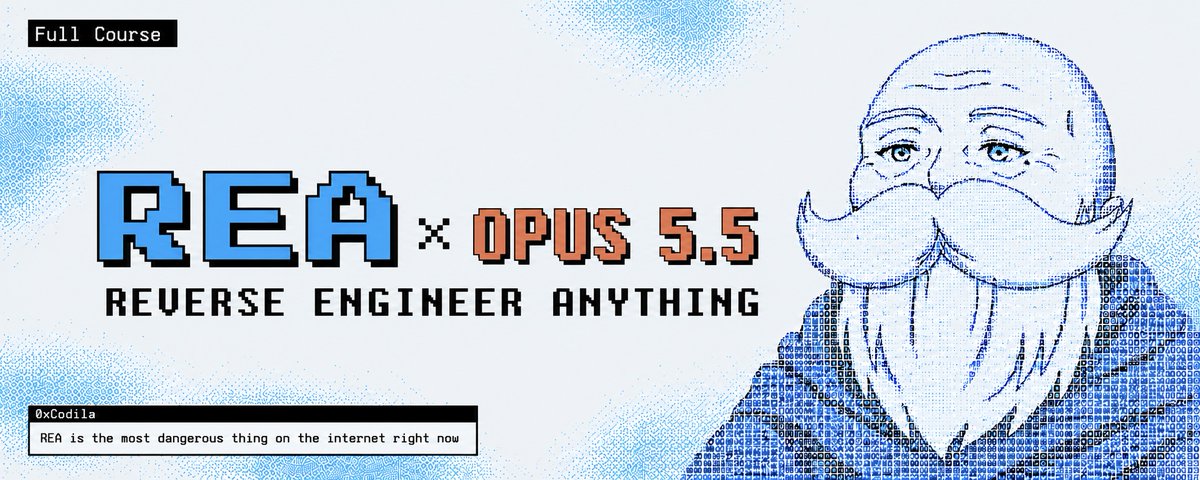
JusticeGate retweeted

REA creator just released prompts that turn any AI agent into reverse-engineering lab
absurdly f*cking dangerous...
One paste and your agents will:
• reverse engineer any paid app
• open Android, IPhone apps, Windows .exe and firmware
• take apart any app without its source code
• and that's just the start...
Send this to Claude Code & Codex & Cursor & Muse Code and thank me later. Before you run it, read the article below:


