


KA Science retweeted

Born #OnThisDay in 1871 was Ernest Rutherford PRS. He was the first to theorise the existence of the atomic nucleus, and worked on the first experiment to split the atom. In our collection we have his homemade potato masher, though this is not what he used to split the atom...


KA Science retweeted

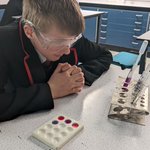
Emma M from the teachers group at #GPSSS22 took this photo. 🔬🧄
What phases of mitosis can you see?
Try yourself and with your students using our 'microscopy of root tip mitosis' protocol: saps.org.uk/teaching-resourc…
#GPSSS22 #plantsci #summerschool @GatsbyPlantScEd #microscopy

KA Science retweeted

A dividing cell photographed through a microscope. Actin and myosin II filaments are shown.
#Science #Biology #CellBiology #Art

KA Science retweeted

Neuron cell looking for connection:
#neuroscience
KA Science retweeted
Two brain cells in the cerebellum shown using dye injection:
#neuroscience by B. Barti

KA Science retweeted
Birth of a brain cell. Stem cell differentiating into a neuron:
#neuroscience
KA Science retweeted
Scientists may have found the first fossil remains of a dinosaur that died on the very day a huge asteroid collided with the Earth bbc.in/3jaxcnF

KA Science retweeted
Britain's butterflies are getting bigger due to climate change 🦋
New research using a computer system called Mothra has analysed 125,000 butterfly specimens and found that 24 species of British butterflies are steadily getting larger.
Read more 👇
nhm.ac.uk/discover/news/2022…
KA Science retweeted
Born #OnThisDay in 1827 was Joseph Lister, President of the Royal Society from 1895 to 1900, and pioneer of antiseptic surgery. His work provided the foundation for the basic principle that bacteria must not be allowed to enter wounds during surgery. #Medicine

KA Science retweeted
What is different about the coronavirus that causes #COVID19? How can we look to prevent future pandemics? Professor of Immunology Charles Bangham FRS explores in this clip:
KA Science retweeted
How your nose smells things. From odors to brain cells:
#neuroscience
KA Science retweeted
Neurons network with each other while a single brain cell stays alone:
#neuroscience
KA Science retweeted
Born this week in 1811 was a name familiar to most students, the chemist Robert Bunsen. Though known for his laboratory burner, he also discovered the elements caesium and rubidium with his colleague Gustav Kirchhoff, who he also worked with on breakthroughs in spectroscopy.


KA Science retweeted
Smallpox was one of the biggest killers in the history of humanity. This is the story of how we eradicated it, and what lessons this might hold for us now:
Video with @BBCIdeas
KA Science retweeted
Cell explodes after getting bitten by another single-celled organism:
#biology
KA Science retweeted
Born #OnThisDay in 1845 was Wilhelm Röntgen, the German physicist who first identified X-rays, for which he won the first Nobel Prize in Physics in1 901. The X-ray below shows the hand of Lord Kelvin, complete with signet ring, and was taken at the Royal Society in 1896. #Physics

KA Science retweeted
Two brain cells are sensing each other. And trying to connect:
#neuroscience by Lila Landowski
KA Science retweeted
Dinosaurs, dodos, woolly mammoths and Tasmanian tigers: Can we, and should we, bring them back? Catch up with last night's panel as they explore the question of de-extinction: #BritishScienceWeek youtube.com/watch?v=dV0GVgyG…
KA Science retweeted
Give this frog a wave! 🐸
This behaviour, foot flagging, allows some amphibians to signal to each other in noisy environments where their croaks can't be heard.
Discover how new Museum research reveals UV light's effect on frogs' view of the world. nhm.ac.uk/discover/news/2022…
KA Science retweeted
Peter Medawar FRS, the father of transplantation medicine, was born #OnThisDay in 1915. He was a biologist & writer whose work on graft rejection & the discovery of acquired immune tolerance was fundamental to the practice of tissue and organ transplants. bit.ly/2H5Hvr8
