





KFF retweeted

Will the midterm election outcomes reshape health policy or will executive power maintain the status quo?
On Nov. 2 at 3pm, @larry_levitt & @jeremyfaust will break down the polling, analyze the election stakes, & answer your Q's LIVE: ehgroup.zoom.us/webinar/regi… @KFFHealthNews @KFF

KFF retweeted

NEWS: One of Trump's key campaign-trail boasts is that he's cut drug prices. The GOP "should win just on this," he says.
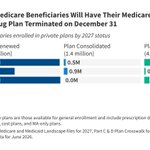
Yet @KFF found that premiums for Medicare stand-alone drug plans are set to jump 50 PERCENT next year, on average.
By @philgalewitz
kffhealthnews.org/medicare/m…

KFF retweeted

New: Medicare Part D Stand-Alone drug plan premiums will rise 50% if enrollees stay in their current plans and don't switch to lower premium coverage.

KFF retweeted
New work requirements in Medicaid go into effect in two months.

Judge strikes down Trump admin's definition of 'medically frail' in Medicaid work rules politi.co/4iMsHir
KFF retweeted
A drawn-out legislative debate over Medicare for All would mean furious lobbying by the health care industry and likely compromises. A Medicare for All system could end up looking more like Medicare today than the proposals introduced in Congress.
jamanetwork.com/journals/jam…

KFF retweeted
Advocates for a national health plan call it Medicare for All, drawing on the longstanding trust in the Medicare program. But, the most prominent Medicare for All plans envision coverage much more comprehensive and affordable for patients than Medicare today.
KFF retweeted

The media is much too focused on issue rankings in polls : economy, corruption etc. Partisan affiliation, the perceived qualities of candidates, the general mood of the country, attitudes towards Trump together can matter more.
KFF retweeted
Employers saw their healthcare premiums rise 5% this year — and some passed on that burden to workers — as the cost of family coverage in job-based insurance exceeds $28,000 for family plans.
kffhealthnews.org/insurance/…

KFF retweeted
Add a 9% increase in the worker share of premiums to Medicaid cuts and ACA marketplace premium hikes and you can understand why health costs are tied with gas prices as a cost of living concern for voters.
Our 28th employer health benefits survey is out: on.kff.org/ehbs2026

KFF retweeted

🚨 KFF’s 2026 Employer Health Benefits Survey is out.
Family premiums rose 5% to $28,303—but workers’ contributions jumped 9% to $7,471, an extra $621 a year.
Explore these findings, GLP-1 coverage, onsite clinics & more:
lnkd.in/eY26zXtk
KFF retweeted
Worker premiums for family health insurance are up 9%. The total average premium is $28,303. The average deductible is $1,955. It's no wonder people are worried about health care costs.

KFF retweeted
Changes to the ACA and Medicaid leading to millions losing coverage and increases in health care expenses legitimately occupy a lot of political focus. But, lack of affordability for the 157 million people with employer coverage should get more attention.
kff.org/private-insurance/wo…

KFF retweeted
We're in another campaign where voters may punish the party in power for disrupting the status quo in health care, this time for changes to Medicaid and the ACA.
It also happened in 2018 after Republicans tried to repeal the ACA, and in 2010 after Democrats passed the ACA.
KFF retweeted
These ACA premium increases will hit hardest for middle-income people who lost eligibility for premium subsidies entirely when enhanced ACA tax credits expired.
@pw_cunningham

Scoop: Healthcare.gov premiums for benchmark plans are set to rise 11% on average in 2027. It's the 2nd year in a row for double-digit spikes but not nearly as bad as last yr's 30%. Insurer participation is down 14%. washingtonsun.com/health/aca…
KFF retweeted

AI has enormous potential to improve health care, but we have to be intentional about how we use it so we don’t reinforce existing inequities.
I spoke with @KFF about both the opportunities and the risks. Watch our conversation here: on.kff.org/4yQQbJ0


AI can improve care, but only if health care leaders are intentional about how it’s used, says Dr. @uche_blackstock.
Listen to this episode for a discussion of the importance of responsible implementation, ongoing feedback, and making sure new technologies don’t reinforce existing inequities: on.kff.org/4yQQbJ0

ALT Podcast episode titled 'AI in Health Care: Who Gets Left Behind?' by KFF's The Business of Health with Chip Kahn, featuring Dr. Uché Blackstock. Quote says: “If we leaders within healthcare are thinking about how we use AI intentionally and responsibly, and we're getting ongoing feedback and including all the key stakeholders we need to like, that is something that can improve care. But I am very clear eyed about the potential harm that it can cause in terms of perpetuating inequities if we're not intentional about it.”
KFF retweeted

Individual market enrollment dropped by 18% or 4.6 million people between June 2025 and June 2026.
This coincides with Marketplace consumers facing higher premium payments due to the expiration of enhanced tax credits.
More from @KFF : kff.org/affordable-care-act/…

KFF retweeted
AI has the potential to improve health care, but patients need to have a seat at the table. I spoke with @KFF about why trust and patient involvement matter.
Watch our conversation!
As patients increasingly turn to AI tools and social media for health information, Dr. @uche_blackstock explains why involving patients in AI development and implementation is essential to building trust and creating tools that meet real needs.
Tune in to this week’s episode now: on.kff.org/4yQQbJ0
KFF retweeted
Can AI help close health care gaps? I share my thoughts with @KFF. Thanks for having me!
Can AI help close health care gaps?
Dr. @uche_blackstock says only if the people most affected by those gaps help design the tools.
Listen to hear more in this week’s episode: on.kff.org/4yQQbJ0
KFF retweeted
There’s still one insurance market where people with pre-existing conditions can be denied coverage: Medigap. 74% of Medicare Advantage enrollees have a pre-existing condition that could lead to a Medigap denial if they switch to traditional Medicare.

KFF retweeted
Recent polls, including from @KFF, show growing support for Medicare for All. This isn’t surprising, given worries about health care affordability and frustrations with insurers. But in a full-fledged national debate, arguments from critics — some true, some not — would resonate.