

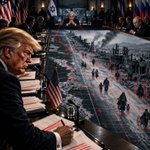

COP31: THE CLIMATE CHAMELEONS
Welcome to COP31. Where the arsonists lecture us on fire safety.
#COP31 #ClimateCrisis #PoliticalSatire #Greenwashing #ClimateHypocrisy #FossilFuels #EconomicDemocracy #PROUT
GHANA'S GOLD: WEALTH FOR WHOM?
Gold provides livelihoods. But a new study from Ghana's Savannah Region reveals serious soil contamination from mining.
Who benefits, and who pays the price?
#PROUT #Ghana #EconomicDemocracy
2
14
WHEN THE POWERFUL FIGHT, WHO PAYS?
No domination from abroad. No oppression at home. Human welfare must come before power.
#PROUT #EconomicDemocracy #MiddleEast #Iran #Peace
24

A New York Times article on the formation of Earth and Mars led me back to Baba’s Shabda Cayaniká.
The English translation seemed to contradict modern science. But the original Bengali revealed two crucial words that had been omitted.
Here’s what I discovered.
#PRSarkar
karmeshvar.substack.com/p/di…

16
The Children Who Say They’ve Been Here Before
An odd pattern in 1,678 reports of past lives, and an Indian philosopher who would probably have wondered what took everyone so long.
Imagine you’re making dinner when your three-year-old starts talking about the children they used to have.
You keep chopping. At this age, they also claim to be a horse.
But the conversation takes an uncomfortable turn. There was a house somewhere else. A husband. Someone they miss terribly. Your child seems upset that you don’t understand.
Then they tell you how they died.
There are plenty of sensible ways to respond to this. Children borrow things they’ve heard, misunderstand dreams and invent elaborate explanations for experiences they can’t yet put into words. Adults can make matters worse by asking leading questions. A family’s desire to believe can do a remarkable amount of work.
Still, some parents have gone looking for the people their children describe.
And sometimes they have found them.
The names, places and circumstances appear to belong to somebody who lived and died before the child was born. These are the cases that have kept researchers at the University of Virginia busy for decades, investigating a subject many academics would rather leave well alone.
Recently, three of those researchers decided to look at the dates.
Saeedeh Sadeghi, Marieta Pehlivanova and Philip Cozzolino examined 1,678 cases in which investigators had identified a deceased person whose life appeared to match the reported memories. They wanted to know whether the circumstances of that person’s death had any relationship to the interval before the child’s birth. Their 2026 study found an association: the more unexpected the death, the shorter that interval tended to be.
At one end, where death had been most anticipated, the median was roughly 21 months. At the other, where it had been least expected, it was about 12.
Nine months’ difference between two dates in apparently separate biographies.
The relationship survived the researchers’ attempts to account for several possible sources of bias. It was also stronger among families whose religions did not support reincarnation. The researchers themselves stopped short of concluding that rebirth was real. UVA’s account of the findings leaves the mechanism unresolved.
That last point matters. A pattern in a collection of unusual reports can have explanations that nobody has identified yet. The way cases are found, remembered and selected could influence the result.
Nevertheless, it is an oddly specific thing to turn up.
If these accounts are entirely the work of imagination, coincidence and human suggestion, why should the suddenness of somebody’s death have anything to do with the timing of a particular child’s birth?
P. R. Sarkar would have had plenty to say about that.
The Indian philosopher and spiritual teacher, known to his followers as Shrii Shrii Ánandamúrti, or Baba, had a formidable appetite for explaining things. His interests ran through meditation, economics, language, psychology and the workings of the universe. He was quite prepared to discuss subjects that most people keep in separate rooms.
Reincarnation, in his understanding, belonged among the ordinary processes of nature. Our difficulty in accepting it came partly from a mistaken idea about where the mind begins and ends.
In Cerebral and Extra-Cerebral Memory, he put it bluntly:
“The brain is nothing more than a worldly machine for mental recollection.”
That is a substantial demotion for an organ accustomed to getting credit for the whole of human existence.
Sarkar’s account gave the brain an essential role in the expression of the mind, while allowing the mind a life beyond that particular piece of equipment. Memories and impressions could exist at levels deeper than those available to everyday awareness.
The familiar radio analogy gives a rough sense of the proposal. Break the receiver and the room goes quiet. The silence tells you something has happened to the radio; it doesn’t tell you whether the broadcast has ended. As an illustration, it is useful. Establishing that a human mind actually works this way would be another matter.
In Sarkar’s philosophy, our actions leave consequences within us. He called their latent reactive potential saḿskáras. These help shape what we seek, how we respond and the experiences towards which we are drawn. Physical death, he taught, does not automatically exhaust them.
Something remains to find expression.
There is an everyday familiarity to that idea, even before reincarnation enters the picture. We carry unfinished conversations around for years. An old humiliation can still make us wince in the shower. We leave a relationship and discover, much later, how much of it came with us.
Sarkar extended this persistence beyond the body’s death. The mind, carrying its unresolved potential, could become associated with a new physical form.
We would arrive with a history, although usually without the means to read it.
This raises an obvious difficulty. If we have been here before, our powers of recollection are disappointingly poor.
Sarkar’s explanation centred on early childhood. A young child is only beginning to accumulate the experiences of the present life. Its demands have yet to occupy every corner of the mind. Under certain conditions, he suggested, impressions from an earlier existence can still reach awareness.
Then the new life takes over.
There is a language to learn, a family to understand, a whole world insisting on being noticed. Eventually there is school, friendship, embarrassment, the urgent business of belonging. Earlier impressions lose their hold.
That would account for a poignant feature of many reported cases: children who once spoke insistently about another life often grow less interested in it. The memories fade. Parents may still be wrestling with what happened long after the child has moved on.
For the adults, it remains the strangest thing they have ever heard.
For the child, there may now be a bicycle.
Sarkar used the term játismara for someone who remembers a previous birth. He also described conditions in which those memories might remain especially clear. In a 1978 discourse on extra-cerebral memory, he included people who had died in accidents.
Here the old teaching and the new research come close enough to make you pause.
They concern different things. Sarkar was discussing the persistence and clarity of memories; the UVA researchers were measuring the interval between a death and a later birth. Treating the study as confirmation of his explanation would stretch it considerably.
Yet both give sudden death a particular significance.
An anticipated death may allow time for a person to withdraw from the business of living. There can be farewells, arrangements, some recognition of what is happening. Even then, leaving is rarely simple.
An accident allows none of that.
A person goes out expecting to come home. There is food in the fridge, a message waiting for an answer, somebody they intend to call. In their own mind, life is still going somewhere.
We know how hard it can be to settle after a conversation ends badly. The mind goes on having it, supplying the answer that arrived too late. An abruptly interrupted life is that idea on an almost unbearable scale.
Within Sarkar’s account, those attachments and unexpressed impulses could outlast the body that had been giving them expression. It is possible to imagine them playing a part in a subsequent birth, or in the strength of what a child later appears to remember.
That is speculation. It is also a more compelling way into the subject than the usual vague assurance that everything happens for a reason. It suggests a process with its own conditions, one that might leave recognisable traces.
There is a further story about Sarkar that his followers have passed on. According to an oral recollection, he once told a small group that they need not spend too much effort convincing the world about reincarnation. Science would eventually establish it.
The exchange survives as a recollection rather than a documented passage from his published discourses, so the wording cannot be pinned down.
Even allowing for that, the confidence is striking.
He apparently felt no urgency to win the argument. Researchers could take their time. If rebirth was a natural phenomenon, careful investigation would eventually encounter it.
Of course, confidence has never been in short supply among spiritual teachers. What makes this particular claim worth considering is the possibility of putting some part of it within reach of investigation. Names can be checked. Dates can be compared. Statements recorded before two families meet can be distinguished from stories assembled afterwards.
Whatever the final explanation, there is work to do.
And the possibility itself has consequences that reach further than the pleasure of a good mystery.
Reincarnation is usually offered as a comfort: you get another chance; the people you love may not be lost forever. Anyone who has stood beside a hospital bed can understand the appeal.
But there is something unsettling in it too.
Suppose we carry the effects of our lives with us. Suppose the habits we cultivate and the harm we leave unresolved do not become irrelevant when the body stops. Then another life would come with responsibilities we might much prefer to forget.
Sarkar’s philosophy gave this long process a direction. Through successive experiences, the mind develops towards the realisation of its unity with Supreme Consciousness, Parama Puruśa. Repeated birth has a purpose, and ultimately an end.
This also helps explain his lack of enthusiasm for people becoming absorbed in their previous identities.
The prospect is irresistible, admittedly. Most of us would like a look at the records. There might be a fascinating explanation for an unreasonable fear, a peculiar talent or the feeling of recognising someone we have just met.
Or we might discover we spent three previous lives as farmers, complaining about the weather in every single one.
Either way, knowing who we once were would say little about what we should do this afternoon. A previous identity could become another possession to be proud of, another excuse, another way of avoiding the difficult business of changing.
Sarkar’s emphasis was on the life being lived now: spiritual practice, a broader sympathy for others, some effort to become less confined by oneself.
There is good sense in that, whatever happens after death. We already have enough trouble putting the lessons of this life to use.
Still, the children are hard to forget.
The compelling part is their apparent lack of interest in making a philosophical case. In these reports, a child may miss a particular person, insist on another name or become distressed by something the adults around them cannot explain. The grand implications belong mostly to everyone else.
We would like to know what the stories mean. We would like an answer large enough to settle our own fears.
The child may simply want to go home.
For now, there are records to examine, explanations to challenge and a curious relationship between two dates. Sarkar’s account offers one way of understanding what might lie behind them. Further research may lead somewhere quite different.
I keep coming back to that imagined conversation over dinner. The ordinary room, the parent with something on the stove, the sudden mention of a life nobody knew to ask about.
Before explaining it away, I’d want to hear the rest.
#Reincarnation #Consciousness #PastLives

225
The Unthinkable Is Becoming Military Policy
Human control over killing should be the absolute minimum. Instead, some of the world’s most powerful states are fighting to keep that boundary vague.
There are moments when technological “progress” stops looking like progress at all.
On 25 August, UN Secretary-General António Guterres and Red Cross President Mirjana Spoljaric issued an extraordinary warning:
“We are now dangerously close to crossing a moral red line: the autonomous targeting of humans by machines.”
They called for legally binding international rules to ensure that decisions over life and death remain under meaningful human control.
Then came the negotiations in Geneva.
Reuters reported on 4 September that the United States and Russia were among the principal countries resisting stronger international restrictions on lethal autonomous weapons. Most participating states supported moving towards stronger regulation, while the US argued that existing international humanitarian law was sufficient and favoured non-binding guidelines. Russia also opposed a binding approach. One of the central disputes concerned human judgement and control over the use of these weapons.
Now the Washington Post reports what happened behind those doors.
According to documents and three people familiar with the negotiations, US and Russian negotiators succeeded in removing language requiring AI weapons to operate predictably and reliably. Language requiring ethical considerations was removed. Most disturbing of all, a provision requiring humans to review military targets developed by AI before a strike was also removed.
And this is not some distant science-fiction scenario.
Israel has already shown us what large-scale AI-assisted warfare can look like.
The Washington Post documented how the Israeli military built what insiders described as an “AI factory” for war. Systems including Gospel and Lavender were used to generate or identify potential targets in Gaza at extraordinary speed. The Post reported serious internal concerns about whether recommendations were receiving sufficient human scrutiny, and described cases in which normal verification requirements were reduced or, according to one soldier, sometimes bypassed. The IDF has defended its targeting processes and maintained that its use of intelligence and AI complies with international law.
Put these developments together and the danger becomes very concrete.
This is not primarily a story about some future superintelligence suddenly deciding to exterminate humanity.
The machines do not need to hate us.
Human beings can build the systems, feed them surveillance data, generate thousands of targets, accelerate the machinery of war and then deliberately weaken the rules requiring another human being to stop and ask:
Who is this person?
Is the information correct?
Who else will die?
Should we do this at all?
That is what horrifies me.
Artificial intelligence could be one of the most powerful tools humanity has ever created for science, medicine, education, agriculture and the reduction of unnecessary human labour.
And at precisely the same moment, governments and militaries are exploring how to use the same extraordinary technological power to make warfare faster and increasingly automated.
We should be very careful about where we locate the danger.
The horror is not that the machine may one day become inhuman.
The horror is how easily human beings can become inhuman while using the machine.
UN/ICRC statement on autonomous weapons
news.un.org/en/story/2026/08…
Reuters, 4 September 2026
reuters.com/world/opposition…
Washington Post, 26 September 2026
washingtonpost.com/technolog…
#AI #AutonomousWeapons #MilitaryAI #KillerRobots #HumanRights #InternationalLaw #Gaza #Israel #Russia #AIWeapons

64
The One Who Was Never Far
Perhaps the One we seek has always been nearer than our own heart.
youtu.be/A6FyzFgooF4
#MysticalMusic #PRSarkar
31
What if Scandinavia was never really outside the Roman world?
This article explores Dagfinn Skre’s striking reconstruction of Scandinavia between AD 180 and 550, from Roman military connections and Uppåkra to lordships, trade and the emergence of kingship

1,400
The Number I Had Never Been Told About Australia
An estimated 2.22 million Indigenous people in 1788. Fewer than 200,000 by 1861. In just three generations.
I knew that Australia’s Indigenous peoples had suffered terribly under British colonisation. What I had not understood was how many people may have been living there before the invasion, or how much the population had fallen within just a few generations.
A study published on 15 September 2026 in Nature Human Behaviour puts the Indigenous population in 1788 at an estimated 2.22 million. The estimate for 1861 is between 177,000 and 193,000, less than a tenth of that number. The researchers calculate about 2.06 million excess deaths over those 73 years. These are modelled estimates, with considerable uncertainty, but the scale is overwhelming. Population study.
It is difficult to comprehend what such losses meant for the people who survived. Families lost the adults who supported them. Communities lost elders before they could pass on their knowledge. Dispossession prevented people from obtaining food and caring for the places they depended on. Beyond the deaths themselves, survivors had to cope with the damage to almost every part of their lives.
The figure commonly repeated for much of the twentieth century was 250,000 to 300,000. It came largely from an estimate published by the anthropologist A. R. Radcliffe-Brown in 1930, more than 140 years after British colonisation began. Much of the information available to him described communities already devastated by disease, violence and dispossession. He recognised that his estimate was probably too low.
Higher estimates have been available for decades. Noel Butlin proposed about 900,000 in 1983, later revising that to between 1.1 and 1.3 million. John Mulvaney and Peter White suggested 750,000 in 1987. The new figure is therefore much higher than the old, commonly repeated estimate, rather than seven times every previous scholarly estimate. Earlier estimates.
I think the low estimate helped people accept a misleading account of colonisation. If Australia is imagined as a huge country with very few inhabitants, it becomes easier to overlook how much was taken from them. The language of “settlement” encourages that impression, particularly when the people losing their land receive so little attention.
The British were occupying land that already belonged to other peoples, with their own laws, languages and ways of living. That would have been true whatever their numbers. The larger estimate helps us understand how many lives were affected, but Indigenous rights never depended on there being enough people to satisfy a European idea of how land should be occupied.
The researchers used archaeological evidence, including more than 5,000 radiocarbon dates, genetic data and estimates of how many people different environments could support. These approaches have different assumptions and limitations. Their central estimate is 2.22 million, with a likely range of roughly one to four million. Further research may revise it. We should be careful about presenting the central figure as an exact count, while taking seriously the evidence that earlier estimates were much too low. The researchers’ explanation.
“Excess deaths” also needs explaining. It means deaths beyond those expected in an otherwise stable population. The researchers cannot reliably separate the contributions of introduced disease, direct killing and the consequences of dispossession. Their figure of 2.06 million should not be described as a count of people murdered.
That distinction does not make hunger or death from disease unrelated to colonial policy. People deprived of reliable food and water were more vulnerable to illness. Families who lost those able to provide for them had fewer means of surviving. The consequences of killing, expulsion and infection overlapped.
A related study published in July examined the 1789 smallpox epidemic. Its modelling favoured an introduction through the British colony in the south-east over the theory that the disease had spread from Makassan contact in the north. It did not support the idea that this single epidemic affected the whole continent. Assuming a fatality rate of 60 per cent, the model estimated about 220,000 deaths in affected south-eastern regions. That figure, too, depends on the model’s assumptions. Smallpox study.
The population research also estimates that non-Indigenous people first became the majority around 1847. At roughly the same time, Australia’s total population was about 1.07 million, possibly its lowest in more than 50,000 years. Immigration was increasing the settler population while the Indigenous population was collapsing. Population study, extended data.
It is worth remembering this when Indigenous Australians are discussed simply as one of the country’s minorities. Their minority status resulted from the deaths and dispossession of their own people, alongside the arrival of settlers. They were subsequently expected to accept the authority of a society established on their land.
Under the legal approach associated with terra nullius, British authorities did not recognise Indigenous ownership as something the Crown was obliged to respect. They knew people lived there; they denied the legal standing of those people’s claims to their own country. The High Court rejected that approach in the Mabo decision of 1992 and recognised native title. It took more than two centuries after the First Fleet for that recognition. Mabo decision.
What concerns me about modern Australia is the continued assumption, among some white Australians, that their ownership is beyond question and that Indigenous rights are concessions for the majority to grant. People whose families have belonged to a place for thousands of years can still be treated as unreasonable for wanting authority over what happens there.
Many white Australians reject that attitude and have supported Indigenous struggles for recognition and justice. The 2024 Australian Reconciliation Barometer found that 85 per cent of Australians surveyed considered the relationship between Indigenous and non-Indigenous Australians important. Yet 54 per cent of Indigenous respondents reported racial discrimination in the previous six months. Support for reconciliation clearly does not mean that racism has ceased to be part of everyday life. Australian Reconciliation Barometer.
I do not think people should be made to feel personally guilty for an invasion that happened before they were born. But we do inherit the consequences of history. Land ownership, wealth and political authority do not start afresh with each generation. People living today have a responsibility for what they support now, including whether they dismiss claims arising from injustices that still affect other people.
This was also why Australia’s treatment of refugees came to mind when I read about the study. The histories are different, and Indigenous suffering deserves attention in its own right. Even so, I find it troubling when people in a settler society speak as though their right to belong is self-evident while vulnerable newcomers are treated as intruders. Knowing how the country was taken ought to encourage greater humility and more concern for the people seeking safety there.
The effects of forced child removal are still being documented. An Australian Institute of Health and Welfare report updated in September 2026 gives a survey-based estimate of about 200,000 Indigenous adults with a parent, grandparent, great-grandparent, aunt or uncle who was removed from family. It also cites the Healing Foundation’s finding that only six per cent of the recommendations of the 1997 Bringing Them Home report had been implemented. Survivors and their families are still waiting for measures recommended almost thirty years ago. AIHW report.
In 2025, Victoria’s Yoorrook Justice Commission concluded that the treatment of First Peoples in the state constituted genocide. Its findings concerned mass killings, disease, sexual violence, cultural destruction and the removal of children. The Commission made 100 recommendations for reform and redress. Australia’s first formal truth-telling inquiry was examining these injustices nearly two hundred years after colonisation began in Victoria. Yoorrook reports.
Apologies and acknowledgements matter, but they do not provide the land, funding or decision-making authority that communities need. Indigenous people should have the means to care for Country, teach their languages and determine how their communities develop. They should be able to influence the institutions responsible for their children, health and livelihoods without constantly having to persuade outsiders that they know something about their own needs.
Aboriginal and Torres Strait Islander peoples have continued their cultures, defended their land and brought much of this history to public attention despite everything done to them. Much of what the rest of us are now learning is known because they and their families refused to let it be forgotten.
I would like this history to be much more widely understood outside Australia as well. I knew there had been terrible injustice, but I had not understood its extent. People should know what happened before dismissing Indigenous demands as excessive, or asking why communities cannot simply put the past behind them.
#IndigenousAustralia #AboriginalHistory #TruthTelling

1
170
What Democracy Is For
A response to International IDEA’s Global State of Democracy 2026: Democracy in an Age of Conflict
International IDEA’s Global State of Democracy 2026: Democracy in an Age of Conflict examines a disturbing conjunction: democratic institutions are weakening in many countries at the same time as violent conflict is becoming more common.
In a functioning democracy, losing political power must not mean losing your place in society.
A person can lose an election and still have a future in the country. An organisation can fail in its political aims and continue to organise, criticise the government and argue for another course. A proposal can be defeated in parliament without those who supported it losing the right to say that the decision was wrong.
Political defeat must not become the destruction of a person’s future.
That may sound obvious in a stable democracy. But much of the IDEA report is about what happens when it stops being obvious, when courts, rights, political competition or the ability to organise can no longer be relied upon after power changes hands.
An independent court matters when somebody needs protection from an arbitrary decision. Freedom of expression matters when those in power would prefer a problem to remain unspoken. The right to organise matters because people acting together can challenge conditions they could never change alone.
International IDEA uses a much broader understanding of democracy than elections alone. Its framework covers representation, rights, the rule of law and participation. Elections sit alongside effective parliaments, independent courts, access to justice, a free press and room for civil society to operate.
The figures show more stagnation than collapse, alongside significant declines in a substantial number of countries. Between 2020 and 2025, 81 per cent of the country-level measures showed no statistically significant change. Yet 98 countries, 57 per cent of those assessed, deteriorated significantly in at least one democratic factor, while 55, 32 per cent, improved in at least one. IDEA excludes Basic Welfare from this comparison because much of the apparent improvement reflected recovery in life expectancy after the Covid-19 pandemic.
Freedom of expression and freedom of the press were among the areas with the widest deterioration.
So the picture is not one of democracy disappearing everywhere. Much of the world is stagnating, often at levels that are already unsatisfactory, while important democratic protections are weakening.
There is another reason to pay attention. Uppsala Conflict Data Program figures cited by IDEA record 65 state-based conflicts in 2025, almost twice the number in 2010 and the highest total in a single year since the series began in 1946. That is not a small fluctuation. There were more state-based conflicts in 2025 than in any other year covered by the post-war data.
This is the background to IDEA’s examination of the connection between democracy and conflict. But should human beings have to demonstrate that freedom prevents war before they are entitled to freedom? The ability to speak without intimidation, seek justice and live without arbitrary persecution is already part of a decent society.
When political defeat becomes dangerous
In a functioning democracy, losing an election does not normally mean losing your ability to influence what happens next. There will be another election. A court may overturn an unlawful decision. Organisations can continue campaigning. Newspapers can investigate the government. People can persuade others and attempt to build a majority for another course.
Looking at the world today, it is not difficult to find systems in which losing may bring imprisonment, dispossession, suppression of an organisation or permanent exclusion from political life. A community may reasonably fear that the rights which allowed it to participate will disappear once its opponents take power.
That is not just a harsher kind of defeat. It changes what is at stake. If losing means prison, exile, loss of livelihood or the destruction of your organisation, then accepting the result may also mean accepting that there is no peaceful way back. In that situation, it is not difficult to understand why some people stop believing that ordinary politics can protect them.
When political losses can be reversed through credible procedures, opponents have reasons to remain within those procedures. Elections provide another opportunity to win support. Courts and enforceable rights make it possible to challenge an injustice without first having to remove the government.
But institutions cannot provide that security simply by existing on paper. People must believe they will still work when the dispute becomes serious.
There is a simple test here for anyone who says they believe in democracy. It is easy to defend judicial independence when a court rules against our opponents, or press freedom when journalists expose people we dislike. The real test comes when the judgement goes against us.
The point is that these protections have to apply even when they are inconvenient.
International IDEA also gives considerable attention to countries between established democracy and established autocracy. These hybrid systems may permit elections while offering little genuine competition or weak protection for those who lose. The report argues that such conditions are associated with greater conflict risk.
One explanation is that an authoritarian state can suppress organised opposition, often brutally, while a functioning democracy offers alternative ways of pursuing grievances. A weak system between the two may permit mobilisation while lacking institutions capable of settling the disputes that follow.
But this is not a universal formula. “Hybrid regime” can cover very different situations: weak public institutions, difficult political transitions, excluded communities, contested sovereignty or divided control over armed forces.
State capacity therefore matters as well. Courts must be able to enforce their decisions. Public institutions have to function throughout the territory. A constitution cannot do much to protect people if armed groups control parts of the country and the government cannot enforce its decisions there.
Myanmar and Sudan show what this can look like in practice. Myanmar’s 2021 coup occurred in a country where the military had never been fully brought under civilian authority and where longstanding armed conflicts already existed. Sudan’s civilian transition similarly took place alongside rival armed organisations with enormous independent power.
In both countries, democracy broke down, but that does not by itself explain the violence.
Nor does this mean that we should simply prefer a stronger state. A state strong enough to impose its will but too unaccountable to be challenged presents another danger. Public institutions need enough capacity to govern while remaining under effective public control.
The majority must be able to govern, but the minority must remain part of society, with rights and a future.
According to the report, established democracies very rarely fight serious wars against one another.
That does not mean democratic countries are peaceful by nature. Democracies have fought many wars against non-democratic states and have repeatedly intervened militarily abroad. IDEA itself stresses this limitation. The democratic-peace finding applies to pairs of democratic countries, not to the behaviour of democracies in general.
The explanation is still disputed, but the relationship itself is remarkably strong. And IDEA’s next finding is difficult to dismiss: in 2015, 42.6 per cent of relationships between states were between two countries that met at least a minimal democratic threshold. By 2025 that had fallen to 34.4 per cent. That is a substantial change in only ten years. A significant part of the international system has moved out of the category in which serious war has historically been exceptionally rare.
How far does the evidence take us?
One thing I appreciate about the IDEA report is that much of its academic discussion is careful.
It explicitly says that the simultaneous rise in conflict and democratic decline does not prove that one caused the other. Many recent conflicts multiplied in countries and regions already affected by violence.
The policy recommendations sometimes go further.
Suppose a study finds an association between a particular institution and a particular kind of violence. Later that becomes evidence that the institution prevents conflict, and then a recommendation to fund that institution as a means of preventing war.
Perhaps the recommendation is sound. But something has changed at each step.
Was causation actually demonstrated? Did the study concern interstate war, civil conflict or something narrower? Does the policy recommendation contain an additional judgement that the original study never tested? And even if funding is justified in general, does the research tell us which countries, organisations or programmes should receive it, and under what conditions it is likely to work?
There need be no dishonesty in this. Governments cannot wait for complete certainty before acting. But public money can still be spent in places where it achieves very little.
Citizens should be able to see where evidence ends and judgement begins.
Good intentions do not remove the need for evidence.
Civil society provides one example. IDEA places considerable weight on research about social accountability and argues in its recommendations that active civil society reduces conflict risk and contributes to positive peace.
There is real research behind this, but some of the evidence concerns serious disputes between countries. It is understandable that IDEA applies the finding more broadly, but the original study does not establish the same relationship for every form of political violence.
Civil society is also not uniformly beneficial. Organisations can expose corruption, bring communities together and provide peaceful ways of acting collectively. They can also mobilise people against those of a different religion, ethnicity or nationality.
What people organise for matters.
Democracy assistance raises a similar issue. There is credible evidence that such assistance can modestly improve democratic institutions and practices. IDEA then argues that democracy support should be treated as part of national-security strategy, partly because prevention is cheaper than military action after conflict begins.
There is a plausible case for that policy. But evidence that democracy aid improves some democratic outcomes, together with evidence that preventing wars saves money, does not tell us how many wars democracy assistance actually prevents.
That does not make the recommendation wrong. It means part of the argument remains an inference.
If the research is uncertain, the policy argument should say so.
Why the United States matters beyond the United States
International IDEA gives considerable attention to the United States.
It identifies seven significant declines across factors and subfactors between 2020 and 2025, involving access to justice, economic equality, parliamentary effectiveness, freedom of expression, freedom of the press, freedom for political parties and judicial independence. Several of these trends began before the present administration.
The report’s comparable index data run through 2025. Its discussion of events during 2026 is more qualitative. Both matter, but they are different kinds of evidence.
Democratic deterioration in any country is first a problem for the people living there. But the United States possesses exceptional military, economic and diplomatic power. Decisions made there affect wars, alliances, development assistance, international institutions and international law.
Millions of people affected by those decisions have no vote in American elections.
Their lives are not less important for that reason.
This is why the condition of American democracy is legitimately a matter of concern far beyond the United States.
A question the report leaves me with
One of the strengths of the IDEA report is that it takes democracy well beyond the ballot box.
But that leaves me with a further question.
If democracy is concerned with how power is distributed and constrained, what should we make of economic power?
We pay close attention to who sits in parliament, whether judges are independent and whether elections are fair. We ask much less often who controls investment, credit, workplaces, land, large corporations or media organisations.
International IDEA includes economic equality in its framework, which is important. But income inequality, wealth inequality and inequality of economic decision-making power are not the same thing.
A society can redistribute income while control of investment and workplaces remains highly concentrated.
Research from the United States has found substantially stronger relationships between policy outcomes and the preferences of affluent citizens and organised business interests than between policy and the preferences of average citizens. This does not mean political inequality simply rises with income inequality. Institutions affect how easily economic resources become political power.
This is no longer only an abstract question about the relationship between wealth and influence. Billionaires can now combine enormous financial resources with ownership of newspapers, social-media platforms and other forms of communication, while also funding political campaigns and gaining direct access to governments. Elon Musk’s interventions in European politics are one obvious example, but he is hardly alone. Jeff Bezos owns the Washington Post, Mark Zuckerberg controls Meta’s global platforms, and billionaire money has become increasingly important in American elections. These people do not all support the same politics, and wealth does not guarantee that they get what they want. But their ability to influence political debate, political organisations and sometimes the conditions under which public debate takes place is on a completely different scale from that of an ordinary citizen. Reuters documented Musk’s direct support for Germany’s AfD during the 2025 election campaign and Bezos’s ownership role at the Washington Post, while the Brennan Center has documented the growing role of megadonors and record levels of outside political spending in the 2024 US election.
A democracy should at least ask what that does to the idea of equal political influence.
So who decides where investment goes? Who makes the important decisions in a workplace? What influence do the people affected have?
These are democratic questions too.
The research on economic democracy remains limited. Union membership is associated with greater political participation, and some studies link stronger workplace representation with more equal political responsiveness and greater political engagement. But this does not establish that cooperatives, unions or workplace democracy prevent democratic collapse or war.
A preference for a particular economic arrangement does not justify claiming more for it than the evidence supports.
At the same time, the moral case for giving people meaningful influence over their working lives does not have to wait for proof that it prevents war.
People spend a large part of their lives working under arrangements that affect their security and opportunities. Whether they have a meaningful voice in those arrangements is itself a question of dignity and power.
What democracy is for
Reading the IDEA report ultimately brings me back to what democracy is for. For all its weaknesses, I think democracy is the best political arrangement humanity has developed so far. The question is not whether we should abandon it, but how much further we can take the democratic principle.
People will disagree about laws, resources, beliefs and the direction of society. No political arrangement can ensure that everyone gets what they want. What democracy can do is make disagreement less dangerous.
It allows people to lose an election without losing their place in society. It protects unpopular opinions. It gives people peaceful ways to challenge decisions and makes public power answerable to those who live under it.
Political democracy gives people a voice over public power. Economic democracy asks whether people should also have a meaningful voice over economic powers that shape so much of their lives.
I see that as an extension of democracy, not an alternative to it. We already accept that political power should not simply be concentrated in a few hands without accountability. It seems reasonable to ask the same question about economic power, particularly when wealth, ownership and control can also become political influence.
None of this guarantees a good society. Institutions can fail. Majorities can behave badly. Civil society can become exclusionary. Economic democracy can be badly designed. Democratic governments can wage unjust wars.
But some things should not depend on who happens to win.
The opportunity to learn, to work, to seek justice and to live without persecution cannot be distributed as the reward of political victory.
A child’s need for food does not begin when the parents’ party wins an election, and it does not disappear when that party loses.
People should be free to disagree about how society can best provide these things. They should be able to criticise one another’s proposals, expose failures and try something different.
But nobody’s claim to a dignified existence should depend upon winning that argument.
The ballot box can help decide who will govern for a time.
It cannot decide whose humanity is to be respected.
References
International IDEA. 2026. The Global State of Democracy 2026: Democracy in an Age of Conflict. Stockholm: International Institute for Democracy and Electoral Assistance.
Davies, Shawn, Therése Pettersson and Magnus Öberg. 2026. “Organized Violence 1989–2025, and Violent Political Protests.” Journal of Peace Research, 63(4).
Gleditsch, Nils Petter and Håvard Hegre. 1997. “Peace and Democracy: Three Levels of Analysis.” Journal of Conflict Resolution, 41(2), 283–310.
Altman, David, Federico Rojas-de-Galarreta and Francisco Urdinez. 2021. “An Interactive Model of Democratic Peace.” Journal of Peace Research, 58(3), 384–398.
Gleditsch, Nils Petter, Håvard Hegre and Håvard Strand. 2009. “Democracy and Civil War.” In Manus I. Midlarsky (ed.), Handbook of War Studies III, pp. 155–192. Ann Arbor: University of Michigan Press.
Hegre, Håvard, Michael Bernhard and Jan Teorell. 2020. “Civil Society and the Democratic Peace.” Journal of Conflict Resolution, 64(1), 32–62.
Gisselquist, Rachel M., Miguel Niño-Zarazúa and Melissa Samarin. 2021. Does Aid Support Democracy? A Systematic Review of the Literature. WIDER Working Paper 2021/14. Helsinki: UNU-WIDER.
Gafuri, Adea. 2022. “Can Democracy Aid Improve Democracy? The European Union’s Democracy Assistance 2002–2018.” Democratization, 29(5), 777–797.
Gilens, Martin and Benjamin I. Page. 2014. “Testing Theories of American Politics: Elites, Interest Groups, and Average Citizens.” Perspectives on Politics, 12(3), 564–581.
Jirjahn, Uwe and Thi Xuan Thu Le. 2024. “Works Councils and Workers’ Party Preferences in Germany.” British Journal of Industrial Relations, 62(4), 849–877.
Marsh, Sarah and Thomas Escritt. 9 January 2025. “Musk Hosts German Far-Right Leader on X, Stirs Angst About Election Meddling.” Reuters.
Reuters. 28 October 2024. “Washington Post’s Bezos Defends Decision to End Presidential Endorsements.”
Pino, Marina and Julia Fishman. 2025. “Fifteen Years Later, Citizens United Defined the 2024 Election.” Brennan Center for Justice.
#Democracy #EconomicDemocracy

693
The Ancient Prophecy That, Remarkably, Turned Out to Be About Us
A short history of the Rainbow Warriors, with catering
Somewhere in a field in Oregon, a man called Dave is explaining to a woman he met forty minutes ago that the Hopi foresaw him.
Not people like him. Him. Dave. Formerly of a call centre in Swindon, currently of a yurt.
He does not say it boastfully. He says it the way you might mention a hip operation. The elders saw it coming, centuries back, and there is nothing anyone can do about it now.
You have to admire the efficiency. The usual route to spiritual maturity is long and badly signposted. It runs through owning up to things, keeping your temper when the printer jams, ringing your mother, and doing the washing up on nights when it is plainly somebody else’s turn. Decades of that, and you might end up moderately decent.
Or you could find out that you are a Rainbow Warrior. Same afternoon. No dishes.
A small historical inconvenience
Indigenous traditions are one thing. A composite spiritual parable published in California and later handed back to Indigenous people as something their ancestors had apparently forgotten is another.
The modern trail leads to a 1962 book, Warriors of the Rainbow, by William Willoya and Vinson Brown. Both authors were Bahá’ís. Willoya was an Indigenous Alaskan who had also been involved in teaching the Bahá’í Faith among Hopi communities, so this is not the neat story of two complete outsiders manufacturing an Indigenous legend from scratch. It is stranger than that, and rather less convenient.
The authors gathered stories and prophetic material from different peoples and read them as parts of one grand religious announcement. In their opening story, the wise Indigenous grandmother was deliberately given no tribe, so that she could stand equally for every tribe. They rounded the book off with a chapter called “The Task of the Warriors of the Rainbow”, which readers of a certain temperament tended to take personally.
Ancient oral tradition had discovered central distribution.
Then the story escaped from the book and improved its ancestry.
In September 1970, Barry Adams, one of the founders of the Rainbow Family, heard that Hopi prophecy expected the Rainbow people to arrive bearing a sacred stone tablet, a red blanket and a hat. He therefore went to the Hopi reservation carrying a stone tablet, a blanket and a hat, and told Thomas Banyacya that, as far as he knew, he was one of the beings they had been waiting for.
This is one of those moments when satire has to put down its tools and take notes.
Banyacya did not specifically remember Adams. A great many white people in red shirts had come knocking at his door, he explained, claiming to be the prophetic white brother. Spiritual office hours had become difficult.
Some decades later, the researcher Michael Niman, who spent years living with and studying the Rainbow Family, asked Banyacya about the supposed Hopi prophecy.
Banyacya had a fairly good idea where the Rainbow Warrior concept had come from. What he did not recognise was the part where it had become Hopi.
“It’s not right,” he said. “We hope they will stop it.”
Niman put it more neatly. The Rainbows, he concluded, had “written themselves into Hopi prophecies”.
Which is an extraordinary thing to do to somebody else’s grandmother.
The Emergency Council on Ancient Authenticity
Minutes of the meeting, reconstructed from a napkin.
Dave was present.
The Acting Chair of Prophetic Affairs arrived with a folder of photocopies and the face of a man whose car has just been clamped.
“We have a situation.”
Nobody moved. Somebody’s kombucha fizzed.
“The Hopi,” he said, “do not have our Hopi prophecy.”
A long pause, during which a wind chime did something unhelpful.
A hand went up at the back.
“Cree?”
Three phones came out. Thumbs moved.
“No.”
“Navajo?”
“No.”
“Ojibwe?”
“There’s a man on a forum who says his cousin’s neighbour thinks possibly.”
“We’ll take it.”
Relief went round the circle like a warm drink.
The Deputy Coordinator for Oral Tradition, who had been quiet until then, cleared his throat.
“What if it turns out nobody predicted us at all?”
The silence this time had a different quality. It was the silence of a group discovering a line item that had not been budgeted for.
Eventually the Acting Chair brightened.
“Perhaps,” he said, “the prophecy transcends provenance.”
Everyone relaxed. Someone wrote it on the whiteboard. Dave photographed the whiteboard. Within the hour it was a quote card with a sunset on it.
Four signs of a genuine ancient prophecy
1. It predicts something you already believe.
If an ancient text says humanity must undergo a planetary awakening involving ecological responsibility, universal love, and people approximately like you, this is promising. Very promising.
If it says you should stop talking about planetary awakening and help Malcolm from number 12 with his fence, further research is required.
Possibly the translation is faulty. Possibly Malcolm is.
2. You are in it.
Essential. Prophecies about other people going on to do magnificent things have always struggled for circulation.
Nobody has ever driven three hundred miles to a gathering on the strength of “and lo, someone in Basingstoke shall be quite good.”
3. You get a title.
“People Who Mean Well” has limited transformational power.
“People Who Sometimes Volunteer” is worse.
“People Who Left the Group Chat Over a Disagreement About Parking” is accurate, but nobody is putting it on a banner.
Whereas:
WARRIORS OF THE RAINBOW.
Now we are getting somewhere.
You may still be unable to tell your landlord that the fridge has been making that noise since March. You may still be paying for a gym you have not entered since the previous government.
But cosmically, you are a warrior, and the fridge knows it.
4. Nobody can find the source.
The strongest available citation is:
“An elder once said…”
If pressed on which elder:
“It comes through the oral tradition.”
If pressed on which oral tradition, go quiet, gaze into the middle distance, and become visibly saddened by Western rationalism.
The questioner will generally apologise.
The Rainbow Warrior performance review
Eventually somebody unhelpful asked the question.
If we are warriors, should we not have some warrior-like qualities? Perhaps just one, to be going on with?
A review process was established, with reluctance, and a spreadsheet.
Dave was chosen to go first, having made eye contact at the wrong moment.
COURAGE
Have you held steady in the face of genuine personal risk?
“I disagreed with a Facebook post.”
“Publicly?”
“I drafted a reply.”
“Did you post it?”
“I saved it to Notes.”
Score: ADVANCED.
SACRIFICE
Have you surrendered significant comfort for the good of others?
“I did the whole weekend retreat. Both days.”
“Was accommodation provided?”
“Yes.”
“Meals?”
“Yes.”
“Dessert?”
“Twice.”
“Was there a hot tub?”
Silence.
Score revised: DEVELOPING.
SELF-DISCIPLINE
Do you reliably do unpleasant jobs when nobody is watching and nobody will thank you?
This question generated what the minutes describe as “considerable negative energy”.
Two people had to go and stand by a tree.
The question was removed from the following year’s assessment on wellbeing grounds.
HUMILITY
Do you believe you belong to a spiritually awakened vanguard chosen to transform planetary civilisation?
“Yes.”
Score: RAINBOW.
Outside the assessment tent, several people were hauling water, chopping vegetables, treating a blister and digging a latrine.
None had applied for a title.
This made their spiritual status difficult to establish.
The problem with ordinary goodness
Try an experiment.
Take the prophecy away. Then the rainbow. Then the warrior.
What is left?
Look after the land. Don’t be cruel. Grow a spine. Help people. Do the dishes.
That is the whole thing. Every grandmother on earth has said it, mostly while pointing at a sink.
The trouble is that none of it comes with a title, a lanyard or an initiation weekend. There is no badge for “rang the council about the drain”.
You just do it, and then the drain works, and nobody writes a song.
The terrible invention of the diary
That evening Dave returned to his yurt early because the drumming circle had been cancelled over a dispute about drums.
On his desk he came across an ancient spiritual technology.
A notebook.
Lined.
£2.49.
He opened it and, for reasons he could not later explain, began asking it questions.
Was I courageous today?
Not especially.
Did I serve anyone?
I forwarded an article.
Did I lose my temper?
Twice. Once at a person, once at a jar.
Was I vain?
Possibly.
He looked at the word for a while.
Then he crossed out possibly, which was the most honest thing he had done since 2019.
Did I enjoy imagining myself as part of a spiritually awakened vanguard destined to transform planetary civilisation?
Very much. It was the best part of the day.
Did I do anything today to suggest planetary civilisation should place its confidence in me?
He put the pen down.
He made a cup of tea.
He came back.
No.
He closed the diary.
Then he opened it again to check the word was still there.
It was.
For the first time in years, considerable spiritual progress occurred.
Nobody noticed, least of all him, which is roughly how you can tell.
The advanced teaching
The next morning Dave raised a concern at circle.
“If we stop calling ourselves Rainbow Warriors, how will anyone know we’re Rainbow Warriors?”
An elderly woman was washing cups at the sink nearby. She had been washing cups at every gathering since the seventies and nobody had ever asked her name, which she found restful.
She did not turn round.
“If you become unusually brave, kind, disciplined and selfless,” she said, “people will probably notice.”
“What if they don’t?”
She handed him a tea towel.
“Then you’ll have found out why you needed them to.”
Dave stood holding the towel for some time.
Then, cautiously, he dried a cup.
It worked.
The Council adjourned for lunch.
A recently discovered prophecy
Years later, scholars unearthed a further ancient text.
Its provenance is uncertain.
Possibly Hopi. Possibly Cree. Possibly typed last Thursday by someone who had just been handed a tea towel.
It reads:
In the final days there shall arise a people who give themselves magnificent names.They shall call themselves warriors, though no battle has tested them; leaders, though nobody follows them; and awakened, though they turn purple when contradicted.They shall speak without pause of the transformation of humanity, and they shall be very tired in the mornings.Then shall appear the Most Terrible Spiritual Practice.Each evening they shall sit alone with a small notebook and ask:“What did I actually do today?”And there shall be great weeping throughout the land, and the sound of many jars being apologised to.And after the weeping, they shall become useful.
Registration required. Lunch included. Bring your own towel.
References
The satirical characters, meetings and proceedings are fictional. The historical material in “A small historical inconvenience” is based on the following sources.
William Willoya and Vinson Brown, Warriors of the Rainbow: Strange and Prophetic Indian Dreams (Healdsburg, California: Naturegraph Company, 1962). See p. 2 for the authors’ statement that they deliberately assigned the opening grandmother story to no particular tribe; pp. 15–16 for its Rainbow Warrior conclusion; and the final chapter, “The Task of the Warriors of the Rainbow”. (Internet Archive)
Michael I. Niman, People of the Rainbow: A Nomadic Utopia (Knoxville: University of Tennessee Press, 1997), chapter “Fakelore”, especially pp. 134–137. This is the principal source for Barry Adams’s September 1970 visit carrying a stone tablet, blanket and hat; Niman’s interview with Thomas Banyacya; Banyacya’s response, “It’s not right … We hope they will stop it”; and Niman’s observation that the Rainbows had “written themselves into Hopi prophecies”. (Google Books)
Arthur Lyon Dahl, “Brown, Vinson (1912–1991)”, in Bron R. Taylor, ed., The Encyclopedia of Religion and Nature, vol. 1 (London and New York: Thoemmes Continuum, 2005), p. 227. The entry provides biographical context for Brown and Willoya, including Brown’s membership in the Bahá’í Faith, Willoya’s Inuit background and Bahá’í affiliation, and the book’s subsequent influence on Greenpeace.
“Hopi Reservation Conference Observes World Peace Day”, Bahá’í News, no. 380 (November 1962), pp. 10–11. This contemporary report places William Willoya among Bahá’í speakers at a Hopi gathering with Thomas Banyacya and records Willoya living in Moencopi as a Bahá’í pioneer. (Bahai Works)
“First Indian Council Fire in the Pacific Northwest”, Bahá’í News, no. 391 (October 1963), p. 5. This contemporary report identifies Vinson Brown as the author of Warriors of the Rainbow and records him speaking at a Bahá’í-sponsored gathering about the return of the Indigenous spirit and the fulfilment of Indigenous prophecies. (Bahai Works)
Frank Zelko, “Warriors of the Rainbow: The Birth of an Environmental Mythology”, Arcadia, no. 16 (2013), doi:10.5282/rcc/5625. Zelko provides broader historical context on the book’s movement into countercultural environmentalism and its influence on the early Greenpeace movement. (Environment & Society Portal)
Note on spelling: Niman prints Thomas Banyacya’s surname as “Banyaca”. The article uses “Banyacya”, the spelling found in contemporary Bahá’í reports and commonly used elsewhere.
#Satire #RainbowWarriors #Spirituality #Mythmaking #NewAge

1
768