

Development Activist; Education Policy Consultant; Farmer; Non-Aligned; Chelsea. Casford Fellow!
Accra, Ghana
Joined January 2023
- Tweets1K
- Following65
- Followers3K
- Likes12






GHANA’S 2027 EDUCATION BUDGET: FINANCING THE STATUS QUO, NOT TRANSFORMATION
Ghana’s economy has expanded significantly, yet education’s share of GDP has declined from 7.9% in 2012 to a projected 2.9% in 2027 against an IMF benchmark of 5.8% GDP.
Meanwhile, the demand for equitable access to quality basic education and relevant TVET continues to grow, just as out of school children rises.
The GH¢52.9 billion allocated to education in the 2027 Budget may only sustain the status quo, but cant deliver the transformation Ghana urgently needs.
Without fundamentally reforming Ghana’s education financing architecture, we risk financing the same inequalities, infrastructure deficits, teacher deployment imbalances and learning challenges year after year.
We cannot finance the status quo with regular funding norms and expect transformational outcomes.
‘You cannot plant the same seeds in the same soil, water them the same way, and expect a different harvest’.-Larteh Proverb!
🤖 Made with AI

1
189

RISING IGF DEPENDENCE AND COST OF UNIVERSITY EDUCATION IN GHANA: UG HOSTEL DEMO IN FOCUS.
Public university budgets are financed mainly from the Consolidated Fund (CF) and Internally Generated Funds (IGF).
An increase in one source’s proportional contribution generally reduces the relative burden on the other; and vice versa.
Over the years, the burden of financing tertiary education budgets has been fast tilting towards tertiary institutions, increasing their reliance on IGF to balance their budgets.
Greater reliance on IGF for financing tertiary education budgets places pressure on universities to increase hostel fees, academic fees and other charges, while expanding fee-paying admissions.
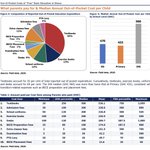
The graph below shows that IGF’s contribution to the tertiary education budget has been rising since 2010, from 30.41% to 49.03% in 2023, effectively shifting more of the cost of public university education onto students.
The years 2024, 2025, and 2026 recorded substantial declines, with rates falling to 41.32%, 32.65%, and 32.38%, respectively, representing the lowest levels observed over the 16-year period.
Despite the decline, the financial burden on students remains substantial, suggesting that the reductions have not been sufficient to facilitate a meaningful shift in educational cost-sharing responsibilities from students to the government.
This could also suggest that increased proportional allocations from the CF to the tertiary education budget are not translating into commensurate expenditure outturns and actual fund disbursements, thereby limiting their effectiveness in alleviating the financial burden on students.
Overall, education expenditure at 3% of GDP remains inadequate to drive the required structural reforms, reinforcing our call for a 40% increase in the 2027 education budget relative to 2026, equivalent to approximately 3.8% of GDP.
It is within this context that I support the student demonstrations against high public hostel fees at the University of Ghana.
However, for meaningful and lasting impact, the pressure must be directed primary at government, rather than university management alone.
On Thursday, the government has another opportunity to fix the situation at system level.
‘You cannot expect an elephant to grow on the diet of a mouse’.-Larteh Proverb!
Data: Selected Appropriation Acts of Parliament, 2010-2025.

ADMISSION FEES IN PUBLIC BASIC SCHOOLS AMID A PHANTOM ‘fCUBE’.
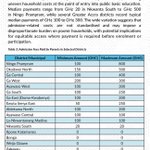
Two decades of underfunding basic education have normalised admission fees in Ghana’s supposedly free basic education system, shifting the burden onto poor parents.
Eduwatch’s recent study in 20 districts reveals parents are paying up to GHC 800 for admissions.
The FCUBE pretence serves two interests: Gov’t conceals its chronic underfunding, while beneficiaries in some schools and district offices profit from denying the existence of fees and preserving the status quo.
With 10% of children still out of school, its time to end the pretence and ask: When will free basic education begin?
A policy must be judged by its reality, not its name. Visit africaeducationwatch.org for the full report.
‘Calling a goat a cow does not make it produce milk like a cow’.- Larteh Proverb!

Stop the lies, Ghanaweb. This happened sometime 2018.

A first-year student of Ghana National College, identified as Ruby Teiko, has died after reportedly experiencing severe breathing difficulties during a dormitory inspection at the school's Elsie Dadzie Hall, with her family alleging that she was made to wait for the exercise to end before receiving assistance.
According to statements from the family, Ruby, who had a history of asthma, complained of breathlessness on two occasions while the inspection was ongoing.
However, the family alleges that the housemistress on duty and another staff member instructed her to wait until the inspection had been completed, despite her worsening condition.
More here:
ghanaweb.com/GhanaHomePage/N…
#ghanaweb
#ghanawebtv

It is well🙏

1. My father is dead.
2. I have thought long and hard about how to say this. I have just had to settle on the truth.
3. On Saturday 10th October, I was with him at the funeral of his sister. We did not speak. He was sitting with the elders. I raised my hand to him. And he nodded and flashed his 32.
4. I looked awa embarrassed. Shy that everyone knew my dad was my number 1 fan and cheerleader; and had no poker face when he say me. He beamed without control.
5. I rolled my eye in my head.
6. That was the last time “we spoke.” Sorry we did not speak. Not in the conventional sense. That is how we spoke. A raised hand met a nod.
7. At my auntie’s funeral. I was only thinking of a work I was doing for the Constitution Review Implementation Committee that I needed to send that Saturday. So I sat half the funeral in my car and worked.
8. I took time to stand and look at the body of my Auntie. I said a prayer. Removed myself when I was getting emotionally overwhelmed and drove back to Accra.
9. That evening I wrote a long post about death. Her death. The next morning, I wrote … ““Slow down. You are doing fine. You can’t be everything… before your time. “
Breathe today. You are alive. That’s a good starting place. You will survive. ❤️”
10. Two hours later, my dad sent me his last message “ Mercy woke me up again”.
11. An hour later, i was at my desk working. When I got a call that a Good Samaritan had found him on the street; and they were transporting him to a hospital.
12. Apparently my father, was taking a walk towards the funeral house where his sister’s funeral was being held.
13. The Samaritan had dialled his last dialled numbers.
14. I called family who were closer to get to him.
15. While on those calls, coordinating to get help for my dad.
16. I got the text “Call me again. What am hearing is not a good news. I learnt he's no more”. I shut down.
17. He arrived at the hospital dead. I found out the next day when I went to the hospital to arrange transfer of “his body”.
18. According to the Samaritan, he was in a Trotro when he say a man collapsed on the side of the road; and some kids trying to steal his phones. He got out, gave them a chase and retrieved the phones.
19. Having no car and no access to any ambulance, he called a “pragya”.
20. He died before they got to the hospital
21. My uncle messaged me some days later. “Your father died a gentleman. He said. I said no. Don’t sugarcoat it. My father died by the side of a road.
22. I did not expect to be this hard hit by the death of my father. Not that I know what to expect on the death of a father.
23. My father loved me. More than I ever could love myself.
24. At night, when I am unable to sleep; which is everyday now. I read messages from his phone.
25. My fathers whole life revolved around forwarding my Facebook posts to friends. Sending news stories about me to friends.
26. He talked to friends about the day I will become president.
27. When people had any problem, he told them his son the lawyer can help. Just give him a call.
28. He had no life outside of me I could find enough details of.
29. I didn’t see that from my end. From my end, I saw a father I could never tell a secret to. Because he couldn’t keep his mouth about me.
30. If I told him, I was in Europe speaking at a conference. He made sure the whole world knew. Details I kept off Facebook; he will tell others even when I made him swear not to.
31. He knew only how to love one way. Proudly.
32. I hated my father for it. It is those we love that we hate the most.
33. My son will never meet my father. And that brings tears to my eyes.
********
God on high, hear my prayer
In my need, You have always been there
He is young, he's afraid
Let him rest. Bring him home
…
The summers die, one by one
How soon they fly, on and on
And I am old and will be gone
Bring him peace, bring him joy
He is young, he is only a boy
You can take, you can give
Let him be, let him live

To put a child in secondary school, you need at least GH¢5,000 just to enrol. That’s about 230 days minimum wage.
Putting a child in public basic school can cost up to GH¢2,000 in admission fees, desks, textbooks, exercise books. That’s 92 days minimum wage.
These basic school costs are usually borne by governments running truly free basic education; excluding Ghana.
20 years into Ghana’s ‘free’ basic education, even school based exam and support classes to cover curriculum is ‘Pay As You Go’. Poor students who don’t pay are excluded.
Globally, the very essence of free education is to remove financial barriers that prevent poor and vulnerable children from accessing education.
Over here in Ghana, we have free food at secondary, but one must pay 5k to enter the door.
We have free tuition at the basic, but parents must first pay to get admission, buy desks, textbooks, before they can benefit from that supposedly free tuition.
If poor families must still pay fees they cannot afford before their children can attend school and sit school-based examinations, then how free is that education?
The government must get serious about this free education business and rethink how we finance basic and deliver secondary education not to exclude poor learners.
This auto-pilot UNDERFUNDING temple is not fit for purpose, as it simply prices the poor out of education. Definitely ain’t regular.
‘You cannot claim to invite the goat to the feast and then tie it outside the gate’.-Larteh Proverb!

MoE must ban students from working for teachers. Students are not house-helps. NaCCA has not approved any curriculum in Domestic Work.‘Education must produce scholars, not domestic servants’.
-Larteh Proverb!
According to the Obuasi SHTS report, P, a female student, alleged that the Headmaster sexually harassed her while she was performing duties at his residence.
Following her complaint, P was reportedly relieved of the responsibility of taking food to the Headmaster’s residence, and another female student, B, was assigned the same duty.
If P was relieved of her duties because of an allegation of sexual harassment, why was another girl assigned to the same residence?
Manasseh’s report indicates that some more girls were sexually abused while performing domestic duties in the Headmaster’s bungalow.
Ghana Education Service, do parents send their children to school to receive an education, or to work as house helps for teachers?
How many more girls are currently working as house helps in teachers’ bungalows across our schools?
The earlier GES bans that practice, the better!
“When a child falls into a pit, the village must not merely ask who pushed her; it must ask why the pit was there.”-Larteh Proverb!
Been listening to the conversation on what Free SHS has actually solved, given that many students still cannot enrol due to poverty.
As of 2025, close to 400,000 placed students had failed to enrol under the policy since the policy began.
While some may have opted for private SHS, many are on the street selling water like Ama.
This month alone, daily community scans and feedback reveal many many students still at home a month after schools reopened.
Just this dawn, Yaa, with Aggregate 8, placed at her dream school, Kumasi Technical Institute, is still home because of poverty.
Meanwhile, we are yet to resolve yesterday’s case of Ama from Kokoben, placed at Kumasi Girls, but still at home selling water just to afford a meal.
My inbox is overflowing with similar cases. These are not just statistics; they are children whose dreams are on hold because of poverty.
So, when people ask what Free SHS really solved, the question is legitimate.
Here is what it has solved: before Free SHS, roughly 6 in 10 JHS graduates transitioned to secondary. By 2024, it increased to 8 in 10.
Removing admission and feeding fees alone cleared a major financial barrier, even though the policy did not cover the highest cost of secondary education-prospectus.
Prospectuses, supplies etc can demand up to GH¢5,000 in an admission year; money many low-income families simply do not have.
This is where targeted support or enhanced localized inclusivity should have bridged the gap. Sadly, we have wrapped an otherwise great policy in political armour, placed it on an untouchable altar, and made any call for reform sound like heresy.
We have mistaken the need to refine the vessel for an attempt to break it, while the poorest children still thirst at its feet.
Free SHS opened the door, but for too many poor students, the cost of walking through it remains out of reach.
‘A road built for everyone is not enough if the poorest cannot walk it’.-Larteh Proverb!
End of today, we would have lost 60 out of 438 instructional hours scheduled for the 1st term of the 2026/27 academic year in public basic schools.
That 13.7% of the term’s scheduled instructional time lost; a significant learning deficit.
The government must accelerate its response to the issues underpinning the teachers’ strike.
Listen to the teachers!
‘When teachers are unheard, the future is left untaught’. - Fresh Larteh Proverb!
Very worried kidney failure is finishing our youth man them 24/7. Seeing some on my TL this dawn. Same finished one of my home security weeks ago.
1. Stop taking unprescribed medicine.
2. Drink about 6 sachets of water a day.
3. Excessive alcohol, smoke, will not help your kidneys.
4. Aphrodisiacs and “magani” will not help your kidneys.
5. Check your BP weekly at any pharmacy. It’s free!
6. Just 30 minutes of walking every day should be fine.
7. Take your supper 3 hours before you sleep. If you don’t have 3 hours, drink tea, koko or light soup. Your lightest food should be supper. Indomie, fried eggs no be light food.
8. Cut down on the boiled / fried meat. More fish and smoked meat.
9. Once a year, do a cholesterol and kidney function test. They wont cost more than GHC 300.
10. Those herbs and social media concoctions you drink at will can finish your kidney quick. Never swallow any herbal med without a doctor’s advice. I mean a proper medical doctor!
All these are far cheaper than 5k/week dialysis. I need you alive.
I beg you!
You don’t wait for the river to dry before you learn how to fetch water.-Larteh Proverb!
Seen videos of Minister H visiting schools to monitor reporting and ensure schools are ready to admit students. Good!
Also, read a distress post from a facebook follower. (Attached). Though not irregular, concerning!
As I indicated during the citizens’ review of the 2026 school placement exercise, placement itself is not the main challenge.
Every year, virtually everyone eventually gets placed, either automatically or manually.
What matters is the % of placed students who actually report to school.
Last year, about 18% of placed students did not report. That is roughly 100,000 students; the highest ever since free SHS.
From the cases I engaged with, a significant number involved candidates placed as day students in “foreign” districts: Distance and the cost of private accommodation is the barrier.
There is also the cost of reporting. In some cases, a parent needed GHS 5,100 for prospectus items, PTA-related charges and other fees (bed etc). For families without that money, the child may simply not report. (Eduwatch, 2025).
Ideally, education authorities should follow up with parents of students who do not report by the end of the first week, establish the reason and provide support where necessary.
Ghana needs to institutionalise this now.
I urge Minister H to instruct GES and TVET Service to:
1. Generate a list of all placed students who did not report last week.
2. Contact every affected parent via phone to establish why the student has not reported.
3. Categorise the cases (inappropriate day placement, financial difficulty etc...)
4. Escalate cases requiring intervention to the school placement officials, district assemblies.
5. Where appropriate, provide financial support for students facing genuine barriers to reporting.
6. Publish weekly reporting data, showing both placements and actual reporting rates by region and district.
The goal of Minister H should be: no placed student should disappear from the system and become a mere statistic.
Eduwatch reiterates that the 2026 Placement will ultimately be measured by the % of candidates placed and enrolled.
“A good shepherd searches for the missing sheep”-Larteh Proverb!
Ref: Africa Education Watch, “Free SHS Admission Costs: Reviewing The 2025/26 SHS & TVET Harmonized Prospectus,” 21 November 2025.


The growing reliance on fee-paying admissions in our tertiary institutions, particularly in STEM programmes, as a means of raising IGF deserves serious attention.
We cannot claim to be building a STEM-driven economy while making access to STEM education increasingly dependent on who can afford it.
In some universities, as many as 99% of Medicine students are fee-paying. Similar trends exits in many other STEM disciplines.
How do you expect someone with an aggregate 6 to study medicine as a fee-paying for many years, and then willingly choose to serve in Sirigu, when the system commodified their training?
If we fail to address this issue now, Ghana may not just continue to miss out of its STEM to Humanities and Gross Tertiary Enrollment targets; we will one day import STEM manpower.
The government must fund the universities well in order to end this disturbing culture of non-salary recurrent self-financing.
You cannot sow maize and expect to harvest rice.-Larteh Proverb!
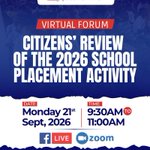
This morning at 9:30, we hold a Citizens’ Forum on Ghana’s 2026 School Placement Activity.
Every year, the Ministry of Education establishes a Technical Committee to review CSSPS performance.
This year, Eduwatch intends to mobilize citizens’ input to the Committee to help shape decisions on any future reform of the CSSPS.
Most importantly, as in previous years, almost every qualified candidate is eventually placed in a school (either self or auto), as there has always been surplus declared vacancies.
The challenge has always been how to translate full placements into full enrolment. By 2025, the gap was almost 20%.
What can be done in the next few weeks to mitigate this gap even as schools reopen?
Join the conversation on Facebook Live Africa Education Watch or WhatsApp Eduwatch on 0303975001 for the Zoom link.

117

Someone approached me after church yest: ‘What business can I start with GHC 400-500k and get cash back by March 2027’?
Any suggestions?
The one who asks questions does not lose his way.
-Larteh Proverb!
Ghanaians have developed an insatiable appetite for Category A quality of secondary education.
On average, about 60% of candidates compete for Category A schools, even though these schools have the capacity to accommodate only about 10–12% of candidates.
There is nothing wrong with that. In fact, it is a symptom of the rising educational aspirations and changing education tastes of a middle-income country.
The challenge is, less 100 of 1,000 public second cycle schools meet the Category A standard. Last time I cheeked, there were 94 Category A schools.
Why so few? Lack of adequate cash to build. There are competing interests from basic and tertiary.
Now, I have heard a recent proposal by senior brother Angel Carbonu to make boarding in Category A schools fee-paying and use the revenue to build more Category A schools.
In 2022, Eduwatch proposed privatizing 50% of Category A admissions, while leaving the remaining 50% for regular free SHS admissions.
There are about 1.5 million free SHS/TVET students today. Let’s estimate that 50% of Cat A student population is 100k.
At a fee of GHC 20,000 per year, that would generate about GHC 2 billion annually.
A standard Category A school with a boarding capacity of 3,000 students would require about GHC 100 million to build.
That means the fees paid by the ‘rich’ could potentially finance 20 new Category A schools every year focusing on Category A deprived regions: Oti, Western North, Bono East. Presently, Oti and North East have zero.
Within five years, we could have 100 new Category A schools from private financing sources to complement what our taxes can do.
More importantly, this could fundamentally change the geographical distribution of elite public secondary education in Ghana.
In other words, we could use the ability of wealthier families to pay for boarding to expand the geographical footprint of elite education to poor regions.
The economics of the proposal are compelling, but this proposal will probably not work because of party politics.
A tall tree gives shade to those beneath it.-Larteh Proverb!