
ELLIS PhD Student in Generative AI @ Ommer Lab (Stable Diffusion)
Munich
Joined June 2017
- Tweets25
- Following186
- Followers44
- Likes126


Pinned Tweet
Do we really need pixel generation to model motion? 🤔
We show how directly representing motion in a compact space enables efficient, scalable planning.
10,000× faster than video models, enabling planning and reasoning in open-world and robotics settings.
Check it out ⬇️

Kolja Bauer retweeted

⚡️Few-step diffusion without a teacher, self-distillation or JVPs.
iDDM: a single model trained from scratch in one stage. ImageNet-256: 4.48 FID at 4 steps and 2.38 at 50, from the same checkpoint
🧵 (1/6)

Kolja Bauer retweeted

Real-world scenes contain many objects moving simultaneously.
Yet current video representations entangle motion globally, exactly what we don’t want for object-centric motion understanding and generation.
We introduce localized context-aware motion representations.🧵👇
Kolja Bauer retweeted

People often think of prediction as choosing a likely outcome. But that’s not how the world works!
Given partial information, the future is a distribution of possibilities. And more knowledge collapses the distribution.
We built a representation that models exactly that 🧵
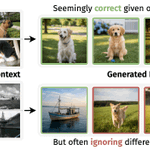
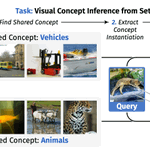
Most representation learning methods produce generic embeddings that try to preserve everything in an image.
We introduce VICIS: a way to use example sets to define a tailored embedding space for what matters.
This is useful whenever the desired visual signal is easier to show than to describe.
Code & weights available now 🧵👇

We don’t see this specialized model as the end goal. Instead, we hope tasks like this can become useful ingredients for training future multimodal models to reason directly from visual examples — not just language.
Paper: arxiv.org/abs/2607.02402
Code: github.com/CompVis/set-learn…

1
2
64
This was joint work with @rmsnorm, @StefanABaumann, @itsbautistam, @jmsusskind, and Björn Ommer. Thanks for the awesome collaboration!
3
106
Kolja Bauer retweeted

second runner up is a super cool paper from Björn Ommer’s group at LMU.
they first encode point trajectories into a latent using a VAE. then they learn to denoise future trajectories conditioned on past.
they do planning experiments on Libero by training a small decoder to convert denoised latents to robot action.
I joked that this is latent stable diffusion all over again by Björn but this time with point trajectories 😄

Kolja Bauer retweeted

Come visit our poster today (Sunday) 3:30 pm at CVPR poster 595! We'll also show some new results on translating the generated motion embeddings back to video 👇
Interested in extremely efficient motion generation without generating full videos? We show how to do this and how this is directly useful for robot planning and controllable video generation
Come visit our CVPR poster today at 3.30, poster 595👇
Video diffusion models learn motion indirectly through pixels.
But motion itself is much lower-dimensional.
We introduce 64× temporally compressed motion embeddings that directly capture scene dynamics.
This enables efficient planning -> 10,000× faster than video models.
🧵👇
1
111

Kolja Bauer retweeted

The internet is full of video. So why can't novel view synthesis just scale on it?
Real-world video is simultaneously unposed, messy, and dynamic, breaking self-supervised NVS.
We fixed that. RayDer learns static-scene NVS from dynamic internet video, scaling like an LLM. A🧵
Kolja Bauer retweeted

Cool stuff
Kolja Bauer retweeted

Amazing work led by @rmsnorm @KoljaBauer and our collaborators at LMU, to be presented at @CVPR! Personally, I find this question of "what's the right level of abstraction for planning in physical space?" to be very intriguing. Pixels over time are very low SNR (ie. the argument behind JEPA) but motion/trajectories carries a lot on information while being extremely compressible. I believe there's a lot more to uncover from this direction. Very glad to be part of this one!
Kolja Bauer retweeted
You don't imagine the future by mentally rendering a movie. You trace how things move -- abstractly, sparsely, step by step.
We built a model that does exactly this. It predicts motion, not pixels -- and it's 3,000× faster than video world models.
Myriad, accepted at @CVPR 2026
