

I share my commentary, analysis, and perspectives on Kurdology from an academic angle. Linguistics, Genetics, Archaeology, History, Culture, and Heritage.
Joined September 2022
- Tweets189
- Following63
- Followers1.9K
- Likes10.3K


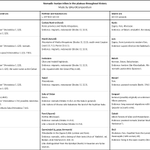

The following image is my tree of the Iranian language family, based on descent alone. Terms like “North West Iranian” and “East Iranian” are not genetic terms, and they don’t map properly onto areal contact zones either. A great deal of research is still needed to refine how the Iranian languages descend (some more than others). A big problem at the moment is that linguists often contradict each other on how some of these branches should be classified, because the traditional groupings rest on a handful of features, assumptions, etc that newer data no longer support.
Glottolog is one attempt to bring the classifications of various linguists together. The problem is that it combines placements that contradict each other. For example, it places North Western Iranian under Agnes Korn’s Central Iranian node, yet Korn (2016), in the same paper that proposes Central Iranian, argues that the North Western node should be deleted from the tree. Central Iranian is also not well established enough to be asserted as fact: Korn herself presents it as a preliminary sketch. Glottolog’s tree also gives no indication of roughly when these splits are supposed to have happened.
The position of Proto Iranian itself might need to be revised. Persian, the ś branch (Khotanese Tumshuqese and Wakhi) and Nuristani, which Halfmann (2025) now places within Iranian, all split off before Proto sp, so their separate histories go back an unknown length of time before 1500 BCE. Nonetheless, until further investigation I have kept Proto Iranian where it is, with the changes that could define it listed beside it. If that node fails in the future, several more Indo Iranian branches would need to be opened up, and the deepest node we could still support would be the one I have called Proto sp.
I have relabelled some branches. For example, Khotanese Tumshuqese is usually called “Saka”, a name that ties it to the Scythians. But the little evidence we have for Scythian proper puts the two on different branches: Scythian has sp (Akkadian Išpakāya, c. 675 BCE, from *spaka ‘dog’), while Khotanese has ś (aśśa ‘horse’). In other cases I have kept the names, like the “Pamir” branch, but limited it to Shughni Roshani, Sarikoli and Yazghulami, a grouping that goes back to Sokolova (1967). The other so called Pamir languages are placed elsewhere.
What I have listed as Proto sp needs the most attention in future. The exact path by which those languages diversified could involve some regroupings, and some of them have had little to no attention in academia. One possible regrouping is whether Ossetian forms a closer branch with Sogdian, as Novák (2014) and Glottolog both propose.
Expand the image, and open it in a new tab for a higher resolution.

Anti-Kurdish narratives are so normalised in academia that foreigners unknowingly put forward exceedingly ignorant proposals. Firstly, the palatal *ḱ in proto Indo-European *ḱerdʰ- becomes Indo-Iranian *ć, and PIE *e becomes *a, which gives *ćárdʰa-. Iranian then loses the aspiration of *dʰ, which gives Proto-Iranian *ćarda-. Iranian turns *ć into s, apart from Old Persian, which turns it into θ. In Middle Iranian the final vowel is lost and *rd becomes *rδ. In Persian and Kurdish this becomes l, with the a lengthened to ā, and in Persian the inherited *θ becomes h.
The final outcome of PIE *ḱerdʰ- (which gives English herd) would therefore be *sāl in Kurdish and *hāl in Persian. The word for “year” went through exactly the same changes from a different root: Old Persian θard-, Avestan sarəd-, Parthian sarδ, Kurdish sāl. The Avestan cognate of herd is sarəδa- “kind, species”. It is not possible for Kurd to come from Proto-Indo-European *ḱerdʰ-. Kurd has k instead of s, θ or h, u instead of a or ā, and keeps r plus a dental (the Pahlavi spelling kwltʾ/kwrtʾ is pronounced kurd) where *rd should have become l. Of course, this etymology is proposed on Wiktionary, where anyone can edit and type nonsense.
Secondly, there is not a single shred of evidence that the word Kurd originally meant herder or tent dweller, and especially if you use any historical Iranian account. There is 11 non-Kurdish Iranian nomadic, tent dwelling, herder tribes living in the plateau before the Islamic age: The Mardi, the Sagartians, the Dropici, the Tapuri, and so on. Eratosthenes of Cyrene and Strabo specifically list the Kurds as a tribal entity living in the Zagros. It has taken a long time, but the most prominent academics in the field now, such as Boris James, now reject the old orthodoxy that Kurd was a lifestyle label. The entire premise of Kurd meaning shepherd or herder rests on isolated, mistranslated and misappropriated early Islamic Arabic historiographical accounts that draw analogies and comparisons. These same accounts treat other ethnic groups, in the exact same way but you will never see a claim like Persian means farmer even though we can build a case showing exactly that if we decide to become disingenuous.
A lot of these older western academics have relied too heavily on the ideologically driven yappings of local near easterners who built narratives to serve certain nation building projects at the expense of Kurds. Or just built upon these narratives out of spite. It doesn't help that the odd Kurd who entered into academia only contributed mickey mouse unserious tier narratives about us Kurds.

Ari retweeted

Hocamızın videosunu mutlaka izleyin.
Van Gevaş'ta bulunan Halime Hatun kümbeti ve mezarlığının Selçuklu ve Türklerle ilgisi olmadığını söylemiştim.
Halime Hatun kümbeti, Hakkari Beylerinin Gevaş kolundan Melik İzzeddin Şîr tarafından kızı için yaptırılmıştı.
Çevresindeki mezarların görselini X hesabımda paylaşmıştım, hocamız kitabesini okumuş ve mezarlardan birisinin Kürt alim Tac’el Kürdi’nin torunu Kemaleddin'e ait olduğunu, mezarın sonunda tahrif edilmiş "el-Kurdi" nisbasının bulunduğunu tespit etmiş.
Buna vesile olmaktan mutluluk duyuyorum.


İlk Kez Paylaşılıyor:
Şükürler olsun Literatüre ve Arkeologlara yeni bir zat keşfediliyor.
İbn Tac-el Kürdi (814-889/1412-1485)
Gevaş/Westan mezarlığında 15. ait bir Kürt Alimin Kitabesi.
Aslında bu konu çok tartışıldı ve hala tartışılmaktadır, yalnız #melabirhanêtarînî nin keşifiyle ve okumasıyla tarih kitaplarında çok meşhur olan bir aile efradının mezarı olduğu tesbit edildi. Burada medfun olunan Tac’el Kürdi’nin torunu Kemaleddindir.
Aslen Ahlatlı olup Kahire’ye yerleşmiş ve oradaki medreselerde ve büyük alimlerden ders almıştır.
Bunun devamı detaylı bir şekilde daha sonra YouTube kanalımızda youtube.com/@estar1?si paylaşacaktır.
@anadoluajansi @AJArabic @BBCArabic
@CNN @France24_fr
Wêneyê Kêlê @Yusufsaladin22 û Nişandana çavkanî ji bi tesadufî @kurdoloji_ars û xwendin û tesbîtkirin @Mbirhanetarini ye.
Jkx parve bikin û bela bikin bila Westan Goristana wê ronî bibe…
#kurdish
Ari retweeted

🧵
1/8
ئەم پۆستە پێشنیازێکی نوێی ئیتیمۆلۆژی (ڕەچەڵەکی وشە) پێشکەش دەکات بۆ ناوی "کورد". خاوەنەکەی پێی وایە ئەم ناوە لە ڕەگی بەردەوامی سەرەتایی ئیندۆ-ئۆراپی (*kr̥t-í-) هاتووە کە بە واتای "بڕین" یان "قرتاندن" دێت و دواتر بووەتە ناوی پۆشاکێک و پاشان ناوی هۆز و نەتەوە.

MAJOR development. After several years of on and off attempts, I have finally solved the etymology of the ethnonym Kurd, which currently has no solution in academia. It comes from Proto-Indo-European *kr̥t-í- “cut” → Proto-Indo-Iranian *kr̥ti- → Proto-Iranian *kr̥ti- → *kur(ə)ti- (“cut”, but also an outer “garment”) → *Kurt(i)- (adopted as a tribal name) → *Kurt → *Kurd (by the 3rd c. CE) → Kurd (from a tribal identity to an ethnonym).
The first image, an etymological tree, sets out and justifies each sound change, if you want to see how the derivation is linguistically proven. It also contains the historical details on each form where attested. X reduces image resolution, so to read it clearly, expand the image and open it in a new tab. The second image shows the garment in question: the thick, tent-like traditional shepherd’s cloak made of dense felted wool, or wool mixed with goat hair.
Specifically, the name Kurd comes from this outer-garment sense, which was later adopted as a tribal name. Among Iranian languages, the garment word first appears in Avestan as kərəti-, in instructions on how Zoroastrians should wear it together with the sacred shirt and belt. In Parthian, kórt-ēn was the garment boys received as a coming-of-age gift when they reached manhood (which is linguistically a close match to the word Kurd, as the stem's predicted outcome of the Parthian would eventually become Kórd/Kurd since that gloss predates t > d). The word has cognates across the Iranian world, living and extinct, such as Khotanese, Ossetian, Sogdian and Bactrian.
There is historical evidence that Kurd still carried a secondary garment meaning in the early Islamic period, as the word was borrowed into Classical Arabic for a type of garment: kurdī, from the narrator Ibn Abī al-Zinād (d. 790 CE in Baghdad), in Abū Dāwūd 915 (before 889 CE), and kurdiyya in Ibn al-ʿArabī (d. 1148 CE), among others. The hadith reads: “…from ʿĀʾisha, with this report. He said: and he took a kurdī that belonged to Abū Jahm. It was said: O Messenger of God, the khamīṣa was better than the kurdī.” This is important because it shows the t > d form unlike Kurt-(ek), and other forms that passed through west Iranian languages later on via Sogdian. They are still from the same root however.
Tribal names and clans very often come from places, animals, objects and so on. The Kurdish tribe Sanjabi is named after the squirrel fur, Herki is named after a citadel, etc. Kurds are first attested in history specifically as a tribe by Eratosthenes, Strabo and others. The older reading of Kurd as “nomad” has no etymological basis in any Iranian language, and many Kurdologists/Iranologists today regard it as an anti-Kurdish narrative with no basis in the historical record (see Boris James). Some earlier academics unknowingly built on Arabic mistranslations and deliberate misreadings, which are now corrected. There were also at least 11 Iranian nomadic tribal organisations on the plateau before Islam with no Kurdish identification, and 5 Iranian tribal organisations on the plateau that never had a Kurdish tribal affiliation which completely contradicts this narrative.
The main sound-change question left open in my tree is how r̥ became ur, since it normally gives ar or ər. There are several resolutions, but it is not yet clear which one it is. The u-form *kur(ə)ti- may have spread by borrowing, as a garment from the East Iranian lands: ur is the usual outcome in Parachi, Sanglechi-Ishkashmi and Shughni (Clayton 2022), and Sogdian kurθ- probably passed into Persian kurta. Or it may be a regular change in some western dialect, as in Balochi kurt “did” < *kr̥ta- (Korn 2003).
Several scholars already tie the garment word to the root for “cut”. Abaev derives Ossetian kærc “fur coat” from Old Ossetian *karti-, which “corresponds perfectly” to Avestan kərəti- “garment” (that is, *kr̥ti-), perhaps from *(s)ker- “to cut”; he calls Ossetian kuræt a loan. Bailey derives Khotanese kīḍakyä “garment” from kart- “to cut, tailor”, comparing kərəti-. Henning took Sogdian kurθ- “garment” as the same word as kərəti-, and Benveniste linked Persian kurta to the Sogdian. Sims-Williams, publishing Bactrian kuratīg “shirt”, calls it “a word of unknown but probably non-Iranian origin”, which would leave room for a substrate source such as the BMAC (2007: 224). Although Sims-Williams did not gloss through the full extent of the Iranian forms, or look too deeply into it.
I have opted otherwise, and agree with the other scholars who do derive it through Iranian, because of the following reasons. Avestan kərəti-, Ossetian kærc and Khotanese kīḍ- show the regular outcomes of *kr̥ti- at opposite ends of the Iranian world. The root has an Indo-European etymology, *(s)ker-t- “cut”, shared with Vedic kṛtí- “dagger”, and the Pahlavi commentary renders kərəti- as kirrēnīdag “cut”. The forms Sims-Williams compares are the u-forms, and they can all be accounted for within Iranian. The Sogdian θ comes from the regular change ty > θy. Persian kurta, Arabic qurṭaq, Pashto kurta and Ossetian kuræt are loans. A word with a regular Iranian etymology doesn’t need a substrate source.
To clarify for anyone who doesn't know, the stem is important for derivation as it carries the evidence of descent, while the the suffixes don’t necessarily. A stem passes down through Iranian forms and goes through its regular sound changes, so kurt- with t, kurθ- with θ and kurd with d each show where a form sits on the tree. Suffixes are added afresh by each language and are often swapped or borrowed depending on the application and context.
Given this etymology, the identification of the Cyrtians with the Kurds is even stronger than it already was, as the forms are an exact match. Identifications with the Carduchi, Qardu, among other folk proposals have become even more improbable, both linguistically and historically, than they already were.


The attested medieval Kurdish word here, gūmīz, colloquially meant urine, but etymologically it is a compound meaning cow’s urine. It's related to the infamous Zoroastrian custom of using consecrated bull’s urine (Avestan: gaomaēza) as a purifying agent in ritual practice, comparable to the Muslim use of drinking camel urine in medicinal healing. Kurds probably did not maintain the Zoroastrian custom after becoming Muslim, but the word from that custom was indeed maintained among some Kurds, which is quite interesting given how deep into the Islamic age that is. Modern Kurdish speakers simply just use mīz (urine).
Cow urine among Zoroastrians was chiefly used as a preventative measure against pollution from corpses, which was blamed on the corpse demon Nasu, and was used in the nine night barašnūm purification. Worshippers rubbed a few drops on their hands and face during the morning for the 5 daily kustī prayers and some rites. The practice goes back to Indo-Iranian roots, as Vedic India showed the same reverence for cow urine (gomūtra).


Here I will make an additional post for those who want an expanded commentary on the post below from the linguistic perspective in particular. Originating as an outer garment (thick, sleeveless felted cloak of religious and cultural significance) that is loaned and then historically adopted as a tribal name for a particular group of Iranians in the Zagros by 220 BCE, and later transforming into an ethnonym in the Islamic age, all the while still maintaining a secondary outer cloak garment meaning. I will walk through the derivation stage by stage, then go through the related forms found across the Iranian world, both ancient and modern.
*kr̥t-í- (Proto-Indo-European). This is the root *kr̥t- plus the suffix -i-. The root is *(s)kert-, the t-form of *(s)ker- “to cut” (Pokorny 941–942). One might ask whether the root had a laryngeal, which would change its Iranian outcome. It did not: Sanskrit kṛntáti “cuts” has a short ṛ, whereas *r̥H would have given īr or ūr.
*kr̥ti- (Proto-Indo-Iranian). The form is unchanged from Proto-Indo-European. The meaning is “cut”: something that cuts or is cut. On the Indic side it gives Vedic kṛtí- “dagger”, a weapon of the Maruts in Rigveda 1.168.3, which keeps both the r̥ and the accent. It is a different word from *kr̥ti- “making”, from *kʷer- (Avestan ākərətiš): the shape is the same, but the root and meaning differ, so the two must not be mixed.
*kr̥ti- (Proto-Iranian). The form is again unchanged: r̥ survives as a syllabic r, which Avestan writes ərə. The main meaning stays “cut”, and a secondary sense appears, probably early in Iranian: a garment. The step from “cut” to “garment” is a natural one, since a garment is a piece of cut or tailored cloth, and the Iranian sources make the link themselves. The Pahlavi commentary renders Avestan kərəti- as kirrēnīdag “cut”, and Bailey derives the Khotanese garment word from kart- “to cut, tailor”.
*kur(ə)ti- (the u-forms). Here r̥ became ur. That is not the expected outcome, but it is not a problem, for two reasons. First, the u is not reconstructed out of nowhere. It is attested, in Kýrtioi by 220 BCE and in Parthian kórtēn. Second, ur after k is a known Iranian outcome: Balochi has kurt “did” < *kr̥ta-, and ur is the usual outcome in Parachi, Sanglechi-Ishkashmi and Shughni (Clayton 2022). So the u comes either from a western dialect of the Balochi type, or from an eastern u-form that spread west with the garment, as the borrowed name of a traded item. This word family shows that kind of travel twice: the *kurət- forms in Ossetian, Bactrian and the Tarim Basin are loans, and later Sogdian kurθ- spread west as Persian kurta. Persian itself cannot be the source, since it gives ur only after labials (murd “died”, burz “high”) and ir after k (kird “did”, kirm “worm”).
*Kurt(i)- (garment word and tribal name). Polybius records the Kýrtioi (Latin Cyrtii) as slingers for the Median satrap Molon in 220 BCE. Livy has Cyrtian slingers at Magnesia in 190 BCE, and Strabo places them in Media Atropatene and Persis. The match is sound for sound: κ = k, υ = u, ρ = r, τ = t. The weak ə after the r, if it was there, has been lost. Greek had δ for d, so the τ shows a real t at this date. With no suffix after the -i, the i never became y, so no θ arose as it did in Sogdian. The word kept its garment sense alongside the name, because its descendants still carry it at both later stages. Parthian kórtēn shows it at the t-stage (below). Arabic kurdī, a plain wool wrap recorded from the narrator Ibn Abī al-Zinād (d. 790 CE) in Abū Dāwūd 915, shows it at the d-stage, though it can also be read as “the Kurdish one”. A garment becoming a tribal name is nothing unusual: the Kurdish Sanjabi are said to be named after squirrel-fur tunics, and the Turkic Qarapapaq and Karakalpak both mean “black hat”.
*Kurt (early Western Middle Iranian). The final -i is lost. Parthian has kórt-ēn, which Hesychius explains: “The Parthians call by this name a garment that boys receive when they reach manhood.” Schmitt lists it among the Parthian garment words in Hesychius. Latte’s edition traces the gloss to Diogenianus, who wrote under Hadrian, so it dates to 138 CE at the latest, with the t still unvoiced. Two details belong only to the Greek: the -ēn is the Greek accusative ending, and the o is a normal Greek spelling of a short u. Greek had no letter for a short u, so older writers used υ (Kýrtioi; Kŷros for Old Persian Kuruš), and later ones often used o (Πάκορος for Parthian Pakur, Ὀσρόης for Husrōw).
*Kurd (later Western Middle Iranian). t became d after r, a regular change in Parthian and Middle Persian (compare Middle Persian kird “did” and murd “died”). It came after 220 BCE, when the Kýrtioi still had t, and was roughly complete by the 3rd century CE. The name did not stay *Kurt, as Balochi kurt did, because the Kýrtioi lived in Media and Persis, inside the area where Parthian and Middle Persian voiced t after r. This gives Kurd, the form found in Middle Persian (Pahlavi kwlt’) and from there into the early Islamic period.
In Arabic, kurdī is loaned to mean a wool wrap in Abū Dāwūd 915, from the narrator Ibn Abī al-Zinād (d. 790 CE), and Ibn al-ʿArabī (d. 1148 CE) repeats it as kurdiyya, quoting the same narration. In Ottoman Turkish, Meninski (1780) gives kürdiye as “cloak, short garment”. Redhouse (1890) gives kürdiyye and kürdekī as “frock coat with short sleeves” and kürdī as “woollen cloth or garment of Kurdish make”. Lady Mary Wortley Montagu (1717) describes the curdee as “a loose robe”.
Now for the other Iranian forms:
Avestan kərəti-. This is a religious outer garment worn over the sacred shirt and belt (Nērangestān 91); the belt counts only if it is tied on the shirt beneath it. Avestan ərə writes r̥, so this is *kr̥ti- itself. The meaning is secure at §91. A second instance at §87 depends on Waag’s emendation, and Bartholomae and Bulsara read that passage as a different word, but nothing here depends on it. The ending -īš could also fit an ī-stem, but Vedic kṛtí- and Old Ossetian *karti- point to an i-stem.
Ossetian kærc “fur coat, sheepskin coat”. It comes from Old Ossetian *karti-, which Abaev says “corresponds perfectly” to kərəti-. The sound changes are regular: r̥ > ar, a > æ, and final -ti > -c.
Khotanese kīḍ- (in kīḍakyä “garment”). The changes are again regular: r̥ > ä, rt > ḍ, and the vowel becomes ī before the -i- of -ti- (Bailey 1979). A Late Khotanese document has kīḍakyä begaṃnä śau, “one garment, woven”, written before Khotan fell around 1006. Khotanese cannot show whether its vowel came from zero-grade *kr̥ti- or a full-grade *karti-, but the zero grade is the one Avestan and Vedic show, so it is the simpler assumption.
The *kurət- loans: Ossetian kuræt (Iron kʷyræt) “beshmet”, Tarim kuratu “shirt” and Bactrian kuratīg “shirt”. These cannot be inherited. A native Ossetian t would have become d, and native -ti gives -c, as in kærc. Native Bactrian would have ιρ and δ (compare κιρδο “made”). So they are borrowings from an unknown donor, and their vowel after the r shows that the u-form had a weak ə there. Each language adapted it in its own way: Ossetian ə > æ (and in Iron u > y, hence kʷy-), Tarim ə > a with a local ending -u, and Bactrian ə > a with ο for u and the suffix -īg. Bactrian kuratīg appears in a letter about “linen shirts from Balkh”, and Tang glossaries of the 8th century give the Tarim form as the “Sanskrit” for Chinese shan “shirt”.
*kr̥θy- (the θ-derivative). A suffix beginning with a vowel turned *kr̥ti- into *kr̥ty-. Since ty > θy is a Proto-Iranian change (Avestan haiθiia- < *satya-), this derivative is old. Sogdian has both kərθ- (krδʾkh, in the early 8th-century Mugh documents) and the u-form kurθ- (kwrδʾk, qwrθy): the regular vowel and the u-form side by side in one language. Both lost the y after θ, as in xēpθ “own” < *xwaipaθya- (Yoshida 2016). kərθ- shows the ordinary Sogdian r̥ > ər, and kurθ- the u-form. That θ cannot come from t, because Sogdian keeps old t. Yaghnobi kŭrta and kŭrsa “shirt” inherit the word, with θ > t in the west and s in the east.
The later kurt- loans. Persian kurta, kurtak and kurtī, Kurmanji kurtek “robe”, Tajik kurta, Pashto kurta, Parachi kurtī, Shughni kurta, Armenian kʻurtik and Arabic qurṭaq (“arabicised from kurta”) all come from Sogdian kurθ-. They have no vowel after the r (unlike Bactrian kurat-), their θ became t, and that t was never voiced, so they were borrowed after t > d. This is also why Kurd has d while kurta has t: Kurd was already in Western Iranian before t > d, while kurta arrived from Sogdian after it.
MAJOR development. After several years of on and off attempts, I have finally solved the etymology of the ethnonym Kurd, which currently has no solution in academia. It comes from Proto-Indo-European *kr̥t-í- “cut” → Proto-Indo-Iranian *kr̥ti- → Proto-Iranian *kr̥ti- → *kur(ə)ti- (“cut”, but also an outer “garment”) → *Kurt(i)- (adopted as a tribal name) → *Kurt → *Kurd (by the 3rd c. CE) → Kurd (from a tribal identity to an ethnonym).
The first image, an etymological tree, sets out and justifies each sound change, if you want to see how the derivation is linguistically proven. It also contains the historical details on each form where attested. X reduces image resolution, so to read it clearly, expand the image and open it in a new tab. The second image shows the garment in question: the thick, tent-like traditional shepherd’s cloak made of dense felted wool, or wool mixed with goat hair.
Specifically, the name Kurd comes from this outer-garment sense, which was later adopted as a tribal name. Among Iranian languages, the garment word first appears in Avestan as kərəti-, in instructions on how Zoroastrians should wear it together with the sacred shirt and belt. In Parthian, kórt-ēn was the garment boys received as a coming-of-age gift when they reached manhood (which is linguistically a close match to the word Kurd, as the stem's predicted outcome of the Parthian would eventually become Kórd/Kurd since that gloss predates t > d). The word has cognates across the Iranian world, living and extinct, such as Khotanese, Ossetian, Sogdian and Bactrian.
There is historical evidence that Kurd still carried a secondary garment meaning in the early Islamic period, as the word was borrowed into Classical Arabic for a type of garment: kurdī, from the narrator Ibn Abī al-Zinād (d. 790 CE in Baghdad), in Abū Dāwūd 915 (before 889 CE), and kurdiyya in Ibn al-ʿArabī (d. 1148 CE), among others. The hadith reads: “…from ʿĀʾisha, with this report. He said: and he took a kurdī that belonged to Abū Jahm. It was said: O Messenger of God, the khamīṣa was better than the kurdī.” This is important because it shows the t > d form unlike Kurt-(ek), and other forms that passed through west Iranian languages later on via Sogdian. They are still from the same root however.
Tribal names and clans very often come from places, animals, objects and so on. The Kurdish tribe Sanjabi is named after the squirrel fur, Herki is named after a citadel, etc. Kurds are first attested in history specifically as a tribe by Eratosthenes, Strabo and others. The older reading of Kurd as “nomad” has no etymological basis in any Iranian language, and many Kurdologists/Iranologists today regard it as an anti-Kurdish narrative with no basis in the historical record (see Boris James). Some earlier academics unknowingly built on Arabic mistranslations and deliberate misreadings, which are now corrected. There were also at least 11 Iranian nomadic tribal organisations on the plateau before Islam with no Kurdish identification, and 5 Iranian tribal organisations on the plateau that never had a Kurdish tribal affiliation which completely contradicts this narrative.
The main sound-change question left open in my tree is how r̥ became ur, since it normally gives ar or ər. There are several resolutions, but it is not yet clear which one it is. The u-form *kur(ə)ti- may have spread by borrowing, as a garment from the East Iranian lands: ur is the usual outcome in Parachi, Sanglechi-Ishkashmi and Shughni (Clayton 2022), and Sogdian kurθ- probably passed into Persian kurta. Or it may be a regular change in some western dialect, as in Balochi kurt “did” < *kr̥ta- (Korn 2003).
Several scholars already tie the garment word to the root for “cut”. Abaev derives Ossetian kærc “fur coat” from Old Ossetian *karti-, which “corresponds perfectly” to Avestan kərəti- “garment” (that is, *kr̥ti-), perhaps from *(s)ker- “to cut”; he calls Ossetian kuræt a loan. Bailey derives Khotanese kīḍakyä “garment” from kart- “to cut, tailor”, comparing kərəti-. Henning took Sogdian kurθ- “garment” as the same word as kərəti-, and Benveniste linked Persian kurta to the Sogdian. Sims-Williams, publishing Bactrian kuratīg “shirt”, calls it “a word of unknown but probably non-Iranian origin”, which would leave room for a substrate source such as the BMAC (2007: 224). Although Sims-Williams did not gloss through the full extent of the Iranian forms, or look too deeply into it.
I have opted otherwise, and agree with the other scholars who do derive it through Iranian, because of the following reasons. Avestan kərəti-, Ossetian kærc and Khotanese kīḍ- show the regular outcomes of *kr̥ti- at opposite ends of the Iranian world. The root has an Indo-European etymology, *(s)ker-t- “cut”, shared with Vedic kṛtí- “dagger”, and the Pahlavi commentary renders kərəti- as kirrēnīdag “cut”. The forms Sims-Williams compares are the u-forms, and they can all be accounted for within Iranian. The Sogdian θ comes from the regular change ty > θy. Persian kurta, Arabic qurṭaq, Pashto kurta and Ossetian kuræt are loans. A word with a regular Iranian etymology doesn’t need a substrate source.
To clarify for anyone who doesn't know, the stem is important for derivation as it carries the evidence of descent, while the the suffixes don’t necessarily. A stem passes down through Iranian forms and goes through its regular sound changes, so kurt- with t, kurθ- with θ and kurd with d each show where a form sits on the tree. Suffixes are added afresh by each language and are often swapped or borrowed depending on the application and context.
Given this etymology, the identification of the Cyrtians with the Kurds is even stronger than it already was, as the forms are an exact match. Identifications with the Carduchi, Qardu, among other folk proposals have become even more improbable, both linguistically and historically, than they already were.
Publication in the journal of Iranian Studies hosted by Cambridge University Press, Boris James debunks the long-held view that “Kurd” in early medieval Arabic sources simply meant “nomad”. He argues that this view was a “hyper-reaction” against pro-Kurdish essentialism. It was reinforced by a misreading of Minorsky, and by misappropriated historical data. He answers it by examining both modern scholarship and Arabic sources from the 9th to the 15th century. He shows that “Kurd” was already the name of a people in the earliest sources, first defined in relation to Arabs and non-Arabs, and that from the 11th century this Arab centric historicity dies down, and Kurds are defined independently from this categorisation. He states it remains impossible to know, for technical reasons, the precise moment when individuals from a specific territory began to see themselves as Kurds from a medieval point of view because the sources offer very little in that regard. The clearest historical evidence of that in the medieval age begins in the 1100s CE due to the Ayyubids.
James concludes that in medieval Arabic sources “Kurd” was a genuine ethnonym. He builds this from medieval authors writing between the 9th and 15th centuries. For the early period he uses al-Jahiz, Ibn Durayd, al-Ya’qubi, al-Tabari, Hamza al-Isfahani, al-Mas’udi and Ibn Hawqal. For the later period he uses Ibn al-Sam’ani, al-Wahrani, ‘Imad al-Din al-Isfahani, Ibn Shaddad, Yaqut, Ibn al-Athir, Ibn Khallikan, Abu Shama, al-Khazraji, al-Dhahabi, al-‘Umari, Ibn Khaldun and al-Maqrizi.
His target is a modern orthodoxy resting on Vladimir Minorsky. In response to some pro-Kurdish authors who treated Kurdishness as a fixed essence, a number of scholars accepted that “Kurd” eventually became an ethnonym but treated its early medieval meaning as simply “nomad”. James’s examples are Basil Nikitine, Wadie Jwaideh and Martin van Bruinessen. He also challenges Jean Aubin, who read “Kurd” as describing a pastoral, tribal way of life, and Hakan Özoğlu, who saw it as an outsiders’ term. In James’s account, three things drove the “nomad” reading. It was a “hyper-reaction” against pro-Kurdish essentialism. Fixing the term’s meaning resolved the puzzle of why groups such as the Lurs and Gouranis were called Kurds then but not now. And these scholars mixed early and late evidence, with Nikitine and Jwaideh stretching Minorsky’s narrow remark about 10th-century western Iran into a general rule.
To correct this, James draws on Jan Retsö’s parallel work on the word “Arab”, Lakoff and Johnson’s view that concepts are defined through one another, Fredrik Barth’s theory of ethnic boundaries, Catherine Quiminal’s “contexts of meaning”, Ian Hacking on social construction, and Gabriel Martinez-Gros’s reading of Ibn Khaldun. He also uses Stephan Conermann’s study of Kurds in Mamluk eyes, while rejecting Conermann’s criticism of Ibn Khaldun. Historians such as Anne-Marie Eddé, Reuven Amitai, Jean-Michel Mouton and Percy Kemp supply further evidence. James separates two historical phases and shows that “Kurd” took its meaning from its shifting relationship with other ethnonyms (‘arab, ‘ajam, turk), not from any fixed trait.
His starting point is how ethnonyms work. Unlike words such as “Muslim”, nothing in the word “Kurd” decides who belongs, and Mas’udi’s legend deriving it from “driven out” merely confirms an existing negative image. Being associated with nomadism no more makes “Kurd” mean “nomad” than calling the Laz “the Belgians of Turkey” makes “Laz” mean “stupid”.
In the first phase (8th to 11th century), authors defined Kurds through two other categories. An Arab element, expressed through Bedouin genealogies and shared pastoralism, linked them to Arabs. A non-Arab (‘ajam) element, chiefly language, set them apart. This was a comparison between peoples, not an equation.
In the second phase (11th to 14th century), “Kurd” stands on its own. Yaqut distinguishes Kurds from Bedouin, and Ibn Khallikan lists Kurdish origin separately from Arab and ‘ajam. Al-‘Umari describes Arabs who “adopted the lifestyle of the Kurds” and ‘ajam who “have Kurdified”. Maqrizi reverses Mas’udi’s weighting, rejecting the Arab genealogy and stressing the non-Arab element, which shows the term had its own dynamic. James suggests three causes for the change: new contacts with Turks, Kurdish and Daylamite dynasties, and the Turco-Mongol invasions; closer knowledge of Kurds once they joined the armies and cities of the great empires; and rivalry with the Turks.
He then identifies six frames in which “Kurd” was used. Two continue from the first phase: Arab versus non-Arab, and Arab tribal genealogy. The third is Ibn Khaldun’s Bedouin cycle, in which Kurds rose with the Zangids and Ayyubids and returned to the margins under the Mamluks. The fourth is a civilisational stereotype of Kurds as violent, rebellious, heterodox and poor in Arabic. The fifth is geographical, tying Kurds to named territories such as Bilād al-Akrād (“land of the Kurds”) as their tribal territory shifted westward. The sixth casts the Turk as the Kurd’s “Other”.
Finally, against Aubin and Özoğlu, whose views leave no room for Kurds’ own role in shaping the term, he finds evidence that Kurds identified as such themselves. ‘Isa al-Hakkari urged a rival to back Saladin as a fellow Kurd rather than leave power to the Turks. Abu al-Hayja’ wrote that Kurds and Turks would never obey each other. Al-Mashtub cut off his son’s Turkish-style braid because Kurds did not wear their hair that way. This rivalry peaked as Ayyubid rule ended, and the creation of a Mamluk “dynasty of the Turks” allowed later writers to depict the Ayyubids as the “dynasty of the Kurds”. Being identified as a Kurdish dynasty also weakened the Ayyubids’ claim to rule universally, beyond any single people.

This map plots every passage in which Ibn Miskawayh writes about Kurds in his history Taǧārib al-Umam. There are 35, describing events from 685 to 980 CE, coloured by period and placed at the towns and districts the text names. They stretch from Mosul, Šahrazūr and Āḏarbāyǧān across the Zagros to Ḫūzistān, Fārs and Kirmān. Most come from the 10th century: the Kurdish ruler Daysam in Āḏarbāyǧān, Ḥasanūya in the Ǧibāl, and Kurdish troops, raiders and chiefs dealing with the Buyid court. The later continuations printed with the book are left out, as they are by other authors.
Abū ʿAlī Miskawayh (c. 932–1030) was an Iranian historian and philosopher from Rayy. He served as librarian to the Buyid vizier Ibn al-ʿAmīd and later worked for ʿAḍud al-Dawla. His Taǧārib al-Umam (“The Experiences of Nations”) is a universal history from the ancient Iranian kings to 979–980 CE. For the earlier centuries he abridges al-Ṭabarī. From the 950s on he writes as an insider, often from what he saw himself or heard from Ibn al-ʿAmīd. This makes the book one of the main contemporary sources for the Kurds of the 10th century.
Open map in a new tab for better resolution.

I’ve tabulated the Iranian tribal groups of the plateau that historical sources describe as nomadic. Here you can see many examples of non-Kurdish Iranian nomads, which refutes the notion that “Kurd” was merely a generic term for Iranian nomads.
The sources treat the Kurds as a distinct group and name other nomads separately. Take for example Sasanian-era Syriac texts distinguish the nomadic Kermanis (Qarmānāyē) from the Kurds, and Yāqūt describes the Baloch of Kerman as “a people like the Kurds” rather than calling them Kurds, which directly implies a distinction.
The notion that “Kurd” means Iranian nomad stems from a misreading of cherry-picked comparative remarks in Arabic and Arabic-influenced historiography, such as “the Kurds are the Bedouin of Persia”. It projects the Arab division between the ʿarab (settled) and the aʿrāb (nomads) onto Iranian society. We know this not to be the case because Sassanian social structure is quite decently attested, and this isn't how society was divided up.

Interesting book on the languages of the Caspian region of Iran. I’ll focus on the Kurdish sections, since that is my focus on X, but there are a lot of other important details. Foremost is Habib Borjian’s finding that Sangesari is a language isolate within the Iranian family, being neither Northwest Iranian nor Persian. It possibly derives from an "East Iranian" tribe absorbed into the local population, with a Caspian layer from areal contact. Sangesari turns *θr, *fra- and *xr- into š (še ‘three’, pəšé ‘father’), and the only parallels are in Chorasmian, Sogdian, Parachi-Ormuri and Balochi. The book is important for the classification of the languages near the Caspian, such as Gilaki, Mazani and the various varieties of Semnan, which should not be dismissed as mere dialects, and can be classified in a few clusters.
The Kurmanji passive research and the Kermanshah study are by Elham Mizban and Ali Alizadeh (ch. 9), and the Ilam attitudes and accent findings come from Hossein Davari and Saeed Nourzadeh (ch. 8), who summarise earlier studies. A note for my Kurdish readers: Garnik Asatrian, a controversial figure in Kurdish studies, wrote only the foreword and is not an author of any chapter.
Mizban and Alizadeh’s main finding is that Persian is now changing the grammar of Kurmanji in Iran as well as its vocabulary, and the clearest example is the way speakers form the passive.
Kurmanji has traditionally formed the passive with the verb hatin, “to come”, so that “the house was sold” becomes māl hāta feritene, literally “the house came sold”, a type of passive that is rare among the world’s languages. Interviewing 74 speakers, the authors collected 598 passive sentences and found that only 36% used hatin, while 64% used bûn, “to become”, which mirrors the Persian passive with šodan. Older speakers without schooling tended to keep the traditional form, whereas women and those educated through Iran’s Persian-only school system leaned towards the new one. The authors read this socially: men may hold on to the traditional passive as a way of asserting identity, while women and educated speakers adopt the Persian-style form because Persian carries prestige.
The book also looks at how Kurds in Iran see their language more broadly. A study it cites from Ilam found that 73% of 360 Kurdish-Persian bilinguals viewed Kurdish positively and saw it as central to their identity. Many still regarded it as lower in status than Persian, which they saw as the language of social mobility, and felt institutional support for Kurdish was lacking. Another cited study found that Kurdish accents in Persian are heard as trustworthy but less dynamic. Research in Kermanshah links the shift from Kalhuri Kurdish to Persian mainly to economic pressure, a shift the book says has sparked debate within the Kurdish community.
Sources: doi.org/10.1007/978-981-95-1…; doi.org/10.1007/978-981-95-1…

I mapped all historical accounts involving Kurds according to the Muslim scholar and historian Al-Tabari (839–923 CE). Born in Tabaristan, in present-day northern Iran, he became one of the most influential figures in early Islamic scholarship. He is best known for his major works, including The History of the Prophets and Kings, which documents events from the creation of the world to his own time, and his extensive commentary on the Qur’an, known as Tafsir al-Tabari.
Open the map in a new tab, and zoom in for detailed and higher resolution view.

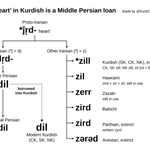
In light of the recent controversy, many Kurds have correctly pointed out that Dilin is a Kurdish name. However, many are incorrectly asserting that “dil”, meaning heart, is not a Persian loanword. The native Kurdish word for heart would be zill, which is now out of use and has been replaced by the Persian word dil. Ultimately, both come from the same Proto-Iranian root. Given the Kurdish sound change rd > ll and the Old Persian change *ĵ > d, one would chronologically expect Middle Persian or Classical Persian to be the source of the loan (since modern Persian renders it as Del, and Kurdish has evidently used it for a long time). In the chart, I have opted for a Middle Persian route because, generally speaking, that is when Kurdish contact with Persian was more extensive. The "în" in Dilin is the Kurdish suffix with which intransitive verbs are formed from certain simple nouns which derives from proto Iranian *-a- (thematic vowel) + *-iHnah.

R1a-Z93 > CTS6: a complete guide and clarification. The Y-DNA lineage R1a-Z93 > CTS6 is shared between Ashkenazi Jews (~11.6% of their FTDNA matches), Kurds, Azeris, “Persians”, Armenians, Spaniards, and now a Pamiri from eastern Tajikistan. This post explains where it comes from and clears up some common misconceptions.
First, the obvious. R1a-Z93 (2644 BCE) is an Indo-Iranian lineage derived from the eastern Corded Ware offshoots, Fatyanovo > Sintashta. This is well established by the countless ancient samples we have.
Why CTS6 is harder to place. R1a-Z93 > CTS6 (1308 BCE) is much trickier to assign to a specific Iranian branch at first glance, because there are no notable ancient samples on this line. That leaves the diversity of modern testers as the main guide, and the modern Iranian-speaking world carries the largest hub of R-CTS6 diversity. Several additional facts reinforce why Iranian-related peoples hold this diversity.
Its important to note that around 1500 to 1000 BCE, the Iranian world was breaking into two cultural spheres: a proto-Scythian/Saka camp and what we can call an Avestan/Zoroastrian camp. Lineages from either side almost never overlap and become divergent, both autosomally and in Y-haplogroups.
The proto-Saka/Scythian camp is roughly defined by Mongun-Taiga/Sagsai > DSKC, Karasuk, whatever the Idzhim burials should be classified as, and perhaps Baitag in south-western Mongolia. Scythians are among the most extensively tested ancient populations. We have hundreds of samples from proto-Scythian-derived peoples, and not a single one has ever yielded R1a-Z93 > CTS6. They only ever carry lines such as R-S23592 and Q-L330. The Khazars, an Oghuric branch of the Turks, have also never yielded CTS6 in ancient samples, and typically carry the same kind of Scythian lines from their Iranian side.
The SCA Avestan/Zoroastrian group, by contrast, can be linked to the Yaz-Dahistan phases, Chust and related cultures. We have only a couple of samples from these peoples, which is why SCA-derived lineages usually lack associated ancient DNA. This is largely due to limited excavation in places tied to this type of Iranian activity. Zoroastrian sky burial does not help either, since vultures and the sun leave no remains. On top of that, Iranians are very poorly tested on FTDNA and YFull, where most testers from Iran are Arabs, Jews, Armenians and others. The two most divergent R-CTS6 clades are carried by Achomis in the gulf.
Because R-CTS6 dates so close to the proliferation of the Iron Age Avestan Iranians, who had not yet migrated onto the Iranian plateau in significant numbers, it is not possible to pinpoint which exact subgroup was responsible for bringing this lineage into the Jewish population. Logically, it would have been Iranians living in the vicinity of Jews.
The Pamiri’s connection to Ashkenazis, predicted around 700 BCE, is still too distant to be of direct relevance, since that is roughly when “western Iranians” began migrating onto the plateau. The Pamiri branch could therefore simply descend from an Iranian who went east instead. It should also not be ruled out that this Pamiri inherited the lineage through backflow from populations further west. After all, Pamiris even carry E-M81 and E-M2 lines.
Strictly speaking, this branch cannot be both Persian and NW Iranian. Linguistically, Persian dialectal forms long predate the Avestan age and were only later assimilated into that social grouping. It has to be one or the other. It's not possible to know for now which one it is, but NW Iranian movement seems more likely.
Clearing up common incorrect claims:
- Pamiris being Scythian. No, Pamiris descend from the Avestan cultural bubble that proliferated out of south central Asia during the iron age (also not Sogdian related).
- There are no confirmed ancient Turkoman samples on this lineage. This 1x coverage medieval Turkoman attributed to R-CTS6 on Carlos Quiles’ sheet is a mislabel. FTDNA shows that DA126 only has enough coverage to reach generic R-Z93, and not any further. Listed as Almaly 126.
- We have no Mitanni R1a-CTS6 samples. Had the Mitanni carried R-CTS6, we would expect a much more western modern distribution, since they disintegrated far outside the Iranian core lands.
- Not a single ancient Alan sample has this haplogroup.
- The Spanish branch clusters upstream and downstream with Armenians and Azeris. The far more logical explanation is descent from Muslim Iranian converts, who are attested in large numbers in Islamic Iberia.
- Ashkenazis carrying SCA Avestan-type lineages is not unusual. Several of their major lines, together roughly 30% of their Y-DNA, are of this type: R1a-BY33370, R1a-Y2619, G-L201, G-BY21343, G-BY764, R2-FGC13211 and Q-Y2200.
- Hazaras testing positive for R-CTS6 (no terminal resolution) is entirely unsurprising. Hazaras, for example, carry around 10 to 15% "west Iranian" Y-DNA.
This post is of interest to @JewishGenomics @iosif_lazaridis @nrken19 @Afghan_DNA @aboutadna

I plotted every historical activity involving Kurds on a map, from classical antiquity to the aftermath of the Islamic conquests (c. 240 BCE–700 CE). On the right, I’ve tabulated the sources on which they are based.
This does not include Corduene, Karduchoi, etc., as these are linguistically unrelated terms, and Kurds settled these lands later as foreigners to the region.
The Kurds in this era were not a generic term for Iranian nomads or shepherds. They are explicitly mentioned as a specific tribal organisation among many other old Iranian tribal organisations. This era predates the ethnic character that Kurds acquired after the development of the Islamic age.
I will be making many more exhaustive maps in the future, detailing all things related to Kurdology. A map of the Kurds of the early Islamic era is currently being completed and will be released in the coming month.
Open the map in a new tab for higher resolution.

Does the Kurdish feature of ergativity come from Hurrian? No. Below, I have tabulated how alignment in past transitive clauses works across various Iranian languages. Ergativity appears across the Iranian language family, in Pashto, Balochi, Yaghnobi and the "Pamir" languages (in decayed forms). Modern Standard Persian has lost this feature, but Middle Persian still had it, and Achomi, a close relative of Persian, still does. Hurrian ergativity worked differently: it applied in every tense, and the verb agreed with the doer.
Of course, no serious linguist has ever suggested this common folk belief that Kurdish got ergativity from Hurrian.

New paper: "Ethnoarchaeological Insights into Seasonal Settlements: The Bardeh Mar Site in Hawraman During the Islamic Period" by Amir Saed Mucheshi (University of Kurdistan, Sanandaj, Iran), Ethnoarchaeology (Routledge, 26 Aug 2026).
Bardeh Mar, a stone-built site in the Hawraman region that looks like an ordinary village, was most likely a winter camp (hawār) used by local herding communities.
The site: Bardeh Mar lay on a terrace of the Sirwan River below Mount Shahou, Kurdistan Province, Iran, at just 784 m. It was excavated in 2015 as a rescue dig before the Darian Dam reservoir filled, and is now underwater. With nearby Sarcham, it is one of the first excavated settlements with standing architecture in Hawraman.
What was found: round and oval houses of unworked stone laid without mortar or plaster, hearths, grinding stones, beads, a few iron objects, clay tobacco pipes and mostly handmade, poorly fired brown pottery. Two nearby cemeteries hold plain, stone marked Islamic graves.
Dating: there are two main phases. Radiocarbon places the lower one in the Seljuk to Ilkhanid era (c. 11th to 14th century). The upper one dates to c. 18th to 19th century, most likely Qajar, based on thermoluminescence and the style of its tobacco pipes.
Comparable pottery: the lower layer's handmade brown wares are better fired and more often decorated with cordons and incised lines. They resemble brown wares from Takht-e Soleiman (Ilkhanid), Hasanlu (Period I, Ilkhanid), Siraf and Tepe Sarqaleh in Hawraman. The upper layer's coarser, heavily mineral-tempered brown wares belong to the later phases of a long-lived Kurdish handmade pottery tradition, recorded in the Shahrizor plain of Iraqi Kurdistan and around Bisotun. One upper-layer clay pipe bowl, with vertical grooves and incised lines forming a rough triangle, closely resembles pipes from Dongola in Sudan, Veštar Cove in Croatia, Tell Madhhur in Iraq and Ramla (Ottoman), all dated mainly to the 17th and 18th centuries.
Not a village: permanent Hawrami villages are dense and stepped up the mountainside, with the roof of one house forming the courtyard of the one above. Their walls are plastered inside and reinforced with horizontal timber beams (dimak). Bardeh Mar has none of this. Its houses are round, scattered and cheaply built. Its pottery has few shapes and none of the large storage jars a year-round household would need.
The hawār connection: Hawrami herders traditionally moved between their villages and seasonal camps called hawār. The summer ones are well known, such as Aspehriz's camps at Hānata and Garlde, at roughly 1,900 and 2,300 m. Less well known is that some villages also kept winter hawār in the valleys, where snow clears first and grazing returns earlier. Naw, above the Sirwan valley, did so until about 50 years ago. Bardeh Mar's round huts closely resemble the kalar, the circular dry-stone huts still built in hawār today.
Conclusion: Bardeh Mar was most likely a winter hawār, reused over many seasons. Its pottery was made from local clays in the regional tradition. Similar low-lying circular stone sites along the Sirwan, such as Gelwan near Hajij and Pacha near Naw, suggest it was part of a wider pattern.
Limits: only two small trenches could be dug before the site flooded, no complete building plans were recovered, and the paper presents no direct seasonal evidence such as animal teeth or plant remains.


