SEO @Shopify. Tweets are mine. Formerly @Tripadvisor, @Vistaprint.
Boston, MA
Joined May 2013
- Tweets2.8K
- Following865
- Followers1.3K
- Likes2.1K






Kyle Risley retweeted

Nice find, Glenn.
"When Google doesn't know the quality or popularity of a URL, it uses the aggregate for its parent path. Then that path's parent, and so on."
Let's connect that to the DOJ findings and attributes we know of from leaks (my own logical inference ahead):
"When Google doesn't know the quality (Q* Quality) or popularity (P* Popularity) of a URL (T* Topicality), it uses the aggregate for its parent path (NSR). Then that path's parent, and so on (predictedDefaultNsr)."
New Site Rank (NSR) - an attribute from Google leaks - specifically, predictedDefaultNsr operating across subchunk path hierarchies - is one of the exact mechanisms behind the parent-path fallback behaviour.
It solves the "cold start" problem for new or low-data URLs.
When Google lacks sufficient engagement or page-specific data for a page, it assigns a default predicted score computed by aggregating signals from higher structural levels (parent paths and host level).
The fallback value is driven by predictedDefaultNsr through the subchunk hierarchy, but the confidence weight Google applies to that fallback depends on siteQualityStddev (Standard Deviation).
The leaked API also contains rhubarb, defined as a "Site-URL delta signals based quality score." While a new URL inherits its baseline from predictedDefaultNsr, the system actively measures how far the page strays from its parent path's baseline once crawled.
This means inherited authority provides the initial entry score, but the page-level delta score quickly overrides it if the document is thin or low-quality.
This is what "Domain Authority" actually is - and why it is easier to SEO a site with a lot of online business reputation than a new site. Domain Authority is an emergent property of New Site Rank’s structural fallback system.
It is the aggregate site-level baseline (Q*and P*) that leaks downward through parent path subchunks to give newly published URLs an instant head start or a severe drag.
I'll caveat this with this: Google's ecosystem is incredibly layered; while predictedDefaultNsr heavily drives what the industry calls DA, it likely interacts with other host-level signals (like sitewide NavBoost/click data and Chrome user data) to create the full "authority" effect. Let's not forget PagerankNS.
My hypothesis therefore would logically be: Domain Authority is predictedDefaultNsr.

Google about Crawl Budget (and specifically Crawl Demand). From Google Search Central Live Barcelona (via John Campbell of ROAST) -> When Google doesn’t know the quality or popularity of a URL, it uses the aggregate for its parent path. Then that path’s parent, and so on.
weareroast.com/news/google-s…


Kyle Risley retweeted

🎉 UCP 2026-08 release is out. MASSIVE upgrade.
👉🏻 shopify.com/ucp/2026-08/
Agents can prove their identity and negotiate identity providers for the buyer; read the terms that govern a purchase down to the individual line item; split a payment across instruments (e.g. gift cards) without splitting the checkout; negotiate payment terms and schedules (due now vs. later); find nearby physical stores that carry what they need; transact in any unit (each, weight, length, whatever); navigate a 3DS challenge with new action primitives; use and build cart permalinks that can travel anywhere a URL can go (QR codes, email, chat), ..., and SO. MUCH. MORE.
88 improvements. 40 contributors. 21 weeks.
Agents: time to cook!

ALT Interactive tour of 2026-08 UCP release
Kyle Risley retweeted
@ChatGPT built-in browser speaks WebMCP and millions of @Shopify storefronts are live and ready! 🎉
That's a huge milestone and upgrade for your agent, which can now use site provided tools and efficiently explore merchant's catalog, build carts, and more.
Pumped to support @OpenAI WebMCP challenge too: openai.com/webmcp-challenge — join in on the fun!
🤫 p.s. psst, need a winning idea? Head to UCP.new to explore how you can build new shopping experiences with Shopify Global Catalog, then install UCP-cli (github.com/Shopify/ucp-cli) agent skill and let it cook.


We’re adding support for WebMCP in the ChatGPT desktop app’s built-in browser and ChatGPT Sites.
When you visit a compatible website, ChatGPT or Codex can automatically use it to complete your task.
Update to the latest version of the ChatGPT desktop app, then just ask Codex to create a WebMCP-enabled app and deploy it to Sites.
Kyle Risley retweeted
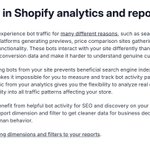
Trying to crawl your Shopify store and getting a 429 "Too Many Requests" response?
🔧Here's how to fix it:
1. Go to Online Store > Preferences in Admin
2. Scroll to the bottom + create a signature
3. Add all three HTTP headers to your crawler
4. Wave goodbye to 429s 👋

/stop-stop-hes-already-dead.jpg

Google AI Overviews with AI-generated images in the wild, after announcing it a month ago - of course, creators are not happy about this, as expected seroundtable.com/ai-generate… via @inspiredtaste


The dominant narrative is that AI search comes at organic search's expense. Our team looked at the Shopify data and that's not what's happening.
(1/x)
Instead:
- AI-referred sessions grew 197% (~3x) YoY
- Organic search sessions grew 12% on a much larger base
For merchants, AI and organic search are complementary discovery surfaces.
(2/x)
Shoppers use them for different reasons, and each channel largely benefits from the same catalog optimization work.
Full breakdown here:
shopify.com/enterprise/blog/…
/end


Pretty cool how you can make a whole career out of knowing the difference between crawling and indexing.
Google indexed Claude Chats because Anthropic didn't block your private chats from search engines searchengineland.com/google-…

Kyle Risley retweeted

The Everywhere Edition is here: If you are on @Shopify, you are everywhere your customers are shopping.
This Edition features some key updates to Agentic Storefronts, Catalog and UCP because we want to be clear that if you want on Shopify you are everywhere by default.
Every Edition is intentionally overwhelming. It’s a celebration of the progress we’ve made each season and serves as a complete list of features for those who want to pay attention.
To make it easier to parse, I broke down some of my favorite features among the 200+ and explained some of the ambition behind them.
Kyle Risley retweeted
UCP 2026-04-08 is out 🎉 and it's a step function upgrade for agentic commerce 🦾
TL;DR: we've landed support for product discovery, cart building, personalization and eligibility claims across the full discovery→ cart→checkout journey, plus order tracking. UCP now covers the full purchase journey.
1/ 🔍 Catalog capability — enables product discovery via search query, lookup by ID, and get-product for fine-grained variant and option resolution.
2/ 🛒 Cart capability — enables basket building with live totals, discounts, and seamless handoff to checkout. Bonus: transport binding for embedded flows alongside MCP & REST.
3/ 🗒️ Order capability — new endpoint to retrieve order status by ID, complementing the existing webhook spec for real-time updates.
4/ 🙋 Context & intent fields — agents can now signal user intent and context so merchants can tailor results, offers, and experiences across catalog, cart, and checkout.
5/ 🔐 Signals — structured input for agents to pass authorization and abuse-prevention data to merchants. Trust negotiation, built into the protocol.
6/ 🪪 Eligibility claims — agents can assert verifiable claims (loyalty tier, membership, etc.) that merchants evaluate for conditional offers and discounts.
7/ ⚙️ And a *long* tail of other improvements: structured error model, request & response signing, version negotiation, disclosure messages for legal compliance, new delegation methods for embedded transport... the list goes on.
Spec: ucp.dev/2026-04-08/specifica…
Changelog, for the curious: github.com/Universal-Commerc…
p.s. we're in the final stretch of polishing the Shopify implementation for all of the above - coming soon to every Shopify-powered storefront near you 😎. See shopify.dev/agents.