

Learning Designer|Scaling inclusive learning with a dash of social awareness|Storyboarding pro|Content Creator|Painting 🎨|Badminton🏸 battler|Sylvanist 🌲 🌴☘️
Hyderabad
Joined August 2011
- Tweets2.5K
- Following202
- Followers248
- Likes3.1K




Pinned Tweet
@cmohry @sumitamisra
मैं अपना पिछला अनुरोध फिर से साझा कर रही हूँ।
आशा है कि संबंधित अधिकारी इस मामले में नियमों के अनुसार जल्द उचित निर्णय लेंगे।
पूरी जानकारी संलग्न वीडियो में है। 🙏

It has been 8 months, and my Father's land mutation in Ambala Cantt is still pending.
Even after a formal memo from higher authorities, the concerned Anuj Patwari continues to delay the process by repeatedly asking me to “come tomorrow,” without providing any written reason or timeline.
This is not a delay. This is harassment.
@anilvijminister
@ambala_dc1
@cmohry
I request your urgent intervention.
🇮🇳What does it take to bring more than 560 princely states into one nation?
Courage, political wisdom, determination and the ability to put national interest above everything else.
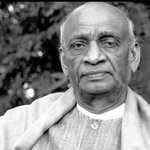
Born on 31 October 1875 in Nadiad, Gujarat, Sardar Vallabhbhai Patel rose from a successful lawyer to become one of India’s most influential freedom fighters and nation-builders.
His leadership during the Kheda Satyagraha of 1918 and Bardoli Satyagraha of 1928 established him as a powerful voice for farmers. His success in Bardoli earned him the title “Sardar.”
But his defining contribution came after independence in 1947.
As India’s first Deputy Prime Minister and Home Minister, Patel worked closely with V. P. Menon to integrate hundreds of princely states into the Indian Union. His diplomatic skill, firm decisions and strategic leadership were particularly significant in Junagadh and Hyderabad.
He also championed the All India Services, recognising their importance in maintaining administrative stability and national cohesion.
Today, the 182-metre Statue of Unity in Gujarat honours his extraordinary legacy. Yet his most enduring achievement remains the political integration of India.
Patel’s life reminds us that building a nation requires more than winning independence. It demands the courage to make difficult decisions and the vision to secure its future.
On his 151st birth anniversary, celebrated as Rashtriya Ekta Diwas, we pay tribute to the Iron Man of India, whose leadership helped shape the country we know today.🇮🇳
#SardarVallabhbhaiPatel #RashtriyaEktaDiwas #NationalUnityDay #IronManOfIndia

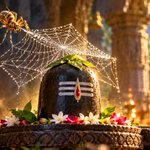
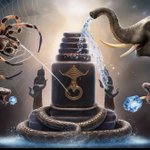
🧵 Did you know the name Srikalahasti is traditionally linked to three creatures?
Sri: the spider.
Kala: the serpent.
Hasti: the elephant.
According to the temple's sacred legend, all three worshipped Shiva in their own distinctive ways.


4/
The elephant brought water and bathed the Shiva Lingam.
Its act of worship came into conflict with the offerings of the other creatures.
According to tradition, Shiva ultimately recognized their devotion and granted them liberation.
🤖 Made with AI

The Mindful Maker retweeted

Shri Guru Charan Saroj Raj, Nij Mann Mukuru Sudhaari
(Cleansing the mirror of my mind with the dust of my Guru's lotus feet)
Barnaun Raghuvar Bimal Jasu, Jo Daayaku Phal Chaari
(I recite the pure, untainted glory of Lord Rama, which grants the four fruits of life: Dharma, Artha, Kama, and Moksha)
Buddhiheen Tanu Janike, Sumiraun Pawan-Kumar
(Knowing that my body and mind lack intelligence, I remember the Son of the Wind)
Jai Hanuman 🙏
Jai Shri Ram 🙏

Hanuman Ji possesses immense cosmic strength, yet due to a childhood curse by sages, he completely forgets his own capabilities until he is reminded of them in the service of Lord Rama.
The Spiritual Lesson:
This beautifully mirrors the philosophy of bhakti. Hanuman Ji does not carry an ego about his strength. His powers only awaken when they are needed to serve a higher, divine purpose. For him, power without bhakti is meaningless.
Rewriting Destiny via the Ramayana
There is a famous lore where Hanuman Ji began carving his own version of the Ramayana on the rocks of the Himalayas using his fingernails. His version, the Mahanataka, was so structurally perfect and filled with pure, ecstatic devotion that it completely eclipsed the version written by the sage Valmiki.
When Valmiki saw it, he was heartbroken, realizing his beautiful epic would be forgotten. Moving out of pure, selfless love and empathy, Hanuman Ji instantly threw the heavy stone tablets into the ocean to preserve Valmiki's joy.
This shows that to a true bhakta, fame, legacy, and recognition mean absolutely nothing; only the happiness of others and the love for the divine matter.
Perhaps the most visually striking depiction of his devotion is when he tore open his own chest to reveal the images of Rama and Sita residing within his heart. This happened when he was gifted a priceless pearl necklace by Sita, which he began chewing and breaking apart. When questioned why he was destroying such a precious gift, he replied that he was looking inside the pearls to see if they contained Rama's name. When skeptics mocked him, asking if Rama was inside him, he tore open his chest.
The Spiritual Lesson:
This represents Dasya Bhava (the attitude of a servant) taken to its absolute zenith. It implies that Hanuman Ji has no independent identity; his very life force, anatomy, and consciousness are entirely woven from the fabric of his Lord.
He is Higher than the Destination
In the Bhagavad Gita, Lord Krishna states that the true devotee eventually merges with the divine. However, Hanuman Ji breaks this mold. He chooses not to merge into liberation (Moksha). He explicitly asks to remain on Earth as a Chiranjeevi (immortal) for as long as the name of Rama is chanted.
For Hanuman Ji, the act of loving and serving God is sweeter than achieving liberation. He chose the journey over the destination, proving that bhakti is not just a means to an end, but the highest end itself.
Jai Hanuman 🙏
Jai Shri Ram 🙏

☀️🪔 Why is Kartik mas astronomically significant?
As Earth’s axial tilt causes the Sun’s apparent position to move southward, daylight hours shorten across India.
Sadhguru Ji connects this seasonal decline in daylight with lighting lamps as a symbol of awareness and inner illumination.
The shortening days are astronomy; the meaning of the lamps is spiritual interpretation.

Why do Hindus light thousands of lamps during Kartik Maas? Is it merely a beautiful tradition, or does it carry a deeper meaning rooted in ancient scriptures?
The Padma Purana, Skanda Purana and Sadhguru revealed different dimensions of Deep Daan.
1/n

Kartik Snan: Why Is Bathing Before Sunrise Considered Sacred?
Kartik Snan is an ancient Hindu religious practice of bathing early in the morning during the sacred month of Kartik but its significance goes far beyond cleansing the body with water.
According to the Padma Purana (Uttara Khanda, Chapter 93) and Skanda Purana (Vaishnava Khanda, Karttikamasa Mahatmya, Chapter 4), Kartik Snan is associated with spiritual purification, devotion, self-discipline and the accumulation of religious merit.
Why is it performed before sunrise?
The Skanda Purana describes approaching the bathing place approximately 48 minutes before sunrise. This early hour is traditionally valued for prayer and spiritual practices, when devotees can begin their day with remembrance of the Divine rather than immediately becoming occupied with worldly activities.
Why is water considered sacred?
In Hindu tradition, rivers such as the Ganga, Yamuna, Godavari and Narmada are revered as sacred. Bathing in their waters during Kartik is believed to help purify accumulated sins and support spiritual progress.
However, the scriptures do not limit Kartik Snan to sacred rivers alone. The Skanda Purana also discusses bathing in ponds, lakes and other water sources, and makes allowances for those who are unwell.
What makes Kartik Snan different from an ordinary bath?
The Padma Purana explains that the practice involves more than entering water. Devotees remember Lord Vishnu, Damodara, Shiva, Surya and the sacred rivers, undertake a religious vow, offer prayers and continue with worship after bathing.
The intention behind the bath is therefore as important as the physical act.
What is its deeper spiritual significance?
Kartik Snan brings together three essential elements of spiritual practice:
Purification: The ritual expresses the aspiration to overcome impurities and past wrongdoing.
Discipline: Rising early and observing a daily vow cultivate consistency and commitment.
Devotion: Beginning the day with prayer directs one’s attention towards the Divine.
Sadhguru describes Kartik as a spiritually significant transition from Sadhana Pada, the period of spiritual cultivation, towards Kaivalya Pada, associated with experiencing the fruits of one’s sadhana.
Water may cleanse the body, but transforming the way we think, speak and act requires conscious effort.
The sacred bath becomes a daily reminder to approach life with greater purity of intention, devotion and awareness.

15/n
Sadhguru recommends lighting three lamps during Kartik:
One for yourself.
One for someone dear to you.
One for someone you dislike.
This brings the practice into the realm of human relationships, not just ritual worship.
🤖 Made with AI

