

Trustless Data Compliance & User Monetization for the AI Economy
Joined May 2025
- Tweets437
- Following40
- Followers68
- Likes17






Pinned Tweet
We are building a decentralized trust layer for the new data economy. Grant or revoke consent to your data, and earn a share of what it generates💰
More info coming soon...
layerd.org

3
2
764
You tap "Accept" on a dozen screens a week.
Ask yourself: which apps hold your yes today, and what did it cover?
Individuals should be able to see that. It's what we're building toward.
4
Your logs prove what your system recorded.
They can't prove to a partner that nobody changed them later.
Independent verification is a different job from record-keeping.
4
A model team inherits a training set from an aggregator. Three hops back, someone collected it.
Before you train, ask one question: can the provenance be checked, or only trusted?
3
We get asked: "Is the consent data on the blockchain?"
No. Raw personal data and full consent records stay off-chain.
What goes on-chain is a cryptographic proof that a receipt exists and hasn't changed.
2
The product team shipped a new SDK on Friday.
By Monday, a new data flow was live.
But had anyone checked whether the original consent covered it?
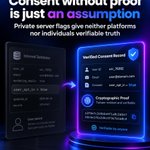
A new data flow needs a fresh consent check, not an assumption that old permissions still apply.
4
Your CMP says a user opted out.
Your data partner's system says nothing changed.
Which record do you trust?
Without independently verifiable consent evidence, resolving that disagreement becomes much harder.
2
A buyer reads the last line of a data contract: "All records are consented."
Nobody on the call can say who wrote that line, or how to check it.
A claim you can't verify is still a claim.
1
A user declines consent. Six months later, can you prove it?
LayerD creates verifiable consent receipts, anchors cryptographic proofs on-chain, and lets data partners check consent status.
No personal data on-chain. Just verifiable proof.
#LayerD #DataPrivacy
3
You've tapped "Accept" hundreds of times.
But can you see what you've agreed to?
What data you allowed to be used. Who you gave permission to. Whether that permission is still active.
Which of these would you want to check first?
1
A data feed is already in your pipeline.
Then someone asks: “Who collected this data first?”
Nobody knows.
Before activating a dataset, ask four questions:
1. Where did it come from?
2. Can consent be verified?
3. Is that consent still active?
4. Can an independent party confirm it?
3
The permission screen had two buttons, and my neighbor tapped "Accept all" in about one second. Then she asked me what she'd just agreed to. Nobody could tell her.
Three questions fix that. Ask them after any sign-up.
1. Who holds my data?
Not "the app" in general. A named company, and the partners it passes your data to. You keep the right to ask.
2. What did I say yes to?
Location, contacts, ads, sharing with others. Each one is a separate choice you made, and you can change it.
3. Could anyone prove it later?
A receipt can. It records your decision and anchors a cryptographic proof on a public blockchain. Your personal data never goes on-chain, only the proof that you chose.
If you can answer all three, you're in control. If you can't, you've found the gap.
Here's a screen that fails question 2: two buttons, "Accept all" and "Manage," where location, contacts, ads and sharing sit behind one yes. That's one tap for four choices, and no receipt for any of them.
Send it to whoever owns your sign-up flow. Ask them which of the three questions their screen can answer.
8
A line in a media plan reads "Auto Intenders, 2.4M devices." Someone asks the buyer where the consent came from.
The answer was a contract clause and a slide.
Curious how this works on your side. When you buy a segment, what shows up as proof that the people in it agreed to be there? A contract line, a dashboard screenshot, or something you can check yourself?
4
Imagine a simple list on your phone: who has your data, and what you said yes to.
That's the kind of visibility we want people to have.
5
We spent 20 minutes on the blockchain and 2 on what goes onto it.
Then a product lead stopped us: "So where does my users' data end up?"
Nowhere on-chain. Only a cryptographic proof of a signed consent receipt goes there. No raw personal data, no full consent records.
Pass this along to anyone who still hears "consent on a blockchain" and pictures personal data on a blockchain.
4
The feed is 40 million records. The seller's whole assurance is one line: "all of it is consented, no need for heavy indemnities."
Your legal team is waiting on your call.
What would you need to see before you load it?
1. An export of their consent logs.
2. An audit report from a third party.
3. A check you run yourself, on your side, without asking them.
Here is the third one in practice: pull a sample of records and verify each cryptographically signed receipt against its device identifier, on your side, before the contract is signed.
A receipt that won't verify, or that points to no device, is a claim with nothing behind it. That is the gap the sample catches, and it's the one to bring to your legal team.
At LayerD, a decentralized Proof of Consent infrastructure, the gap between a claim and a cryptographically signed receipt is the whole job.
Which of these three checks does your team run before a data load today?
7
A buyer asks one question at the end of a data deal: "Can you show me the consent for these records?"
Your CMP export answers with a timestamp. A cryptographic receipt anchored on a public blockchain answers with proof anyone can check.
Only one of those holds up when the buyer asks a second question.
2