

SEO nerd. Helping SaaS brands become the answer in AI search.
Reddit Marketing 👉
Joined July 2009
- Tweets32.9K
- Following747
- Followers30.3K
- Likes7.9K




The DevOps engineer.


Binance's initial investigation suggests that the security incident may involve a compromised DevOps engineer’s laptop, which allowed an attacker to gain access to a service container and submit unauthorized withdrawal transactions. We have found no evidence of any wallet private key leak. We will share a detailed technical post-mortem once the investigation is complete and the facts are fully verified.
The estimated total impact sits at around $6.3B. We have worked with blockchain partners to freeze affected assets, with ~$3 billion frozen on-chain so far.
Binance will cover all losses from the SAFU fund and the company’s funds. User funds are safe. We will also publish an updated Proof of Reserves once the remediation is complete.
As an immediate precaution, Binance has:
- temporarily suspended deposits and withdrawals while security checks are completed;
- revoked the affected address authorisation;
- engaged law enforcement and blockchain intelligence partners to trace and recover funds.
Our teams are working around the clock to resolve this issue safely and thoroughly. We are working closely with our law enforcement partners to confirm the identity of these criminals and bring them to justice.
Please rely only on official Binance channels for updates. Please feel free to contact Binance Customer Support if you have any further questions.
binance.com/en/support/annou…

Biggest crypto heists ever:
1. Binance (Oct 2026) – $6.3B
2. Bybit (2025) – $1.5B
3. Ronin (2022) – $625M
4. Poly Network (2021) – $611M*
5. Coincheck (2018) – $530M
6. Mt. Gox (2014) – $473M
7. Wormhole (2022) – $320M
Yesterday’s Binance hack is 4x the previous record.
North Korea is blamed for the top 3.

BREAKING: Binance has been hacked with wallets across the Ethereum, Bitcoin, and TRON networks seeing outflows of -$5.7 billion.
The hack includes $1.45 billion worth of Bitcoin and $875 million worth of ETH.
If confirmed, this would mark the biggest hack in crypto history.
We expect more information shortly.
Alek Asaduryan retweeted
Google is spending tens of billions a year on AI data centers, chips, and models.
That money has to come from somewhere, and search ads are the only machine big enough to pay for it.
So the machine gets squeezed:
1/ Exact match that isn’t exact.
2/ Close variants that keep expanding.
3/ Auction pricing nobody outside Google can audit.
Every advertiser on Google Ads is now quietly funding Gemini.
And here’s the irony: the more Google spends on AI, the more people get their answers from AI instead of clicking ads.
The ads business is paying for the thing that’s replacing it.

As someone who has personally spent $500k / mo+ on Google Ads for years, I can tell you with certainty:
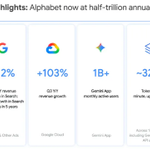
This revenue growth in Search is artificial & extremely unhealthy for Google’s business long term
Search volumes are declining as legacy search is being increasingly cannibalized by non-monetized LLM queries
Google’s response?
Manufacture revenue growth via short-sighted, highly extractive, customer-hostile tactics. I.e. charge advertisers more for lower quality clicks, including clicks they do not want and explicitly did not approve Google to charge them for
A few examples to illustrate:
For all of its history until recently, Google operated on a 2nd price auction model
I.e. if you bid $5 CPC and the next highest bidder bids $1 CPC, Google charged you $1.01 for the click (one penny more than the 2nd highest bidder) rather than the $5 you bid
This was a genius move by Google early on as it incentivizes advertisers to input their true maximum willingness to pay rather than trying to play the game of bidding low and constantly adjusting to try to stay just ahead of the next highest bidder while still not paying too much
However recently, Google silently deprecated the 2nd price auction and began charging advertisers as much as their bid and budget caps allow, regardless of what anyone else is bidding
It’s a short-sighted cash grab at the expense of the long term health of the advertiser ecosystem
Making thing worse, Google also recently nerfed keyword targeting precision
Google previously had precise keyword targeting settings that allowed advertisers pick individual search phrases to bid on, defined down to the character w/ exact match or phrase match targeting
This was one of the core features that made search advertising magic, enabling advertisers to run extremely precise campaigns based on exactly what their target customer typed
But now, even if you bid on a specific term or phrase using the strictest exact
-match targeting settings, Google will show your ad across 1000’s of unrelated keywords, labeling them as as “exact match (close variant)”
The definition of “close variant” means whatever they want it to and changes constantly. The result is advertisers get billed for clicks that are totally irrelevant to their business and that their targeting settings explicitly forbid Google from targeting. Google does it anyway and there’s no ability to turn this off
So now exact match is broad match, and broad match is just meaningless spam
This is all very bad for advertisers, but for Google, it allows them to show your ad and bill you for clicks across 1000x more searches that were previously going unmonetized (mainly because they’re garbage queries no one wants)
This is how you grow revenue atop declining search volumes
Lastly, and perhaps most egregiously, Google quietly stopped respecting budget caps by a factor of 2x. For example campaigns we’ve been running for years with $1000 daily budget caps suddenly began spending $2000+ per day
And the extra spend is entirely on the garbage keywords Google arbitrarily throws in as “exact match (close variants)” which have no value to our business, but can’t be turned off
Google offers no refunds nor any recourse for overspend or spend on keywords you explicitly did not target
These are not the actions of a healthy business. These are the actions of company whose core business is in decline but desperately needs to pump quarterly earnings so Wall Street will continue to fund insane capex while hopefully looking through their rapidly deteriorating negative free cash flow
Google operated a benevolent monopoly for the better part of 25 yrs
Meaning the value Google captured from Search was but a small fraction of the value it created, and that spread produced a potential energy that justified expectations of high earnings growth far, far into the future
This is now no longer the case
At the alter of AI capex, Google is sacrificing the golden goose
Reddit just reported its best quarter ever: $895M revenue, +53% YoY.
But the call also revealed that Google is quietly cutting Reddit off, and that Reddit is about to wall off its content.
10 takeaways from Q3 that matter for anyone in SEO, GEO or Reddit marketing 🧵

The takeaway:
Reddit is no longer a free SEO side door. It’s turning into a walled garden that charges for access.
If your strategy relies on Reddit threads ranking on Google or getting cited by LLMs, plan for less of both.
Follow for more on SEO, GEO & AI search.

Google is spending tens of billions a year on AI data centers, chips, and models.
That money has to come from somewhere, and search ads are the only machine big enough to pay for it.
So the machine gets squeezed:
1/ Exact match that isn’t exact.
2/ Close variants that keep expanding.
3/ Auction pricing nobody outside Google can audit.
Every advertiser on Google Ads is now quietly funding Gemini.
And here’s the irony: the more Google spends on AI, the more people get their answers from AI instead of clicking ads.
The ads business is paying for the thing that’s replacing it.
As someone who has personally spent $500k / mo+ on Google Ads for years, I can tell you with certainty:
This revenue growth in Search is artificial & extremely unhealthy for Google’s business long term
Search volumes are declining as legacy search is being increasingly cannibalized by non-monetized LLM queries
Google’s response?
Manufacture revenue growth via short-sighted, highly extractive, customer-hostile tactics. I.e. charge advertisers more for lower quality clicks, including clicks they do not want and explicitly did not approve Google to charge them for
A few examples to illustrate:
For all of its history until recently, Google operated on a 2nd price auction model
I.e. if you bid $5 CPC and the next highest bidder bids $1 CPC, Google charged you $1.01 for the click (one penny more than the 2nd highest bidder) rather than the $5 you bid
This was a genius move by Google early on as it incentivizes advertisers to input their true maximum willingness to pay rather than trying to play the game of bidding low and constantly adjusting to try to stay just ahead of the next highest bidder while still not paying too much
However recently, Google silently deprecated the 2nd price auction and began charging advertisers as much as their bid and budget caps allow, regardless of what anyone else is bidding
It’s a short-sighted cash grab at the expense of the long term health of the advertiser ecosystem
Making thing worse, Google also recently nerfed keyword targeting precision
Google previously had precise keyword targeting settings that allowed advertisers pick individual search phrases to bid on, defined down to the character w/ exact match or phrase match targeting
This was one of the core features that made search advertising magic, enabling advertisers to run extremely precise campaigns based on exactly what their target customer typed
But now, even if you bid on a specific term or phrase using the strictest exact
-match targeting settings, Google will show your ad across 1000’s of unrelated keywords, labeling them as as “exact match (close variant)”
The definition of “close variant” means whatever they want it to and changes constantly. The result is advertisers get billed for clicks that are totally irrelevant to their business and that their targeting settings explicitly forbid Google from targeting. Google does it anyway and there’s no ability to turn this off
So now exact match is broad match, and broad match is just meaningless spam
This is all very bad for advertisers, but for Google, it allows them to show your ad and bill you for clicks across 1000x more searches that were previously going unmonetized (mainly because they’re garbage queries no one wants)
This is how you grow revenue atop declining search volumes
Lastly, and perhaps most egregiously, Google quietly stopped respecting budget caps by a factor of 2x. For example campaigns we’ve been running for years with $1000 daily budget caps suddenly began spending $2000+ per day
And the extra spend is entirely on the garbage keywords Google arbitrarily throws in as “exact match (close variants)” which have no value to our business, but can’t be turned off
Google offers no refunds nor any recourse for overspend or spend on keywords you explicitly did not target
These are not the actions of a healthy business. These are the actions of company whose core business is in decline but desperately needs to pump quarterly earnings so Wall Street will continue to fund insane capex while hopefully looking through their rapidly deteriorating negative free cash flow
Google operated a benevolent monopoly for the better part of 25 yrs
Meaning the value Google captured from Search was but a small fraction of the value it created, and that spread produced a potential energy that justified expectations of high earnings growth far, far into the future
This is now no longer the case
At the alter of AI capex, Google is sacrificing the golden goose
Apple didn’t raise prices. AI did.
Look at the chart. The more storage, the bigger the jump:
-iPhone 17: +$100
-iPad Air 1TB: +$250
-MacBook Pro 2TB and 4TB: +$400
-MacBook Pro 512GB: gone entirely
Every AI lab on earth is buying chips and memory by the warehouse. The same supply that goes into your laptop is going into data centers, and they’re outbidding you.
So here’s the irony: the AI that’s supposed to make everything cheaper is making your laptop more expensive right now. 😁
You’re not just paying for a MacBook anymore. You’re paying the AI tax.
And Apple, the company everyone says is “behind in AI,” is passing the bill straight to you.


That's a smart move.

Oldest growth hack in the book:
You want to meet someone, so you tell them
"I'm going to be in [insert wherever they are] next week, want to grab lunch?"
They say yes. Then you go buy the plane ticket.
I've done it more times than I'd like to admit.
People say yes to a meeting that's convenient way more than one where you flew in just for them.