

Roman Catholic | Actuary | PhD Student of Aquinas| Lay Dominican Inquirer Usury Catechism: https://nitter.cf/t.co/gRNP7Be0r3 Podcast: https://nitter.cf/t.co/sLjb3HjqvF
Joined July 2021
- Tweets10.6K
- Following180
- Followers452
- Likes8.5K






Pinned Tweet
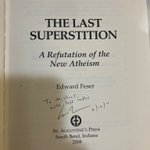
This books contains my defense and clarification of the Angelic Doctor’s arguments against usury and my argument against several common and traditional excuses for usury.
cuapress.org/9780997220537/r…

I understand stock valuation, but statements like this suggests there is something deeply wrong with the way we think about economic value.


When the stock market drops by a significant amount, I’m always reminded of the distinction between real and artificial wealth
Interestingly it appears that Molina thinks even lucrum cessans in delay involves an implicit pact. This is unparsimonious as there is no need for a pact. The cause of restitution arises from the loss cause not some implicit agreement.
It is so frustrating when authors simply dismiss Aquinas as intellectually dishonest rather than discover why he took a position.
Van Roey admits that Aquinas rejects lucrum cessans but suggests he merely follows his contemporaries rather than having robust reasons to reject it that the subsequent Thomist failed to grasp and thus errored in their approval.
Using Claude's Fable to create a broad map of the development of lucrum cessans. Here's the second shot at showing the path of influences.


I blame Peter Olivi, picked up by Sts. Bernadine and Antononius, for the expansion of lucrum cessans.
Juan de Salas, a fellow Jesuit approvingly cited by the "Prince of the Thomists", Juan De Lugo, rejects Molina among a score of others, that St. Thomas approves of any lucrum cessans apart from delay.
"D. Thom. absolute negat, licitum esse pacisci de lucro cessante."
A lot of the elections appear to be like “Should I go with the evil I know or the evil I don’t know?”
I don’t intend to have messy hair, it’s just natural philosopher/actuary/wfh vibes.
media.benedictine.edu/benedi…

1. Voting is a moral obligation of every citizen, therefore one ought to vote.
Positive precepts are not absolutely binding as one can always be hindered from doing them as taught in Veritatis Splendor, therefore, a moral obligation to vote is not absolutely binding.
Negative precents are absolutely bind as one can always choose to do nothing, as taught in Veritatis Splendor. One has an absolute moral obligation not to act irrationally. Voting under present circumstances is irrational. Therefore, one has a moral obligation to not vote rather than to vote.
2. If you don't vote the "bad guys" will win.
As was shown, a single vote is indecisive to the outcome of an election. Therefore, not voting also does not determine who will win.
Further, under present circumstances, there are two parties that have overwhelming control of politics. Historically, which ever one has wone, the bad results one proposes to avoid have occurred. Therefore, the "bad guys" win regardless.
Buddha said “There is a Way I found. Follow it.”
Jesus said “I am the Way.”
If Gautama had met Jesus, he would be Christian.

It is odd that the late Scholastics spend a couple paragraphs proving lucrum cessans and multiple disputations trying to show if a husband can keep the fruits of a security held for a dowry not yet received.

