

We publish independent research on under-followed micro & small caps: business, industry, valuation, and what could change the thesis. Leo Frontier Research.
Atlanta, GA
Joined January 2018
- Tweets3.5K
- Following311
- Followers1K
- Likes2K


$NVDA lost about $1.2tn of market value in the seven trading days Jensen Huang was gone. With him back this morning, it regained about $1tn of it in a few hours.
That's the market putting a price on one founder: roughly a quarter of the world's most valuable chip company.
The SEC and DOJ investigations haven't gone anywhere. Is any CEO worth $1tn?
79
The ECB did use the word subprime. The comparison breaks on who is borrowing.
Subprime borrowers had credit scores under 620, and 18% of 2006 loans were seriously late within a year. Microsoft is rated AAA and covers its interest about 53 times. US data-centre vacancy is 1.4%, a record low, with 80% of what's being built already leased.
The real risk sits one step down, with AI labs that have signed for far more compute than they earn. This week Anthropic raised $79bn of new money in shares, not loans.

Désolé de jouer les rabat-joie juste après l’IPO d’Anthropic. Mais j’ai lu le dernier rapport de stabilité financière de la BCE, et il fait froid dans le dos.
Son constat : la façon dont on finance l’IA ressemble un peu trop aux subprimes.
Pour faire tourner leurs modèles, les géants de la tech construisent des data centers gigantesques. Cette année, la facture devrait avoisiner les 725 milliards de dollars, un montant tel que leurs bénéfices ne suffisent plus à suivre.
Alors ils empruntent.
Et c’est justement dans leur manière d’emprunter que la BCE retrouve des mécanismes qui rappellent la crise de 2008.
---------
👉 Une partie de la dette est invisible
Imaginez que vous vouliez faire construire une maison sans avoir l’air endetté. Vous demandez à un ami de contracter le prêt à votre place, en lui promettant un loyer pendant vingt ans. Sur le papier, aucun crédit à votre nom. Dans les faits, cet argent, vous le devez bel et bien.
C’est le montage choisi par Meta pour son centre de données en Louisiane : 27 milliards de dollars empruntés par une société partenaire, et absents des comptes de Meta.
Chez Microsoft, ce sont 365 milliards de dollars de loyers promis pour des centres de données qui ne sont même pas encore en service.
Au total, la BCE chiffre ces dettes "invisibles" à plus de 4000 milliards de dollars.
👉 L’argent qui tourne en rond (infographie ci-dessous)
Nvidia fabrique les puces. Il va investir jusqu’à 100 milliards de dollars dans OpenAI (ChatGPT), qui se sert de cet argent pour... acheter des puces Nvidia.
Un peu comme un concessionnaire qui prêterait à ses clients de quoi acheter ses voitures, avant de se féliciter de ses ventes record.
Résultat, tout le monde a l’air de vendre énormément, alors qu’une partie de la demande est financée par le vendeur lui-même.
👉 Des promesses, surtout
D’ici 2030, OpenAI s’est engagé à dépenser quelque 600 milliards de dollars en puissance de calcul. Son chiffre d’affaires 2025 ? 13 milliards. Si les revenus tardent à venir, c’est toute la chaîne qui risque de vaciller : OpenAI d’abord, puis ses fournisseurs, puis ceux qui leur ont prêté.
👉 Qui a prêté ?
Les Américains, pour l’essentiel. Pimco, le gérant d’actifs, a mis environ 10 milliards de dollars dans un seul centre d’Oracle. JPMorgan et le japonais MUFG ont monté pour Oracle un prêt de 38 milliards, et il leur a fallu des mois pour trouver d’autres prêteurs avec qui le partager.
Et l’Europe dans tout ça ?
Nos banques ont prêté environ 75 milliards d’euros au secteur, soit à peine 1% de leurs crédits aux entreprises, un risque que la BCE juge limité. Le point faible est ailleurs. Il se trouve du côté de nos fonds et de nos assureurs, qui ont placé jusqu’à un quart de leurs actions dans la tech américaine et achètent de plus en plus d’obligations émises par les géants de l’IA.

130
$IOVA Iovance has sold $292m of its treatments so far this year, more than in all of 2025. On the 1st of January, Amtagvi's price goes up 9%.
The demand came first and the price rise second, and a dearer dose costs no more to make.
8
601
This morning Nasdaq futures were up 2% because Anthropic priced well. By the close, Anthropic was up 17% and QQQ was down 2.2%.
AMD fell 7.7%, Amazon 3.9%, Alphabet 3.5% and Nvidia 3.3%.
An $81bn listing needs $81bn of buyers. Today looks like plenty of them sold other AI stocks to pay for it.
142
Applied Optoelectronics just signed its sixth share-sale programme since August 2025, for up to $550m. Each dollar raised now costs about four times the shares it did in the summer.
Its stock has become a dear way to pay for the expansion. $AAOI

1
187
$PANW is up about 10% on 39% revenue growth. Its GAAP operating profit fell from $309m to $96m.
That gap is what buying growth costs. Amortisation of acquired intangibles rose to $282m from $39m, stock-based pay to $622m from $387m, and the diluted share count is up 18% in a year.
Strip those out and it's a great quarter. They just aren't optional.
1
1
123
Next week the AI trade sits two exams in three days.
Tuesday, Nvidia reports for the first time since Jensen Huang quit, with Wall Street expecting about $109bn of revenue. Thursday, Anthropic is set to list and raise about $61bn, more than twice Saudi Aramco's $25.6bn record.
That $61bn has to come from somewhere, and much of it will come from people who already own the AI trade. With the 10-year near 5.15%, the week may hinge less on AI demand than on who pays for it.
1
150
In a Japanese laboratory, cancer cells supplied an ingredient for a chemical that then slowed their own growth: carbon monoxide.
Researchers at RIKEN tucked a palladium-containing compound into albumin, a blood protein. The protein shields the metal from substances inside cells that would otherwise disable it. Once taken up by the cancer cells, the protected compound used their carbon monoxide to build the active chemical.
The experiments used cultured cells and produced modest effects. Tests in living animals remain ahead. The eventual ambition is to finish making a treatment inside the diseased cell, using part of its own chemistry as the raw material.
141
Nvidia lost its CEO and about $580bn of market value this week.
It's still worth more than AMD, Broadcom and Micron put together.
1
115
$AMD added $224bn of market value in four days for the crime of not being Nvidia.
By 12:48pm today it had handed back $102bn of it. AMD is down 10.6%, Broadcom 5.3%, and Nvidia, the company that actually lost its CEO, 3.2%.
The rivals were priced as the winners of Nvidia's crisis. A day later, the market is less sure the crisis has winners.

153
Six weeks ago $MOD handed its truck and engine cooling business to Gentherm. Last night Bloomberg reported Samsung is in talks to buy what's left.
What's left is a data-centre cooling company. Data-centre sales grew 95% last quarter, orders passed $1B for the first time, and a hyperscaler signed for more than $400M of air handlers through 2027.
The clean-up made Modine much simpler to buy. Wednesday's investor day was meant to set new targets. It may now set the price conversation instead.

1
385
Cerebras has more demand than buildings to serve it.
Cloud demand is running ahead of supply, so Q4 cloud revenue is guided about flat. Nearly all of the guided 40% jump comes from hardware.
The OpenAI contract even prices the wait. If capacity is late, OpenAI gets credits, and Cerebras has already deducted an estimate from its $26.1B order book.
Management says the credits barely touch revenue. December, when new capacity starts, is the date to watch.

130
ADI Global lost $8.65 a share. Nearly all of it is a $660M goodwill write-down, set off partly by its own falling share price.
The real number is the debt. Three months after the Resideo spin, net debt of $792M is about what the whole stock is worth today.

233
$ASTS bears have done the maths: the 2026 guide needs $61M to $111M in Q4, after $42.3M in Q3. What they've left out is last year.
In Q3 2025 AST booked $14.7M. In Q4 2025 it booked $54.3M, 3.7 times as much, as gateway deliveries and government milestones landed at year-end.
This year the low end needs Q4 to be 1.45 times Q3. That's a much smaller jump than the one AST made last December, and it says recent contracts give it upside.
Today the stage belongs to Blacklift, a rocket due in late 2028. The number that matters lands in seven weeks.
Our verdict: the Q4 hurdle is real, but it isn't a rescue. It's the same shape as last year, with a lower bar.

445
$RGTI's headline loss for Q3 was $3.1M. Its cash fell $44.2M.
The gap is accounting. The operating loss was $33.2M on $1.4M of revenue, and non-cash changes in the value of its warrants and earnouts cut the reported loss to $3.1M.
Cash and investments went from $541.3M at the end of June to $497.1M at the end of September. Part of that is building: $42.6M of capital spending in nine months, on cooling capacity and its fab.
$497M with no debt is still a long runway, and the Commerce Department's $100M arrives monthly as costs come in.
Our verdict: ignore the $3.1M. The number to track is how much cash goes each quarter against the 300+ qubit system Rigetti promises for mid-2028.

1
258
$LWLG is down 19% today, and the reason is one sentence on last night's call.
In August, Lightwave Logic said it was aiming for volume production in the second half of 2027. Now it expects 2028, after foundry delays and longer qualification.
The other 2028 date is cash. It had $87.8M at the end of September, down from $95.9M in June, and says that funds its plan "into 2028".
The good news was real. Foxconn demonstrated a transceiver built on Lightwave's polymer, running 200G per lane. Q3 sales were $38,000.
Our verdict: the technology moved forward this quarter and the calendar moved back. With production and the end of the funded plan now in the same year, any further slip likely means raising money before revenue arrives. Watch the early-2027 customer run on the final design.

4
868
$NXXT shows why growing revenue is not enough to make a small cap investable.
Nasdaq trading is due to be suspended at the open on the 11th of November. The company plans to seek a review, but says that will not delay suspension.
The warning signs were visible months ago.
1. April’s annual report showed just $384,000 of cash at the previous year-end, against $14.5m of operating cash burn during 2025. Additional capital was needed immediately.
2. August’s results showed revenue growing 41%, driven by mobile fuel delivery. Yet $1.96m of quarterly gross profit was smaller than $2.68m of interest expense. That is accounting expense, not cash interest paid.
3. July’s secured convertible financing raised about $1.8m against $2m of principal. Cash repayment at maturity carried a further 50% principal premium, plus interest. The lender also had conversion rights.
None of this made delisting inevitable. It made continued access to funding central to the investment case.
Our view: small-cap research must establish whether a company can fund its ambitions on terms that leave shareholders a worthwhile stake.
Before asking how large the business could become, ask what shareholders must give up to get it there.

1
1
1,008
$APPS fell roughly 37% today despite 27% revenue growth. We think the disappointment is understandable, but the recovery deserves a closer reading.
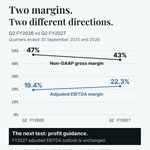
1. Gross margin weakened. Non-GAAP gross margin fell from 47% to 43% as revenue-sharing costs grew faster than sales. More advertising activity does not automatically mean better economics for Digital Turbine.
2. Yet adjusted EBITDA margin improved from 19.4% to 22.3%. Lower gross margin and better operating leverage happened in the same quarter. Treating every margin as the same number misses that distinction.
3. Cash generation improved too. Operating cash flow less capital spending was $10.0m, versus $6.7m a year earlier, by our maths.
The disappointment sits in the outlook. Management raised annual revenue guidance by $20m but left adjusted EBITDA guidance unchanged at $145m–$155m.
There is also a credibility issue: June revenue-sharing expenses were understated by $3.5m. The company says the correction did not change operating cash flow or covenant compliance.
Our view: the recovery is producing cash, but management has more to prove about how much of the growth shareholders will keep. The next convincing upgrade needs to reach profit.

1
282
$DSP’s $20m Waymark acquisition tackles a simple obstacle to TV advertising. Before a business can buy airtime, somebody has to make the advert.
We think making that step cheaper and faster could help Viant win more advertising budgets.
Three reasons this deal deserves attention:
Connected TV already represents more than half of advertiser spend on Viant’s platform. That spending grew nearly 40% year-on-year in Q3. Waymark strengthens a channel that is already working.
Waymark creates video ads from a company’s brand inputs. Viant wants to connect that creative production with its audience targeting and measurement, helping advertisers produce and test different versions more easily.
The deal closed on the 6th of November. It contributed nothing to the Q3 revenue growth of 29%. The existing business supplied that growth before this addition.
The competitive test matters. Amazon already offers AI-generated streaming-TV ads at no additional cost. Video generation alone will be difficult to defend.
Our view: the opportunity is to turn easier ad creation into more campaigns and repeat spending through Viant. We like the strategic fit. Customer spending and campaign performance will tell us whether the $20m was well spent.

1
155
$QUBT rose 8.4% Monday. In tonight’s results, interest and other income was roughly 30 times GAAP gross profit.
We think the real investment debate is what management can build with the money.
Revenue reached $9.5m, with growth primarily driven by acquisitions. That alone does not establish how quickly proprietary quantum products are scaling.
GAAP gross profit was $428,000. Interest and other income was $13.0m, mainly from cash and investments. Intangible amortization also depressed gross margins, so the reported 4.5% margin needs that qualification.
Roughly $1.3bn in cash and investments gives QUBT substantial staying power. It still lost $28.6m at the operating level this quarter.
The INmune Bio commercial agreement is a useful early customer milestone. Now we want repeat orders, better manufacturing utilization and stronger margins.
Our view: QUBT has financed the opportunity. Shareholders still need evidence that management can earn an attractive return on that capital.

409