

Timeless Ideasthetic Storyteller 🪶 'which story do you prefer?' Degrees of freedom, Tales of 4D Blueshift Omnisphericalist, 4D brainwired, Sound Engineer
Delfshaven, Art Gallery
Joined March 2022
- Tweets2.8K
- Following407
- Followers277
- Likes26.6K






Dave Levi Verschoor retweeted
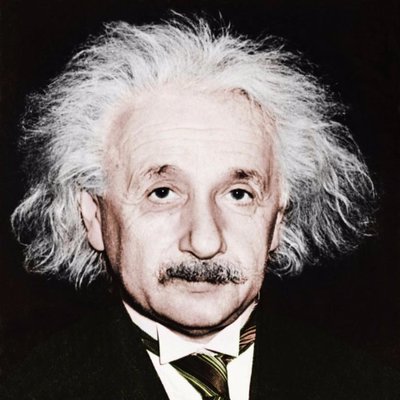
"A human being is part of the universe.. limited in time and space. He experiences himself.. as something separate, a kind of optical delusion of his consciousness. The striving to free oneself from this delusion is the one issue of true religion." — Albert Einstein

Dave Levi Verschoor retweeted

She was studying the stars when she lost her sight. Then she learned to listen to them.
Wanda Díaz-Merced grew up in Gurabo, Puerto Rico. Diabetes slowly destroyed her vision while she studied physics, and the plots her research depended on became unreadable.
In 2005, as a NASA Goddard intern, she began working on software that turns data into sound, with pitch rising and falling as the signal does. She used it on gamma-ray bursts, the most energetic events in the universe.
Later experiments showed that sound can help even sighted astronomers spot faint signals the eye misses.
She earned her PhD at Glasgow in 2013, and her 2016 TED talk has been played over a million times.
She went on to open astronomy to everyone who wants a place in it.


Dave Levi Verschoor retweeted

A puzzle any five-year-old solves in seconds still breaks language models in 2026 ↓


Dave Levi Verschoor retweeted

You cannot command the river to change its course, but you can learn to move through its waters without losing yourself. /G\
🤖 Made with AI


When a human brain
tries to forcefully overwrite its hardwired,
gravitational sense of "up and down,"
it triggers severe spatial disorientation.
Your brain relies on gravity to understand reality
(e.g., liquid falls down, plates hold food).
If you mentally flip a plate upside down in a true 4D sense
—where "up" and "down" no longer exist as absolute truths—
your brain’s predictive processing completely breaks down. 😂
Up is down
🦦
😵 Spatial Alienation


Dave Levi Verschoor retweeted
On January 28, 1986, the Space Shuttle Challenger exploded just 73 seconds after launch, killing all seven astronauts aboard.
President Reagan appointed a commission to investigate the disaster. Among its members was Richard Feynman, the 67-year-old physicist who was battling cancer and had reluctantly agreed to join the investigation. During a televised hearing, while officials debated the technical details, Feynman decided to demonstrate the problem himself.
He took a piece of the rubber O-ring material used to seal the shuttle’s rocket booster joints, clamped it to simulate the pressure inside the joint, and placed it in a glass of ice water at approximately 32°F (0°C), the temperature at launch.
After leaving it there for a moment, he pulled it out and released the clamp. The rubber remained compressed. It failed to spring back into its original shape.
In front of the cameras, Feynman had demonstrated the problem in a glass of ice water. The unusually cold launch conditions had compromised the O-rings’ ability to seal the joints properly, allowing hot gas to escape and contributing to the destruction of the shuttle.
His simple experiment cut through layers of technical jargon, bureaucratic explanations, and public relations spin. Anyone watching could understand the danger that had been overlooked.
Feynman later wrote in his appendix to the official investigation report:
“For a successful technology, reality must take precedence over public relations, for nature cannot be fooled.”

Dave Levi Verschoor retweeted

With decades of experience behind them, older female orcas are often the pod's most valuable leaders. After they've reached menopause, they continue to play a crucial part in helping their family survive.
#NatGeoQueens is streaming on @DisneyPlus and @hulu.

