Zebrafish Lab in Lille - Studying cancer using gene editing, transgenesis and cell transplantation in #zebrafish @Canther_Lille @univ_lille @CNRS_HdF @CHU_Lille
Lille, France
Joined March 2020
- Tweets1.3K
- Following1.2K
- Followers1.3K
- Likes5.5K
ZEBRALille retweeted
The outer ear is a mammalian innovation but where did it come from? In our study in @Nature, @MathiThiru95 and colleagues find that the outer ear arose from modification of an ancestral gill program first originating in marine invertebrates. nature.com/articles/s41586-0…
1/n
ZEBRALille retweeted
Excited to share our latest study! Cyclic ruthenium-peptide prodrugs penetrate the blood-brain barrier and target #glioblastoma, activated by light in orthotopic #zebrafish tumor model. A promising step toward innovative therapies! #CancerResearch
pubs.acs.org/doi/10.1021/acs…
ZEBRALille retweeted
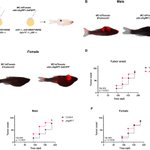
The main study from my postdoc @MGodinhoFerr is out! #Telomerase isn't required for tumor initiation but its lack drives #Cancer #regression later. Regression occurs via tumor-autonomous mechanisms (cell cycle arrest, apoptosis, melanocyte differentiation) and immune rejection.
ZEBRALille retweeted
Excited to share @AmpatzisLab and @KizilLab's's new paper on #zebrafish 's intracardiac nervous system (IcNS), highlighting the presence of pacemaker-like neurons that partake in heart rhythm—linking cardiac and neuroscience research. nature.com/articles/s41467-0…
ZEBRALille retweeted
1/4 Our @biorxivpreprint, 'Origin of Ewing Sarcoma by Embryonic Reprogramming of Neural Crest to Mesoderm' is now available on bioRxiv! In this study, we explore the enigmatic origin of Ewing sarcoma using our zebrafish genetic cancer models. We revealed that neural crest cells can uniquely tolerate EWSR1::FLI1 expression, leading to tumor formation in vivo. A big thanks to our collaborators @clairearataphd and @CrumpLab for this adventurous journey! #NeuralCrest #cancer #EwingSarcoma #zebrafish @amatrudalab @ChildrensLA @biorxiv_cancer👉biorxiv.org/content/10.1101/…
ZEBRALille retweeted
Zebrafish study reveals clues to how inflammation drives scoliosis. elifesciences.org/articles/9…
ZEBRALille retweeted
David Ish-Horowicz FRS (1948-2024): outstanding scientific discovery, with a unique touch of selfless humanity
An Obituary by Ilan Davis (@ilandavis), with his personal reflections on David's unique approach to science and scientific friendship:
journals.biologists.com/dev/…
ZEBRALille retweeted
A zebrafish knockout model of the N-terminal acetyltransferase Naa80 demonstrates that this enzyme is required for actin N-terminal acetylation and normal inner ear development. @medofak_uib @OMRF @NAT_machinery @varshneylab @rasmusree hubs.la/Q02STX1j0
ZEBRALille retweeted
The dynamics & functional impact of tRNA repertoires during early zebrafish embryogenesis
@ddnedialkova et al @MPI_Biochem find increased translational activity during maternal-to-zygotic transition sensitizes maternal mRNA decoding rates to tRNA supply
embopress.org/doi/full/10.10…
ZEBRALille retweeted
🚨NEW study from our LAB showing the predictive value of Patient-derived Breast Cancer 🐟zebrafish Avatars ! A co-clinical study where we compare the patient clinical response to treatment with their matching 🐟zAvatar! ✨100% @ChampalimaudF @TheSFPM
biorxiv.org/content/10.1101/…
ZEBRALille retweeted
Gα13 controls pharyngeal endoderm convergence by regulating E-cadherin expression and RhoA activation
Read this #OpenAccess Research Article by Bo Hu, @FangIowa & colleagues:
journals.biologists.com/dev/…

ALT Figure 1 (A-F′) Bright-field images showing different phenotypic classes of cardiac edema and tail blister in gna13a/gna13b-deficient embryos at 49 hpf: normal morphology (A), mild cardiac edema only (B), severe cardiac edema only (C), tail blister only (D), mild cardiac edema and tail blister (E), and severe cardiac edema and tail blister (F). Lateral views. (A′-F′) Zoomed-in images showing the tail region (outlined in A) of embryos in A-F. Blue arrowheads, cardiac edema; red arrowheads, tail blister.
ZEBRALille retweeted
SCAR-6 elncRNA locus epigenetically regulates PROZ and modulates coagulation and #vascular function. #epigenetics
-> embopress.org/doi/full/10.10…
🚨🚨I am excited to share that my PhD work is now published in @emboreports! 🎉 We uncovered the role of novel SCAR-6 elncRNA locus in coagulation and vascular function. doi.org/10.1038/s44319-024-0…
♥️🐟🩸
ZEBRALille retweeted
📢New Preprint alert!🚨 Excited to share my PhD work!
SCAR-6 elncRNA locus epigenetically regulates PROZ and modulates coagulation and vascular function.
biorxiv.org/content/10.1101/…
from @sridharsivasubb @vinodscaria lab @IGIBSocial
#lncRNA #vascular #zebrafish #coagulation
ZEBRALille retweeted
Great collaboration with Dr. Duong and Dr. Murphy. Also, thanks to Anjelica Rodriguez-Parks for her effort in establishing CUT&Tag in my lab and contributing to this research.
epigeneticsandchromatin.biom…
ZEBRALille retweeted
Interesting review by @Lau_E_Sanchez: "Knockout, Knockdown, and the Schrödinger Paradox: Genetic Immunity to Phenotypic Recapitulation in Zebrafish" (mdpi.com/2073-4425/15/9/1164):
Phenotypic discrepancies between zebrafish knockouts and knockdowns aren't as wide as once believed!
Maternal gene contributions can mask zygotic mutations, creating unexpected outcomes in zebrafish phenotypes and introducing the concept of "Schrödinger genes"—where genes may exhibit conditional phenotypes!
Morpholinos (MOs) still have a role in zebrafish research, but their off-target effects require strict controls. Pairing MOs with CRISPR tools offers a powerful combination for understanding gene function!
Graded maternal contributions lead to phenotypic variability, complicating results in knockout models. Both maternal & zygotic inputs must be considered for accurate gene function studies!
"Susceptible," "Immune," & "Schrödinger" genes—categorizing phenotypes based on maternal-zygotic interactions.
ZEBRALille retweeted
Embryo cells differ a lot from adult cells - but why? In a new paper from the @NorthTrista lab, they show that embryonic blood stem cells use mitophagy, which the adults do not. A great combo of #zebrafish and iPS cells (two systems I love) to show relevance from fish to humans.
ZEBRALille retweeted
🧪A team of researchers, led by @HelenFarrants & @ERSchreiter, developed a new way for engineered protein biosensors & bright, fluorescent Janelia Fluor dyes to work together, creating a new biosensor for measuring physiological signals in live animals.➡️janelia.org/news/new-biosens…
ZEBRALille retweeted
Excited to share new work from my collaborator! A small-molecule screen using Tau-expressing #zebrafish model uncovers a key regulator of microglial synaptic elimination in #tauopathy. Congratulations to the Burton lab!
nature.com/articles/s41467-0…
ZEBRALille retweeted
Our latest work on the NeuroVascular Unit is out! New insights into neuronal vs. glia differentiation, Notch3 regulation, BBB formation and more! All spearheaded by the one and only @IvanBassi3 in close collaboration with @RuizdeAlmodovar! 1/5
nature.com/articles/s41467-0…
ZEBRALille retweeted
📣 Check our paper on macrophages, BCG and bladder cancer! 👉doi.org/10.1242/dmm.050693
Work spearheaded by the talented PhD student @mayra_m_91! Now in Ecuador launching her career! All the best @mayra_m_91!
We unravelled a new step in the BCG MoA using our 🐟#zebrafish xenografts!
💉❓Did you know the #BCGVaccineAgainstTB is also the oldest #CancerImmunotherapy used for early-stage #BladderCancer? Researchers 📍 @ChampalimaudF, unraveled the 1st steps of the #ImmuneProcess by which this vaccine destroys #CancerCells 👉Paper: doi.org/10.1242/dmm.050693