

CEO @GSSC_LT, Lecturer @TSPMI, @AtlanticCouncil Millennium Fellow, Top 2 influencer in 🇱🇹, @CambridgeEMBA, @OxfordSBS, @VU_LT alumn. RTs ≠ endt.
Vilnius
Joined April 2009
- Tweets7.3K
- Following5.6K
- Followers24.2K
- Likes2.5K




My sources tell me there was no change recently regarding the US position on potash.
Ever since President Trump took over for the second term, this issue has been part of conversations with Lithuania, but not regarded as pressure - which would be clear and obvious. We will see how it develops.

The Trump administration is pressing Lithuania to open a central Baltic Sea port to potash exports from Belarus, despite European sanctions.
vist.ly/5qmpu

Linas Kojala retweeted

A balanced piece by @owenmatth although I'm not as optimistic that 3-way talks mark 'the beginning of the end of this bloody war' Previous rounds have failed. This is true though:
'As for raising Russia’s standing in the world, Putin has done the opposite. Far from proving that Russia is a superpower, he’s shown it to be fanatically aggressive but too weak even to impose its will on its closest backyard – while economic isolation from western markets and investment has made Moscow into an economic vassal of China'.
spectator.com/article/trump-…

Linas Kojala retweeted

Over the past few days, Ukraine has struck at least four plants producing components in the Russian missile (and broader) supply chain:
October 23: The Proton plant in Oryol, hit by Storm Shadow/SCALP-EG cruise missiles. Proton produces optoelectronics and electronic components for Iskander-M, the S-71K Kover cruise missile, and Pantsir-S1.
October 24: The Tolyattikauchuk plant in Tolyatti, hit by long-range drones. Tolyattikauchuk produces isobutylene, reportedly a feedstock for solid rocket propellant. Satellite imagery appears to show two damaged isobutylene process units.
October 25: The AVISMA plant in Berezniki, hit by long-range drones. AVISMA produces about 96 percent of Russia’s titanium sponge, used in alloys for missiles and combat aircraft.
October 25-26: The Energia plant in Yelets, hit by Storm Shadow/SCALP-EG cruise missiles. Energia makes batteries for Iskander-M and is reportedly Russia’s sole producer of batteries for glide-bomb guidance kits.
We will have to see how much of a dent this makes in Russian missile output. Previous strikes on Russian component manufacturers appear to have had limited effects. However, Russia has not previously faced successive strikes on different parts of the supply chain within a short period of time, including attacks using heavy missile systems.

Linas Kojala retweeted

“Ukraine's air defenses have intercepted nearly 60% of Russian Geran-4 jet-powered attack drones over the past three months, with interception rates reaching 80% during some attacks, the General Staff of Ukraine's Armed Forces said.
Fighter jets, including F-16s, Mirage aircraft, and MiG-29s, play a significant role in intercepting Russian jet-powered drones, according to the General Staff.
It did not mention interceptions rates of the more advanced Geran-5 drone.”
kyivindependent.com/ukraine-…

Linas Kojala retweeted

One thing is clear from recent discussions in berlin and this week in Brussels.
There is significant confidence that EU can find its share of the extra 70 billion euros in funding Ukraine needs next year. Strong chance that’s settled by year end.
Linas Kojala retweeted

Regarding Russian conscripts, this is not the case. The overwhelming percentage of Russian forces fighting in this war are men well over 30 who accepted service contracts for money. They were not conscripted, or mobilized. For more on this topic: warontherocks.com/a-return-t…


The lengths some politicians go to explain why Russia bombs Ukrainian cities. Putin repeatedly denies Ukrainian statehood and calls Russians and Ukrainians “one people – a single whole”, but apparently his own words are too obvious a clue.
Russia attacked Ukraine in 2014, when its non-bloc status was still enshrined in law. NATO’s European members and Canada were spending roughly 1.4% of their combined GDP on defence, with spending still falling in real terms. Quite the threatening military build-up.
Even these rather inconvenient details fail to interrupt the elaborate explanations.
Occam’s razor might help here. Perhaps a ruler who denies a nation’s identity and invades its territory actually means what he says.

A really insightful piece, starting with the idea of why trying to lure Putin with business opportunities or even territorial proposals does not work.

In my new piece for @TheAtlantic yesterday on Trump’s Russia - Ukraine negotiations I have a short section on how to deter Putin from escalating its shadow war against Europe. Three concrete ideas that may work— threaten to place air defense in western Ukraine, extend Ukraine’s use of Starlink into Russia, and in the event of a mass casualty event in Europe, designate Russia as a state sponsor of terrorism. The last one we used successfully in 2024. All of these, if communicated privately, may given Putin pause. theatlantic.com/internationa…


Linas Kojala retweeted

In my new piece for @TheAtlantic yesterday on Trump’s Russia - Ukraine negotiations I have a short section on how to deter Putin from escalating its shadow war against Europe. Three concrete ideas that may work— threaten to place air defense in western Ukraine, extend Ukraine’s use of Starlink into Russia, and in the event of a mass casualty event in Europe, designate Russia as a state sponsor of terrorism. The last one we used successfully in 2024. All of these, if communicated privately, may given Putin pause. theatlantic.com/internationa…
Linas Kojala retweeted

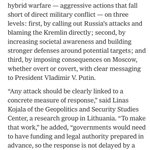
'Today, after nearly five years of war, and 22 months of the second Trump administration, the mental map guiding Russian strategy has changed. First, Russia now sees Europe, instead of the United States, as its principal geopolitical adversary, a shift that has driven Russia’s defense establishment to call for an approach known as “castling” to deal with the main threats. Related to this, Moscow now attributes new strategic agency to Europe itself because of the dramatic military modernization taking place in many European countries and the growing interest among some European leaders in developing or extending their own nuclear deterrent. A third shift concerns Russia’s theory of deterrence: Moscow’s traditional understanding of nuclear coercion is giving way to new thinking about nonnuclear strategic deterrence using advanced conventional weapons systems aimed at Europe.
...
One of the most notable trends in Russian strategic thought over the past year has been the emergence of the idea of “castling.” A term borrowed from chess, castling in geopolitics describes the repositioning of forces and resources to optimize a state’s strategic posture. Moscow’s defense experts have used the concept to describe a strategy for dealing with a new reality: for the first time since World War II, they have argued, Europe, rather than the United States, has become Russia’s principal geopolitical adversary. According to this view, European countries are now the principal source of Ukraine’s military capacity, political resolve, and strategic resilience; it is Europe and not the United States that has made Ukraine its proxy and is encouraging Kyiv to pursue Moscow’s strategic defeat.
As a consequence, Moscow must direct coercive pressure at Europe—its elites, its decision-making centers, and its critical infrastructure. By doing so, Russia can instill into Europe’s calculus what theorists in Moscow call a “deterring fear”: a European reluctance to antagonize Russia through further support to Ukraine. Such action, they argue, can also rebuild Russian credible deterrence for long-term competition with the West, which is now centered on Europe.
....
Drawing on this experience, Russian military theoreticians center NNSD on using massive, deep, precision strikes against the adversary’s critical military, political, and economic infrastructure. The strategy, they suggest, should be aimed not only at Ukraine but also at its European supporters. Although the exact contours of NNSD are still emerging, the concept appears to be more escalatory than the hybrid warfare and deniable asymmetric campaigns that Russia is currently pursuing in Europe.'
Linas Kojala retweeted

NATO was preparing to invade Russia so aggressively that most members spent less than 2% of GDP on defence, the EU produced fewer artillery shells annually than Russia could fire in a week in 2022, and Germany, Europe's largest economy, had fewer than 185,000 active-duty troops
Linas Kojala retweeted

Russian President Vladimir Putin cited genetics to declare that Russians and Ukrainians are “one people” and reiterated his claim to Ukrainian territory, saying: “I think that it is not their territory but the historical territory of Russia.” wapo.st/48aZaZF


Linas Kojala retweeted

🇱🇹🇵🇱 The GSSC, together with @PISM_Poland and the @LithuaniaMFA, hosted the 11th Lithuanian–Polish Roundtable in Warsaw.
Policymakers and experts discussed Russian hybrid threats in the Baltic Sea, Lublin Triangle cooperation, and policies towards Belarus.
🔗 Read more: gssc.lt/en/event/the-11th-li…

1/10
“Neither I nor Trump, we’re not eternal in these presidential seats.”
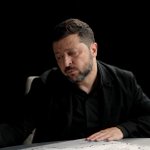
Zelenskyy’s interview with @StevenBartlett on The Diary Of A CEO contains several revealing political arguments. A thread on Putin’s goals, Trump and Ukraine’s conditions for a ceasefire.

9/10
Why doesn’t Trump apply the same pressure to Putin?
“I don’t know. Honestly, I don’t know.”
Zelenskyy mentions possible economic deals or a special relationship, but explicitly acknowledges the limits of his knowledge:
“I don’t know everything. I can only guess.”