Ph.D. student @PrincetonCS. ex @Meta.
Princeton, NJ
Joined November 2022
- Tweets65
- Following543
- Followers541
- Likes762


Pinned Tweet
🪄 Bring your 3D characters to life with words!
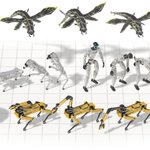
Introducing UniMate: one unified model for text-driven animation across diverse skeletons—from humans and animals to articulated objects.
🎬 A rigged asset + a text prompt → motion.
No per-skeleton retraining needed!
🌐 linzhanmou.com/unimate/
Linzhan Mou retweeted

This is an old hat. That's exactly what the neural fast weight programmers did in the 1990s (including the 1991 unnormalised linear Transformer). Overview with links to the original papers: people.idsia.ch/~juergen/fas…


We asked GPT-6 Astra to edit Qwen3.5-0.8B weights to improve math.
It directly changed only 0.016% of weights, fixing 0.8B's reasoning loops & improving math up to 6x and even instruction following 3x, without gradients or training.
We call this Weight-Space Programming: frontier LLMs can now natively read/write neural network weights! 🧵
Blog: rikiyat.github.io/blog/weigh…

Readers added context they thought people might want to know
LLM was given weights explicitly as text in prompt and used code/forward passes (per authors' logs) to ablate Qwen looping direction, a known thinking-mode issue per model card. Primarily fixed repetition in that mode, not general 'natively' improving weights/math.
rikiyat.github.io/blog/weight-sp…
github.com/RikiyaT/lm_und…
huggingface.co/Qwen/Qwen3.5-0…
huggingface.co/RikiyaT/Qwen3.…
Linzhan Mou retweeted

We found a way to scale humanoid control that reduces GPU-hours by more than 1000×.
Across 129,514 motions, SuperMimic surpasses the state of the art (128 GPUs, 7 days) with 1 GPU in 3 hours.
Project: supermimic.github.io
Demo: supermimic.github.io/demo/
Linzhan Mou retweeted

Honored to co-lead RAX with Xiangcheng (@xczhangxx)! Excited to share what robots can learn through scaling exploration—no demos, no model finetuning!
We’re open-sourcing the full framework and every experiment session. Please fell free to try out!
Project + sessions: robot-agent-exploration.com/
Paper: assets.robot-agent-explorati…
GitHub: github.com/robot-agent-explo…
Huge thanks to @du_yilun for your advice and support, and to all our amazing collaborators—it’s been a joy working with you!
@TonyC56348978 @yitongli165665 @wangyenjen @Lyubh22 @haotian_yeee @ChuyeHong @YXWangBot @Huangyu58589918 @Haoyu_Xiong_ @yangzhen04 @xieenze_jr @MandersonTravis @StefanoErmon @pabbeel Antonio Torralba @dawnsongtweets @Weirui_Ye

Robotics has spent years scaling demonstration data and model size. What happens when we scale EXPLORATION for robot agents?
We're incredibly excited to share RAX, an agentic robotics system that learns by scaling online exploration.
A coding agent connects directly to the robot’s perception and control APIs, learns from feedback, and builds programs that perceive, plan, and act. The model stays frozen. As exploration scales, the agent improves its programs and builds up reusable skills.
The results:
• ZERO teleoperation or action demonstrations on real robots—from insertion with 0.1 mm clearance and air-fryer manipulation to deformable objects and long-horizon mobile whole-body control.
• +37 percentage points on average over leading learned policies across five simulation benchmarks: RoboDojo, BEHAVIOR-1K, HumanoidArena, DexJoCo’s bimanual tasks, and LIBERO-Pro.
• One framework spanning single-arm, bimanual, dexterous, humanoid, and mobile robots, with new embodiments connected through APIs.
The craziest part: on each real-world embodiment, going from scratch to mastering the tasks took roughly two hours. No teleop. No model finetuning.
We’re open-sourcing the full framework AND every experiment session. We can’t wait to see what people build with it!
Project + sessions: robot-agent-exploration.com/
Paper: assets.robot-agent-explorati…
GitHub: N
Project fully led by @RunhanH and @xczhangxx who are absolutely awesome.
How it works, experiments, and robot videos below 🧵
(1/N)
An insightful read on how embodied agents can learn to improve themselves through practice.

The used key is always bright.
Just released an agentic robot project RPG, where self-improving embodied agents play a heavy role. Wrote a blog on what motivated the project, what we learned, and some vision about what the future is like.
astro-eric.github.io/blogs/r….
🧱 A little LEGO world, built with a coding agent!
Explore, take apart, and rebuild 3D LEGO sets right in your browser.
linzhanmou.com/resources/leg…
Encoder-free, pixel-space, unified understanding + generation for images and video. Very cool work from @CongWei1230

Let's remove VAEs and ViTs from video models!
🚀 Introducing 𝗣𝗶𝘅𝗲𝗹𝗨𝗠𝗠: an encoder-free unified multimodal model for image and video understanding and generation, directly in pixel space.
Code and model available today!
🌐 nv-tlabs.github.io/PixelUMM
📄 arxiv.org/abs/2609.38597
Linzhan Mou retweeted

⚡ One policy, millions of embodiments, over 200 robot models. Can we add yours?
We're building γ₀, a generalist RL policy for motion control trained across millions of randomized embodiments derived from a growing collection of more than 200 robot models.
Linzhan Mou retweeted

New Open-Source AI Animator: Text-to-Animation for Humans, Animals, Creatures, Robots & More
UniMate generates motion from text prompts for rigged 3D characters. Describe an action and turn it into animation.
Highlights:
• One model, different skeletons—no separate retraining for each rig.
• Generate transitions between existing keyframes.
• Edit motion with text while keeping selected joints unchanged.
• Extend animations with a sequence of prompts.
• Export animated meshes as FBX and GLB.
• MIT-licensed code + downloadable preview weights.
github.com/Friedrich-M/UniMa…
Linzhan Mou retweeted

This was a really challenging task when we first started thinking about a unified generative motion prior for large-scale, diverse animation skeletons! It took Linzhan months to prepare the first version of the dataset, and a lot of effort to figure out how to model these irregular structures. Now the data and models are all available!

🪄 Bring your 3D characters to life with words!
Introducing UniMate: one unified model for text-driven animation across diverse skeletons—from humans and animals to articulated objects.
🎬 A rigged asset + a text prompt → motion.
No per-skeleton retraining needed!
🌐 linzhanmou.com/unimate/

Linzhan Mou retweeted

🔊 My first tweet, for the shared work! Excited to share our work, UniMate, with labmate @LinzhanMou and the team!
🧑🎨 One unified model, diverse rigs, prompt in, motion out. A step toward building efficient, high-fidelity tools that free artists from tedious work and give them more time to create. Checkout our work at SIGGRAPH Asia, which I will be attending this Dec. Feel free to reach out!
🤖 Looking ahead, a shared representation across diverse embodiments could extend beyond animation to support robot control and action prediction.
#SIGGRAPHAsia2026 #Animation #GenerativeAI #3D #MotionGeneration #AI #AIGC #Robotics #RobotLearning #EmbodiedAI
🪄 Bring your 3D characters to life with words!
Introducing UniMate: one unified model for text-driven animation across diverse skeletons—from humans and animals to articulated objects.
🎬 A rigged asset + a text prompt → motion.
No per-skeleton retraining needed!
🌐 linzhanmou.com/unimate/
Linzhan Mou retweeted

One model to control/animate them all: humans, animals, and articulated objects...
Check out @LinzhanMou’s UniMate: linzhanmou.com/unimate/
One unified model can animate diverse rigged assets from text prompts, with no per-skeleton retraining.
This idea could go beyond kinematic motion generation— a unified representation across different embodiments could also be very useful for robot control and action prediction.
Very nice work from @LinzhanMou! Congrats!
#SIGGRAPHAsia2026 #Animation #Robotics #RobotLearning #EmbodiedAI #GenerativeAI #3D #MotionGeneration #AI #AIGC

🪄 Bring your 3D characters to life with words!
Introducing UniMate: one unified model for text-driven animation across diverse skeletons—from humans and animals to articulated objects.
🎬 A rigged asset + a text prompt → motion.
No per-skeleton retraining needed!
🌐 linzhanmou.com/unimate/
UniMate will be presented at @SIGGRAPHAsia 2026!
Code, dataset, and model checkpoints are now released!
🎮 Demo: linzhanmou.com/unimate/inter…
📄 Paper: arxiv.org/abs/2609.05415
💻 Code: github.com/Friedrich-M/UniMa…
🤗 Dataset & checkpoints: huggingface.co/collections/L…
Huge thanks to our amazing team: @JiahuiLei1998, @frankzydou, @chenyueccai, @chaoyue_song, Adam Finkelstein, and Szymon Rusinkiewicz!
Special thanks to @frankzydou for his valuable insights and suggestions on the demo design!


Linzhan Mou retweeted

Introducing GEN-1.5, a one-shot learner.
It can learn new tasks in a few seconds. Show it what to do, and it generalizes.
This capability emerged from pretraining on physical data at scale, as a step towards our mission of building general intelligence for the physical world.
Linzhan Mou retweeted

Robot policies can move but can't think.
LLMs can think but can't move.
So we connected them.
Real robot: 16.7% → 97.3%
Sim (LIBERO-PRO): 12.8% → 53.3%


Linzhan Mou retweeted

In my recent blog post, I argue that "vision" is only well-defined as part of perception-action loops, and that the conventional view of computer vision - mapping imagery to intermediate representations (3D, flow, segmentation...) is about to go away.
vincentsitzmann.com/blog/bit…