

Tracking where the money flows Crypto / DeFi / TradFi / Capital allocation. Deep dives into where capital actually flows | Follow for no-BS metrics
US
Joined July 2023
- Tweets415
- Following64
- Followers61
- Likes289





Lioto retweeted
"You save $160!" No. You spend $240. 🛒
Black Friday is November 27. Here's the math retailers hope you never do.
1. The "deal" might not be the cheapest price of the season.
A Visualping study tracked more than 2,600 products last holiday season and found that roughly one-third of Black Friday and Cyber Monday deals had been available for less earlier on. About 61% of luggage deals and 50% of microwave deals had previously been cheaper.
consumeraffairs
2. The "was" price may be fiction.
In one survey, 59% of shoppers believed retailers raise prices before a sale and cut them back to normal, and 54% thought stores advertise a "was" price the item never really sold at. Consumers' Checkbook tracked big-ticket items at 24 major retailers for 33 weeks and found that 21 of the stores claimed to offer discounts more than half the time.
chainstoreage
inquirer
3. "Pay later" is booming, and so are its surprises.
Adobe forecasts a record $21.3 billion in buy-now-pay-later spending this holiday season. In another survey, 53% of BNPL users expected to still be paying after January, compared with 16% of other shoppers.
adobe
omnicalculator
Now the part that matters most:
A "40% off" TV: $400 → $240.
The ad says: "You save $160!"
The real story: if you weren't going to buy a TV, you didn't save $160. You spent $240.
And that $240, invested at a 7% average return for 30 years, would become about $1,830.
The only discount that counts is the one on something you were already planning to buy.
My 5-step Black Friday plan:
Write your list today. If it's not on the list, it's not a deal, it's an impulse.
Track prices now, not on Friday. Tools like CamelCamelCamel, Keepa or Capital One Shopping can show a product's price history.
consumeraffairs
Compare the final price, with tax and shipping, not the headline percentage.
Use the 24-hour rule on anything that wasn't on your list. If you still want it tomorrow, buy it.
Skip "pay later" for non-essentials. If you can't pay for it today, ask why you're buying it today.
I'm not anti-shopping. Good deals are real, and some of them are great. I just want you to know which ones.
What's the worst "deal" you ever fell for? Tell me below. 👇
Study figures are from public reports and surveys. Illustrative math: 7% average annual return. Not financial advice.


Lioto retweeted
People lost their minds over GTA 6. Rockstar reportedly made $3.79 billion in a single day. For a video game. 🎮
Take-Two said GTA 6 generated $3.79 billion through preorders and first-day sales, and called it the biggest entertainment launch in history.
asianetnews
It arrived after a 13-year wait since GTA V in 2013. Thirteen years of hype, trailers, rumors and delays. Then one release date.
etvbharat
Here's what made the numbers so wild:
→ The standard edition costs $79.99 and the Ultimate Edition costs $99.99.
→ Industry data suggested about 89% of early buyers picked the Ultimate Edition, the most expensive one.
→ Sensor Tower estimated around 17 million copies sold by November 18, about $1.65 billion in revenue. (Third-party trackers and company figures differ, which is normal in launch week.)
gta 6 predicted to make up to 5 2 billion during launch week 3388183
+2
Most people didn't buy the cheaper version. When hype is high, we tend to pick the premium option and don't think twice.
Now the finance angle, because I can't help it:
A $100 purchase invested at 7% for 30 years becomes about $760. That's not a reason to skip the game. Fun is worth money, and 13 years is a long time to wait.
But it's a great example of how emotion works. Hype creates urgency: "buy now or miss the conversation." And urgency is when we stop doing the math.
3 rules for hype spending (games, sneakers, concert tickets, anything):
Set a fun budget and spend it guilt-free. Fun money is part of a healthy plan.
Don't put hype on a credit card you can't pay off. At 24% interest, a balance can roughly double in about 3 years (72 ÷ 24).
Wait 24 hours on anything you didn't plan to buy. If you still want it tomorrow, buy it.
I'm not judging anyone who bought on day one. I'm just fascinated that a single release can move billions of dollars in 24 hours.
So tell me honestly: did you buy GTA 6 on day one? Was it worth it? 👇
Sales figures are from public reports and third-party estimates, and they vary by source. Illustrative math: 7% average annual return. Not financial advice.

Lioto retweeted
Trump: "We don't care about this war; we are making good money off of it."
Trump: "Ukrainians are fighting well because they have American weapons."
This is what Trump's "I want peace and for the war to end" sounds like.
Xi: "All nuclear weapons must be destroyed, because there will be no winners in such a war."
Xi: "We plan to build up our nuclear arsenal by 2030."
Xi's words after testing a new nuclear warhead.
Lioto retweeted

This looks like a SPY GADGERT!
Cameras like this weren't built for spying. They were built for medicine.
The smallest one on sale has a sensor 0.575 mm wide. 200 × 200 pixels, four wires, made for endoscopes 1 mm thick.
And the way you catch one is old physics: a lens has to look at you, so it shines your light straight back.
I made a pop-up book of how it works. Link in the reply.

Lioto retweeted

Get lucky today with @hyperluckyrwrds @luckyhypercom. ⚡🎁


Lioto retweeted
On November 17, millions of Americans were told the banks would be wiped to zero and the internet would go dark for 3 months.
It’s November 18. You’re reading this online. Your money is still there.
So let’s talk about what actually happened, because it’s more uncomfortable than the rumor.
The “prediction” came from a cartoon.
The claim was tied to a 2023 Simpsons episode that aired on November 19, 2023. That episode shows a fictional blackout in Springfield and mentions November 17, but it never names 2026 and never predicts a global disaster.
ibtimes
Complex
Read that again. A cartoon gag from 2023 had people reconsidering their bank balances in 2026.
Then came the “proof.”
A routine nationwide emergency alert test was scheduled, and FEMA said the public didn’t need to do anything. It was just a test message on radio and TV. Online, it became “the government is preparing us.”
ibtimes
telegraf
And then the banks glitched.
Customers of major US banks reported trouble accessing their accounts on Monday, November 16. Chase blamed a technical issue for delayed transactions, and officials said the reported problems did not amount to a nationwide banking shutdown.
Complex
ibtimes
A normal outage. A viral rumor. Perfect timing. Millions of people connected dots that were never connected.
The “global internet kill switch” doesn’t exist.
The internet is a collection of independent networks, with no single switch that could turn off the whole world. Banks also keep backups, so one hack can’t simply erase their data. And the rumor itself came with no named hacker group and no technical details.
telegraf
krakobit
So here’s the question nobody wants to ask:
If a rumor with zero evidence can make you stop and wonder whether your savings still exist, how much of your financial life is built on information you’ve never verified?
Your biggest financial risk this week wasn’t a cyberattack.
It was you, at 2 a.m., about to withdraw your cash, move your savings, or sell your investments because someone on a timeline said so.
Markets don’t collapse because of hackers nearly as often as they collapse because of people who panic at the same time.
What actually protects you:
→ Bank deposits in FDIC-insured US banks are covered up to $250,000 per depositor, per bank, per ownership category.
→ A small cash reserve and a backup card from a second bank are reasonable any day of the year, not just before “doomsday.”
→ If a scary post names no source, no group, no technical detail, and no confirmation from a regulator, that’s not news. That’s content.
The date has passed. The internet is working. Your accounts are there.
The only thing that disappeared on November 17 was people’s ability to tell a warning from a rumor.
Be honest: did the news make you check your bank app? 👇

Lioto retweeted
BEN FRANKLIN LEFT $4,400 IN HIS WILL.
200 YEARS LATER, IT WAS WORTH ~$6.5 MILLION.
1/ Benjamin Franklin left Boston and Philadelphia about $4,400 each in his will. 🇺🇸
There was one condition: don’t touch it for 200 years.
It grew into roughly $6.5 MILLION combined.
No hedge fund. No “secret strategy.” No crypto.
Just compound interest and patience. 🧵👇
2/ Here’s what’s wild about the math.
For the first 100 years, the money barely looked like anything. A few hundred thousand dollars after a full century.
Then the curve went vertical. Most of the growth came in the last stretch of the timeline.
That’s how compounding works: the early years feel boring, and the late years do the heavy lifting.
3/ Franklin actually understood this in 1790.
He wrote that the money should be lent out at interest to young tradesmen who needed a start. Gains were reinvested, and small withdrawals were allowed at set milestones.
He was running a 200-year investment plan with no spreadsheet and no financial advisor.
4/ Why this matters for you today:
A 401(k), an IRA, or a plain index fund runs on the same engine.
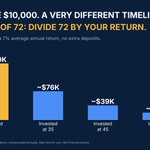
Invest $500 a month from age 25 at a 7% average return, and you’d have around $1.2M by 65. Start at 35 instead, and you’d end up with roughly half that.
Ten years of waiting costs you about $600K. Not because you invested less each month, but because you gave up ten years of compounding.
5/ The real enemy isn’t the market. It’s us.
People quit in year 3 because “it’s not growing.” They panic in a downturn. They chase whatever went up last month.
Franklin’s plan worked because nobody could touch the money. Automate your investing and you get the same protection from yourself.
6/ The lesson:
You can’t control the market.
You can’t control the economy.
You CAN control how early you start and how long you stay.
Time is the only edge ordinary investors have. Don’t interrupt it. ⏳
Follow for more simple money ideas. Repost if you know someone who needs to hear this.
Not financial advice. Returns are not guaranteed.

Lioto retweeted
X ALGORITHM NEWS 🚨
X just added a second way to score posts to its open source algorithm. It's switched off (for now). If X flips it on, posts people actually stay on would pull way ahead (so small accounts: write to be read, not skimmed)
tl;dr:
- today a post's score is a sum: likes + replies + time spent + the rest
- the new formula multiplies: everything else × time spent × how unlikely people are to scroll past
- in X's own test, time spent alone tripled the score
- the setting is still on the old way, nothing changes today
Full details:
- How it works today
X guesses how likely each person is to like, reply, share, stay and so on. Each guess gets a number and X adds them all up.
Time spent is one item on that list. A small one.
(I check the open source algo daily with Claude and share updates with you)
- How the new one would work
Three parts, multiplied together:
1. everything people might do with your post: likes, replies, shares, follows
2. a time part that grows the longer X thinks people will stay
3. a skip part that grows the less likely people are to scroll past
Multiplying is the big deal. A like on a post people stay on would count for more than a like on a post they skim.
- What X's own test shows
X wrote a test for the new formula. In it, a post people are expected to stay on for 20 seconds gets its score tripled, from time alone.
Those are test numbers. X hasn't said what it would use for real.
- Is it on?
No. The setting still says the old way, and the skip part is set to do nothing.
- My read
Every change since October points the same way. Likes up, time spent up, taps down, copy link gone. This is the same idea taken a lot further.
- Why it would matter if you're small
You can't win on reach yet. You can win on the people who do see your post staying on it. Under this formula that's worth more than it's ever been.
If it goes on, you'll hear it from me that day. Until then, write posts people don't want to leave.

Lioto retweeted
The Economist launches The World Ahead 2027: heralding the post-Trump era, amid upheaval from bond markets and AI
The Economist launches The World Ahead 2027: heralding the post-Trump era, amid upheaval from bond markets and AI
London, United Kingdom
17 листопада 2026 р.
Main Content
grid item
The Economist has today launched The World Ahead, its annual future-gazing report analysing the themes that will prove most consequential in the coming year.
Political and financial shocks seem likely, and AI-led turmoil appears all but certain. The backlash against big tech firms will grow, as worries grow about the impact of artificial intelligence.
As always, journalists from The Economist are joined by a diverse range of political, academic, and business voices, with contributing articles from presidents, prime ministers, industry leaders and eminent scholars of history and science.
“He won’t be a lame duck - more like a destructive Angry Bird”
Commenting on this year’s edition of The World Ahead, its editor, Tom Standage, said: “The post-Trump era is beginning. But don’t expect the president to go quietly. With Democrats taking charge of both chambers of Congress, Donald Trump will, if anything, become even more aggressive and mercurial. Expect more executive orders, legal spats, sudden renamings of geographical features, grandiose building projects and military adventures as he furiously tries to retain his influence and shape his legacy.”
“Elsewhere, the world will grapple with aftershocks from the Iran war, as fertiliser shortages and a super El Niño threaten food security for millions. The political, financial and cyber risks associated with AI will become ever more apparent as its capabilities grow. In Europe, the big question will be whether voters in France elect Marine Le Pen as their next president. That would cause a political earthquake in the EU, and would also spook bond markets, which are already concerned about France’s unsustainable fiscal position.”
The World Ahead 2027 will be included in The Economist’s weekly print edition dated
November 21st, as well as being sold as a stand-alone newsstand edition from November 26th. Articles exploring the top ten themes for the coming year are online today at economist.com and cover the following topics:
The post-Trump era: As the race to succeed him begins, the president won’t be a lame duck—more like a destructive Angry Bird. The world will start to wonder what a post-Trump America might look like.
Aftershocks from Iran: America's allies no longer trust it and its enemies no longer fear it. The war's consequences will reshape regional politics, reconfigure energy flows and threaten food security, with fertiliser in short supply.
Hottest year ever, again: Expect another year of droughts, wildfires and heat waves. Yet Mr Trump has unwittingly become the world's greatest salesman for renewable energy. It's the best way not just to address climate change, but to escape from the ups and downs of global energy markets.
The AI backlash grows: The danger of a crash will rise, as Al firms take on more debt in complex, opaque deals. But while worries about AI’s political, financial and cyber risks are justified, concerns about its impact on jobs and the environment are overstated.
Europe's populist right: Victory for Marine le Pen would throw a spanner into the Franco-German engine that powers the European Union, and heighten concerns about debt-laden France's precarious public finances.
Bond-market pressure: And it’s not just France. Many rich countries are living beyond their means, and bond yields are rising. This can't go on forever. Something, somewhere, has to break.
.

Lioto retweeted
Perfume and Crypto
An iconic perfume house is launching a massive crypto quest.
10,000 limited-edition bottles at $250 each. Under every cap lies a QR code leading to a wallet with a bonus:
🔸 10 bottles — 1 BTC each
🔹 100 bottles — 1 ETH each
🔸 1,000 bottles — 250 USDT each
1,110 buyers get a free luxury fragrance or hit a life-changing jackpot.
Already know which brand this is? 👇
🤖 Made with AI

Lioto retweeted
You’re trading blind.Most of you have never seen how the market is actually built,In this 35-minute MIT lecture, a professor walks in and calmly destroys every retail assumption you’ve ever had.He doesn’t give tips.
He shows the structure:Who really moves the price.
Why your “strategy” is just noise.
How risk is priced before you even open the chart.
Why 90% of people are liquidity — and will stay liquidity.Then he runs a simple trading game with students.
Watch what happens.
It’s brutal.This is not motivational content.
This is the operating system the other side of your trades already uses.Lecture 1, Part II — MIT 18.642 (Fall 2024).If you skip this, you’re choosing to stay average.Watch it. Save it.
Or keep donating money to people who already understand this.
#Finance #Trading #MIT #Quant #Investing

Lioto retweeted
Democrats are preparing an investigation into the crypto business of Trump and his family, — Bloomberg
Against this background, Trump Media transferred 4,259 BTC worth about $344 million to the Crypto сom exchange. This may indicate preparations for the sale of a portion of the company's bitcoins.
What do you think, why did they do this?
Lioto retweeted
HOLY SH*T, A 21-YEAR-OLD MIT STUDENT MADE $3,412 IN JUST 20 SECONDS
he started with $280 and let Grok Bot run the trading terminal. the bot kept opening and closing trades. 20 seconds later, he was up $3,412. his reaction says everything
by the end of the trading session, the profit counter had reached $45,000
he opened the activity feed to see which trades had made the money
here’s how he set up the trading process:
→ DISCOVERY: monitor new Solana pools and save the original transaction behind every candidate
→ SCREENING: remove tokens with open mint permissions, concentrated ownership, bundled buying, or weak liquidity
→ ANALYSIS: score the survivors against the same entry checklist instead of inventing a new reason for every coin
→ POSITION SIZE: calculate the order from current equity and the maximum permitted loss
→ EXECUTION: check the obtainable price, submit the order, and confirm what actually filled
→ EXITS: attach the exit conditions and record every partial sale, fee, and remaining position
the dashboard shows the entire route from a new pool to a closed trade
what kept getting rejected:
→ a volume spike produced by the same small group of wallets
→ a clean-looking chart with too little liquidity for the order
→ a developer wallet still controlling too much supply
→ an entry that had already moved beyond its permitted price
→ a missing contract check that stayed unresolved
12,640 pairs scanned
748 reached analysis
47 qualified for an order
46 filled. one expired without a fill
33 winning trades. 13 losing trades
winning trades: +$45,246.70
losing trades: −$246.70
session P&L: +$45,000
$280 starting capital → $45,280 closing balance
the rejected candidates stayed in the journal alongside the trades. he could inspect the evidence, entry, exit, and fees instead of trying to reconstruct the session from a balance screenshot
save this. the trade that made the money is only one part of the process worth studying
the full course below shows how to build a Grok Bot trading terminal with connected data, order execution, position protection, and a record behind every decision ↓


Lioto retweeted

I gave my Grok Bot $2,324 and went to sleep.
9 hours later: $11,705.
5.09x. And no single agent made that money alone. It’s a relay.
Five agents.
Each one does one thing, then hands the coin to the next:
SCOUT finds every new pair on Solana. 13,600 tonight
ANALYST runs the rug and holder checks. Top 10 over 30% — dead. Mint not revoked — dead. Only 312 survived
SNIPER enters the ones that pass. 0.4 second fills
RISK trails every open position and never lets a winner turn red
BANKER takes the exit and moves the profit off the table
A coin has to get past all five.
Most don’t make it past the second.
13,600 pairs found.
312 passed the checks.
20 trades taken.
18 green. 2 red.
The first approval of the night was $TRUMP.
A −34% wick, bids stacked underneath, 5 checks passed.
SCOUT found it. ANALYST cleared it. SNIPER was in before the bounce.
Nobody on the desk does two jobs.
Nobody skips a step.
The scout can’t buy. The sniper can’t pick. The banker doesn’t care how good the chart looks.
Hour 0 — $2,324
Hour 3 — $4,419
Hour 6 — $7,485
Hour 9 — $11,705
I woke up.
The relay never stopped.
The whole build is in the post below ↓

