

@LockStockBarrl
Account based inCanada
About this account
- Account based in
- Canada
- Connected via
- Canada App Store
Account-level information from X, not a live location or the device used for a specific post.
Luck is a residual—it’s what is left over after you subtract skill from the outcome.
Joined June 2011
- Tweets2.5K
- Following772
- Followers7.7K
- Likes11.8K







Pinned Tweet
$AUUA.v
Thank you to @MSmicrocaps + @Atrium_Research for highlighting the benefits of Aluula’s unique attributes for the Defence Industry
drive.google.com/file/d/1hS6…
mscliffnotes.substack.com/
$AUUA.v
ALUULA’s proprietary production process creates materials that enable previously impossible product designs and performance.
aluula.com/wp-content/upload…

$AUUA.v
My presentation for ALUULA explaining competitive advantages over the old coated commodities like coated nylon, specialty fabrics like Gore-Tex, Kevlar + Vectran, incumbent UHMWPE composites w/ interlaminar adhesives
drive.google.com/file/d/1hS6…
“During periods of rapid growth, capital expenditures rise faster than Revs. This weakens near-term cash flow. The returns appear years later, after the new capacity is operating + generating Revenue. Investors who focus only on current cash flow see the worst part of the cycle.”

From 1973 to 1986, Walmart reported negative free cash flow for 14 consecutive years. Its stock returned 33% annually over that period, three times the return of the S&P 500.
@mjmauboussin’s framework for understanding free cash flow. 10 lessons for investors:
1. A company’s value is the present value of its future free cash flow. Free cash flow is profit after taxes minus investments in growth, primarily capital expenditures. An investor’s job is to find the company that will ultimately generate the most FCF. But that FCF will not always be positive along the way.
2. Negative FCF is not always bad. If a company invests at a return above its cost of capital, it creates value. People love posting charts showing negative FCF at the hyperscalers. What matters is the return those investments will generate over the following years.
3. The Walmart lesson. From 1973 to 1986, Walmart had negative FCF for 14 consecutive years because it invested aggressively in expansion. Its return on invested capital averaged about 18%, well above its cost of capital. The stock returned 33% annually, three times the return of the S&P 500. Negative FCF was a sign of growth, not weakness.
4. Focus on investment returns, not the minus sign. The key question is whether revenue and profit are keeping pace with capital expenditures. If profit grows faster than investment, value is being created. If it falls behind, cash is being destroyed.
5. Watch return on incremental invested capital (ROIIC). It measures the return generated by each new dollar invested. If ROIIC is above the company’s current average return on capital, its overall return should rise. If it is lower, the average should fall. Hyperscalers’ combined ROIIC is currently near its peak at more than 35%, compared with a cost of capital of about 8%.
6. Subtract stock-based compensation. Paying employees with shares is effectively a combination of issuing stock and paying wages. If SBC is properly deducted from operating cash flow, the reported cash flow of large technology companies falls by 10% to 20%. Many investors ignore this and overstate the true figure.
7. A mature company can return to growth. A sharp increase in capital expenditures can move a business back to an earlier stage of its life cycle. Alphabet, Meta, and Oracle moved from “maturity” to “growth” after accelerating data center construction. This is not deterioration. It is a new investment phase.
8. The current decline in hyperscaler cash flow is expected to be temporary. Combined FCF for Amazon, Alphabet, Microsoft, Meta, and Oracle falls from $170 billion in early 2024 to negative $265 billion in 2027. Consensus then expects it to recover to ~$505 billion by 2030. Returns on capital remain above the cost of capital throughout this period. Microsoft is the only hyperscaler expected to maintain positive FCF across the entire forecast horizon.
9. Returns arrive with a delay, so patience matters. Amazon CEO Andy Jassy explained it directly. During periods of rapid growth, capital expenditures rise faster than revenue. This weakens near-term cash flow. The returns appear a few years later, after the new capacity is operating and generating revenue. Investors who focus only on current cash flow see the worst part of the cycle.
10. Consensus forecasts are not facts. The further out the forecast, the less reliable it becomes. Watch how estimates change. Are revenue and profit expectations rising as quickly as capital expenditure forecasts? The differences can be enormous. The 2027 EBIT forecast for Micron was raised by $192 billion, while Nvidia’s was raised by $231 billion. Their capital expenditure forecasts increased much less. That is a sign that investors expect those investments to generate strong returns.
$MSFT $META $AMZN $ORCL $SPCX $NVDA $MU

Goo Goo Dolls - "Long Way Down" [Live 5/5/96] youtu.be/hcqvLDOOeik?si=ReCy… via @YouTube
Very true!

The hardest part of owning a 10 bagger
Everyone wants to own a 10 bagger but very few people want to live through what owning one actually feels like. That is the part investors underestimate.
A 10 bagger rarely goes from $10 to $100 in a straight line. It might go from $10 to $18, fall to $12, run to $30, collapse to $19, climb to $55, fall back to $35 and only years later become $100.
Looking backward, the chart looks easy. It removes the fear, the bad quarters, the scary headlines, the downgrades, the recessions and all the moments when selling felt like the intelligent thing to do.
That is why finding a great business is only half the job. The other half is becoming the kind of investor who can actually hold it long enough for greatness to matter.
A lot of people find the right company and still miss most of the return. They buy early, the stock doubles, and suddenly it feels expensive, too large or less exciting than the next shiny idea.
Meanwhile the business may be doing exactly what they hoped. Revenue keeps growing, free cash flow keeps growing, the moat keeps strengthening and management keeps reinvesting intelligently.
This is why one of the most important skills in investing is separating the stock price from the business. A stock can fall 40% while the business becomes more valuable, and a stock can rise 100% while the business quietly gets worse.
Price is information, but price is not the business. The real question is whether the company is becoming stronger or weaker over time. Is the runway still large? Is free cash flow per share still growing? Is management still allocating capital intelligently and is the long term destination still intact?
This is also why conviction is so misunderstood. Conviction does not mean never selling. It means understanding the business well enough to know what would actually make you change your mind.
Maybe growth becomes structurally weaker, the moat starts disappearing or management begins destroying value. Those things matter because a stock being down 25% from its high, by itself, usually does not.
The strange part is that great investments often become harder to own as they succeed. The position gets larger, the valuation gets higher and the dollar swings become much more uncomfortable.
That is when trimming starts to feel responsible and sometimes it is. But often times it is just fear or boredom wearing a very intelligent disguise.
The question should not be how much the stock has already gone up. The question is how much larger the business can still become. Your cost basis tells you everything about your past return and almost nothing about the future opportunity.
Some of the most expensive investing mistakes happen after you were right. You found the business, understood it early and made a lot of money, then sold while the company itself was still in the early stages of becoming something much bigger.
This is why destination analysis matters. Instead of obsessing over the next quarter, ask what the business could look like five or ten years from now. How large can revenue become, what can margins become and how much free cash flow can eventually belong to each share?
The market makes this difficult because it gives you a new price every second and a new reason to react every day. The business itself compounds on a completely different clock.
Everybody wants the 10 bagger. Very few people want the fear, doubt and discomfort that usually come with owning one. That discomfort is often part of the price you pay for an extraordinary outcome.
A 10 bagger rarely feels like a 10 bagger while you own it. Most of the time it feels like a stock you almost sold five different times. 🌹
Heartfelt congratulations @iancassel
Beautifully delves into the idiosyncrasies + helpful frameworks for microcaps that can only be distilled down from years of active practice, curiosity, skill + intense desire to win
An authentic account of both battle scars + stunning wins

📗Stock Picker is officially published! lnk.to/stockpicker
The world didn't need another "invest like me" or instruction manual for successful investing. What time has proven is all great investors and stock pickers invest differently. In fact, that is what makes them great. I wrote this book to inspire and motivate you to invest like you. To do it your own way. That is my story and it can be your story too.
I also wrote the book to educate the masses on microcap investing, a space that has been largely forgotten by most of the financial industry. My mission is to pull quality investors, companies, stakeholders into microcap. That is how we make a positive impact on this investment class.
Help me spread the word. Tell a friend. Leave a positive review. Thank you. 🙏

Noah Kahan - The Great Divide in the Live Lounge youtu.be/UAWRRkt7Rx0?si=4gOC… via @YouTube
#SummerSong
“This should not be possible and highlights one of the most counterintuitive parts of investing: You are rewarded not for effort but for the quality of your decisions”
Frameworks + case studies are useful to deeply understand an opportunity
Time horizon is critical here

In many areas of life, effort leads to reward. If you study harder, you get better grades. If you practice longer, you can become a better athlete. If you work more hours, you may get a promotion.
The stock market is not one of those places. Instead, you can be rewarded immensely for doing almost nothing.
Herb Wertheim’s early investment in Heico is an incredible example. It is, by almost any measure, one of the greatest Sidecar investments in history.
Wertheim understood something powerful: wealth compounds when your money starts working through other people’s effort. He said:
"You take what you earn… and invest it in other people’s labor."
Most people spend their lives selling their own time, exchanging hours for dollars. While admirable, there is no scale. Wertheim realized the key is to find people who are smarter, more driven, and more obsessed than you, and simply ride on their coattails.
In 1992, he began building a position in Heico when it was a penny stock. An optometrist by trade, running an aerospace company was not in the cards for him. But he didn’t need to. He could just buy a slice of the work being done by the Mendelson family.
Laurans Mendelson, along with his sons Eric and Victor, took over Heico in 1990. They devoted their careers to the company. They lived and breathed aerospace parts, 24/7. They navigated evolving regulatory and competitive landscapes and several recessions. They managed the day-to-day operational grind and made the tough decisions. They built one of the world’s great companies.
While the Mendelsons did the heavy lifting, Wertheim was along for the ride.
And here is the kicker: Today, Wertheim’s stake in Heico is worth $1.2 billion. Remarkably, this is as much as the shares owned by the late Laurans Mendelson himself.
Again, the man who simply bought the stock wound up in the same place as the man who spent thirty-plus years building the company.
This should not be possible and highlights one of the most counterintuitive parts of investing: You are rewarded not for effort but for the quality of your decisions.
The market doesn't know if you did 1,000 channel checks. It doesn't care if you spent 100 hours researching a stock or five minutes. All that matters is if you are right.
It is easy to feel the need to do something to justify our returns. So we have too many opinions, over-trade and constantly tinker with our portfolios. In doing so, we miss the opportunity to build generational wealth by making one or two great decisions and having enough self-awareness to get out of our own way.
The famed “double by pass” h/t @EightTrack180
“…in microcap investing, your biggest winners don't just outperform your mistakes. They pay for all of them.
And perhaps the greatest investing skill isn't discovering the next 100-bagger.
It's having the conviction to still own it after it has already become a 10-bagger.”

$AUUA.v
My ALUULA pitch at @PlanetMicroCap @MicroCapClub
youtu.be/EPdBVzHXjP4?si=BPt9…
Launching a new plant to ~10x capacity
For an ‘ingredient inside’ company, the **level of integration** of the component dictates the stickiness of brand partner + durability of the moat

Complexity does not necessarily get rewarded in the market
Instead, seek ——>
“Unrecognized Simplicity”
If an investor clearly + concisely articulates a thesis — there are high level insights which can be formulated in advance with deeper thinking coupled with case studies


Loved this pod with @jeremygiffon and @patrick_oshag. Unreal what people have access to in terms of investment knowledge today.
The clip below (awesome!) speaks both of complexity and simplicity and of the legend and investment fiend Richard Rainwater. The below is true: Rainwater would decide on a deal very fast and very much kept it simple, though powerful. I.e, the requirement of a partner in a deal to have a one-page thesis AND to have a preferably large % of his net worth. Think about how many downstream dynamics that that simplicity actually solves for...
I would humbly add, though, that it requires nuance to understand how Richard could get this simplicity and even more so for us to learn, develop, and grow as investors and apply this lesson. Richard built, over time, the right structure/culture and setup to be able to act quickly and simply.
First, Richard was a Math and Physics major at UT and then went to Stanford Business School. So he had the table stakes IQ and also exposure to smart people at both schools. Richard was also partly Lebanese, by the way. Lebanese are a people who, for millennia, have commerce running through their blood. Analyze the Lebanese diaspora in almost every country, and you find a bunch of them have done incredibly well.
Second, Richard then worked at Goldman in institutional sales for a year after Stanford. Most investors have a tendency to look down on sales guys but institutional sales happens to be a great place to start, as you are exposed to a) a broad network of money managers, b) you learn sales, which is a big but underrated advantage for investors, and last, c) you learn vicariously what to do and what not to do by watching the behavior of your clients.
Third, Richard had capital at Bass and at Rainwater Inc. that was mostly proprietary and structured for long-term advantages. That enables a certain type of non-institutional behavior. Like deciding super fast on a deal, flexibility, and the ability to use that temporal advantage offensively.
Fourth, if you know Richard's operational history, he had to make mistakes, which he did, to learn to be good. When Richard began to run money for the Bass Brothers, he had a few snafus and capital incineration exercises where he learned what not to do. So his pattern recognition was developed from good and bad reps, which then enabled him to qualify opportunities.
Fifth, Richard was an extrovert and had an eye for talent, both talent that worked for him and in his external network. Most of his opportunities came from his network. His network acted as a filter for high-quality opportunities. Richard had guys like David Bonderman (TPG), Dan Stern (Reservoir), and Eddie Lampert (ESL) working for him at the beginning of their investment careers, and that is just to name the three that first come to mind; the others are legion. Why does it matter as per the clip below? Well, you could decide fast on an opportunity if Bonderman, Stern, and Lampert had already filtered through it and then shown it to you.
Sixth, Richard developed over time an investment framework and investment selection criteria that were differentiated. To name a few: a) "I really don't look for values as much as I look for systemic changes--big major changes that are occurring in an industry." b) once he identified those changes, he would then look next to partner with the smartest people he could find in the space, and then seed their investment business, thereby going on offense with his long term proprietary capital base. Hence his "find the guy, don't be the guy" principle. Think how differentiated these criteria were, especially in the 70s and 80s. Hell, they are fairly differentiated, even today.
So... If you had Richard's investment structure/culture or setup, as listed above, if an opportunity came to you, filtered through your setup, you could decide very fast.
To have this set up takes years of work, the right relationships, experience, and you need to start with the right personality and brain power. Most will not have that. But...it doesn't mean that you can't go about building or improving the right operational history, develop an eye for talent, build a differentiated idea selection criteria, and to work on improving the quality and long term nature of your capital.
Hope that helps,
Happy Hunting!
PS: One of my favorite stories is Eddie Lampert, the introvert, calling working for Richard like working at Grand Central because of all the people that would walk in and out of his office. Eddie's primary mode was to read 10ks and live in his internal world, while you'd often find Richard meeting with people all day, often standing on his desk during meetings.
PPS: one thing that is helpful to understand the difference between complexity and simplicity is this quote that my uncle Peter Kaufman (if you are lucky to know him, he is your uncle) loves and first exposed me to 👇🏼:
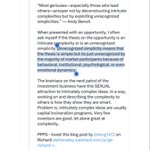
“Most geniuses—especially those who lead others—prosper not by deconstructing intricate complexities but by exploiting unrecognized simplicities.” — Andy Benoit
When presented with an opportunity, I often ask myself if the thesis on the opportunity is an intricate complexity or is an unrecognized simplicity. Unrecognized simplicity means that the thesis is simple but its just unrecognized by the majority of market participants because of behavioral, institutional, psychological, or even emotional dynamics.
The brainiacs on the nerd patrol of the investment business have this SEXUAL attraction to intricately complex ideas. In a way, working on and describing the complexity to others is how they show they are smart. Problem is, intricately complex ideas are usually capital incineration programs. Very few investors are good, let alone great at complexity.
PPPS - loved this blog post by @kevg1412 on Richard aletteraday.substack.com/p/g…

MBB retweeted

Great companies investing isn't simply buying obvious quality. That's the surface-level interpretation.
The universe spans multiple spectrums: nano to mega cap; pre-inflection to consensus; VC-like opportunities with exceptional odds to mature FCF compounders.
The edge comes from digging deep enough to understand what you're buying, allowing you to stack the probabilities in your favor. There will always be losers. Humility demands that. But over a large enough dataset, the losers should be overwhelmed by the extraordinary winners. The Achilles' heel is overpaying.
MBB retweeted

This could be the most important thing you read this year.
The myth of luck
People love talking about luck. Someone builds a billion dollar company and they were “lucky.” Someone bought the right stock at the right time and they were “lucky.” Someone met the love of their life by chance and they were “lucky.” Looking backward, life often appears random. Looking closer and thinking deeply, it usually isn’t.
What we call luck is often the delayed byproduct of consistently putting yourself in good positions. It has far less to do with predicting exactly what will happen and far more to do with making decisions that slowly improve the odds in your favor. Most people don’t notice this because the compounding is invisible while it is happening. By the time the outcome finally arrives, the years of preparation have been forgotten.
One of the biggest mistakes people make is believing life is a game of certainty. They spend their time asking whether something will happen instead of asking whether they are positioned if it does happen. Great investors, entrepreneurs, athletes and leaders understand this difference. They know they cannot control the future, but they can absolutely control how prepared they are for it.
Every decision changes the probability distribution of your future. Reading one more book probably won’t change your life. Neither will one workout, one conversation, one dollar invested or one networking event. The power comes from stacking those decisions year after year until the probabilities begin to heavily favor you. Eventually people call the outcome luck because they never saw the thousands of small decisions that produced it.
This is why people constantly confuse the harvest with the seed. They celebrate the company after it becomes worth billions but ignore the decade spent learning, failing, reading, improving and taking intelligent risks. They admire the investor after the stock has increased tenfold but rarely appreciate the thousands of hours spent studying businesses before making the investment. The harvest is obvious, but seeds were buried underground where nobody was paying attention.
The fascinating thing about life is that good decisions do more than increase your odds. They create optionality. Every dollar you save gives you another opportunity you can say yes to. Every relationship you build opens another door. Every skill you develop creates possibilities that simply did not exist before. Wealth is not just money. Wealth is having choices when opportunity finally knocks. Luck is when opportunity meets preparation.
Looking backward, these moments seem almost inevitable. Looking forward, they are almost impossible to identify. Nobody knows which book will change the way they think forever, which conversation will lead to a business partnership or which investment will transform their financial future. The goal is not to predict the exact opportunity. The goal is to keep putting yourself in positions where opportunities are more likely to find you.
One of the reasons I love investing is because it constantly reinforces this lesson. You do not need to predict recessions, elections, interest rates or tomorrow’s headlines with perfect accuracy. You simply need to consistently buy wonderful businesses at sensible prices, avoid permanent mistakes and allow time to do most of the heavy lifting. Positioning is usually far more valuable than prediction.
The same principle applies almost everywhere else in life. Healthy people are rarely transformed by one workout. Great marriages are rarely built because of one romantic vacation. Exceptional careers are rarely created because of one brilliant meeting. Extraordinary lives are usually nothing more than ordinary decisions compounded for an extraordinarily long period of time.
1/2 👇