


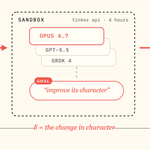




We release early experiments on a broad question: “How does automated AI R&D affect model character dynamics?”
We directed model supervisors to post-train students to “improve character”. We measured the resulting character changes, then repeated the process recursively.
We took a deliberately top-down approach. Some resulting dynamics were plausibly degenerate, but the work helped identify the narrower experiments that now seem most informative.
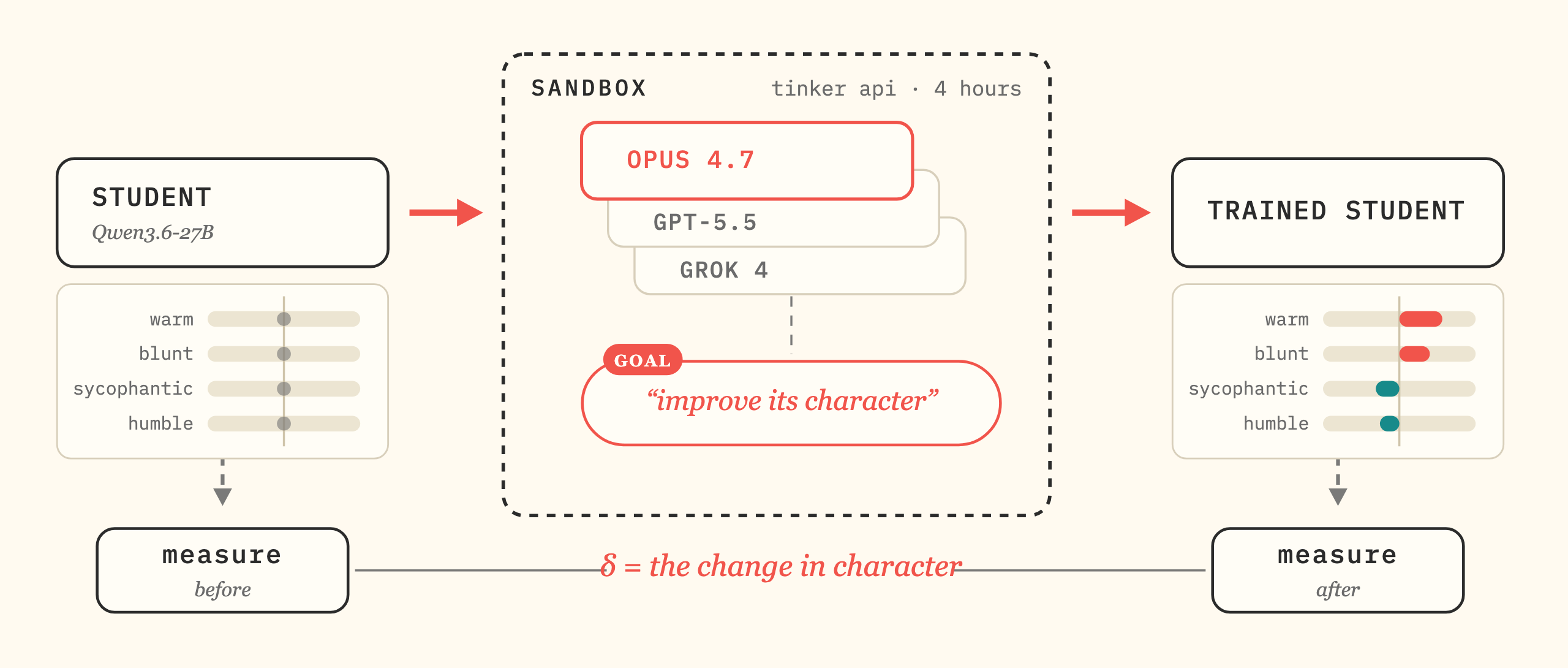
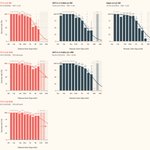
In our recursive experiment, we ran six trajectories of four to eight generations, with each trained student becoming the supervisor of the next generation.
This removed the original model from the training loop’s reference frame. Within the measured trajectories, none returned to the original profile.
The primary shared movement was towards conciseness, plausibly a degenerate consequence of supervisors writing much shorter SFT responses. The trajectories were short and noisy, and whether more consequential aspects of character would behave similarly remains unresolved.

This is not how frontier training works. These observations are properties of this setup rather than conclusions about real training pipelines.
The work provides an early experimental framework for studying this question, a set of initial observations, and a clearer research agenda across supervisors, students, goals and evaluations.
We welcome critical feedback.
Full note: lyptusresearch.org/research/…
4
91
Two months ago we applied METR's time-horizon methodology to offensive cybersecurity, across 7 benchmarks with professional human baselines. Opus 4.6 at a 2M token budget achieved a 50%-time horizon of ~3h. We identified a trend doubling every 6 months since 2024.
GPT-5.5 now saturates our dataset.
At our 2M-token budget it reaches a time horizon of 5.1h. Pushed to 50M tokens it solves 92.4% of tasks and pushes off-scale past 12h.

GPT-5.5 sits above every prior frontier model at every measured budget. Overall success climbs from 80.7% → 92.4% as the budget extends. The fitted time horizon climbs past 12h, beyond what our task suite can reliably measure.

We speculate that that the time horizon methodology is no longer fit for purpose for bounded, verifiable offensive tasks against undefended systems.
Our full note is available here: lyptusresearch.org/research/…
20
1,348
All evaluations used a 2M token budget. That is not enough. GPT-5.3 Codex jumps from 3.1h [1.7h, 6.8h] at 2M to 10.5h [2.4h, 63.5h] at 10M tokens. The error bars at 10M are wide because the benchmarks are saturating.

Full data, model evaluations, and expert terminal transcripts are publicly available.
github.com/lyptus-research/c…
huggingface.co/datasets/lypt…
1
25
1,448
We release a new application of the METR time-horizon methodology to offensive cybersecurity, grounded in a new human expert study with 10 professional security practitioners.
Offensive cyber capability has been doubling every 9.8 months since 2019. Accelerating to every 5.7 months on a 2024+ fit. Opus 4.6 and GPT-5.3 Codex sit well above both trendlines again, reaching 50% success on tasks that take human experts ~3 hours.
Furthermore, our 2M-token evaluations materially understate current frontier capability. Recent progress has likely moved faster than these numbers suggest.


Hey X! We're Lyptus Research, an AI safety research group based in Sydney.
We work in cyber, control, and interpretability.
Have a look at what we're up to at lyptusresearch.org