
Research Associate at IIMAS - UNAM. Interests: theoretical machine learning, data privacy, information theory and random matrices.
Mexico City, Mexico
Joined October 2013
- Tweets88
- Following77
- Followers109
- Likes91






Pinned Tweet
In two weeks our local seminar on information theory, machine learning and statistics will resume (mariodiaztorres.com/itmlss.h…). This term the seminar focuses on generalization in machine learning, privacy and related topics.
Mario Diaz retweeted

Jornadas de Probabilidad, Estadística y Ciencia de Datos
25, 26 y 27 de abril, 2022
Auditorio IIMAS, UNAM
El registro estará abierto hasta el jueves 21 de abril de 2022.
sites.google.com/sigma.iimas…


The seminar consists of a series of two-hours talks aimed at graduate students and researchers with a basic knowledge of information theory and machine learning. Sessions take place every other Friday from 9am to 11am (CST) over Zoom (cuaed-unam.zoom.us/j/8360872…).
1
We already have a great lineup of speakers! Tyler Sypherd, Hrayr Harutyunyan @harhrayr, Shahab Asoodeh @Shahab698 & Wael Alghamdi.
Mario Diaz retweeted

Over the last year, I've spent a fair bit of time thinking about information-theoretic generalization bounds. In particular, what is exactly "information-theoretic" about them?
We provide some answers in a new paper w/@lugosi_gabor: arxiv.org/abs/2202.04985
1/n

After watching the whole NSF CIF meeting, two points where particularly insightful:
* We need to embrace an instance-dependent/algorithmic paradigm.
* Experiments and Applications are different things; theory papers should be accompanied with the former.
nsf.gov/events/event_summ.js…
1
Mario Diaz retweeted

[Favor de retuitear] ¡La fecha límite de solicitud para el programa de doctorado en @hseas es el 15 de diciembre! Mi grupo está buscando hasta dos nuevos miembros para trabajar en teoría de la información y sus aplicaciones en aprendizaje automático y compresión de datos.
Ya llegó la época más bella del año, la época del FEST! 😅

Quiero invitarles a un evento de mate que estoy organizando con unos amigos. El evento se llama FEST 2021 y consiste en presentar diversos temas de interés en matematicas. Sera virtual los dias 15-17 de diciembre. Los detalles pueden consultarse en
cimat.mx/~jagil/Seminarios/F…
2
We continue tomorrow with the third session of the seminar this term. Amedeo Esposito (EPFL) will talk about Information Measures, Independence and Learning.
Come and join us at 9am CDT!

In two weeks our local seminar on information theory, machine learning and statistics will resume (mariodiaztorres.com/itmlss.h…). This term the seminar focuses on estimation of divergence measures, generalization in machine learning, and related topics.
1
We continue tomorrow with the second session of the seminar this term. Wael Alghamdi (Harvard University) will talk about Measuring Information from Moments.
arxiv.org/abs/2109.00649
Come and join us at 9am CDT!

In two weeks our local seminar on information theory, machine learning and statistics will resume (mariodiaztorres.com/itmlss.h…). This term the seminar focuses on estimation of divergence measures, generalization in machine learning, and related topics.
We start tomorrow at 9am CDT! I'll talk about some theoretical properties of MMSE estimation via neural networks.
In two weeks our local seminar on information theory, machine learning and statistics will resume (mariodiaztorres.com/itmlss.h…). This term the seminar focuses on estimation of divergence measures, generalization in machine learning, and related topics.
4
In two weeks our local seminar on information theory, machine learning and statistics will resume (mariodiaztorres.com/itmlss.h…). This term the seminar focuses on estimation of divergence measures, generalization in machine learning, and related topics.
The seminar consists of a series of two-hours talks aimed at graduate students and researchers with a basic knowledge of information theory and machine learning. Sessions take place every other Friday from 9am to 11am (CDT) over Zoom (cuaed-unam.zoom.us/j/8360872…).
Last term we had amazing talks by Tyler Sypherd, @HaghifamMahdi, @BorjaRodrguezG2, James Melbourne & @IvaroEkel. This term won't be the exception, there is already a great lineup! Wael Alghamdi, Amedeo Esposito & @neu_rips
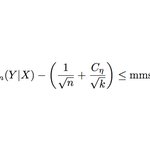
By combining classical function approximation and large deviations results, we established the following (probabilistic) lower bound for the MMSE*.
* Simplified expression for Twitter's sake.
4/7

1
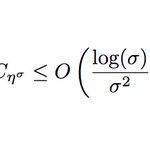
A key technical contribution of our work is the following upper bound for the Barron constant. While proving this bound is relatively simple, finding the right bound was tricky as there are many ways to relate the Barron constant of eta with the L1-norms of its derivatives.
6/7

1

In joint work with @KairouzPeter & Lalitha Sankar (ASU), we established theoretical lower bounds for the MMSE via neural network estimation.
arxiv.org/abs/2108.12851
1/7

