

Follow us to know about China's national defense in the new era.
Beijing, China
Joined December 2025
- Tweets410
- Following11
- Followers371K
- Likes12




Ministry of National Defense of China retweeted

Full text: Communique of the Fifth Plenary Session of the 20th Central Committee of the Communist Party of China.
english.scio.gov.cn/topnews/…

Senior Colonel Zhang Xiaogang, Spokesperson for the Ministry of National Defense (MND), answered media queries on October 29.
More information is provided below:
Question: It is reported that the recent far-seas training voyage of the PLANS Liaoning Carrier Task Group to the Western Pacific lasted over 40 days, the longest one since its commissioning, and the task group was well-equipped. During the training, Japan Self-Defense Forces dispatched ships and aircraft to track and monitor the formation, and released the number of sorties of carrier-based aircraft taking off from the PLANS Liaoning. Yet a Japanese defense official claimed that Japan's monitoring capacity is limited and that it needs to further strengthen its "defense posture". May I have your comment on that?
Zhang Xiaogang: The training of the PLANS Liaoning Carrier Task Group (CTG Liaoning) in relevant waters of the Western Pacific is a routine arrangement within the annual plan of the Chinese military. It aims to test and improve the combat capabilities of the CTG in the far seas, does not target any specific country or objective, and is in compliance with international law and international practices.
Many netizens refer to the Japanese side as a "chief photographer" of the Chinese Navy, because it often snoops on China's normal exercises and training. By recklessly hyping up and smearing such activities, Japan deceives the Japanese people and makes up excuses for its military expansion. Anyone familiar with history knows that manipulating public opinion first, fabricating excuses next and taking actions in the end is an old trick of Japanese militarists to launch aggression in the past. The international community should stay on high alert against such tricks played by Japan's right-wing forces, and resolutely curb the reckless moves of Japan's neo-militarism.

Senior Colonel Zhang Xiaogang, Spokesperson for the Ministry of National Defense (MND), answered media queries on October 29.
More information is provided below:
Question: This year, China's defense minister didn't attend the 13th ASEAN Defense Ministers' Meeting-Plus (ADMM-Plus) held in the Philippines. Why did the Chinese side make the decision to send its defense attaché to the meeting?
Zhang Xiaogang: The ADMM-Plus is the highest-level and largest defense and security dialogue and cooperation mechanism in the Asia-Pacific. Established in 2010, it has served as an important platform for countries to build trust, strengthen cooperation, and uphold regional peace and stability. As the rotating chair of this year's ADMM-Plus, the Philippine side has allowed a certain self-serving politician to act recklessly and abuse its chairmanship to put up obstacles to China's participation. Such moves seriously violate ASEAN's principle of consensus through consultation and run counter to the open and inclusive spirit of the ADMM-Plus. They do not conform to basic diplomatic protocols and undermine China's legitimate rights as a member of the mechanism. Many ASEAN countries have raised questions and opposition over this.
Against such a backdrop, the Chinese side still decided to send representatives to attend the meeting, which demonstrates our firm support for ASEAN centrality and our responsible attitude towards regional defense and security cooperation. The Philippine side's wilful acts to hijack ASEAN and stir up trouble would only undermine the credibility of the ADMM-Plus, erode solidarity and mutual trust among ASEAN countries, and ultimately, impair the fundamental interests of the countries and peoples in the region, including the Philippines.

Senior Colonel Zhang Xiaogang, Spokesperson for the Ministry of National Defense (MND), answered media queries on October 29.
More information is provided below:
Question: According to reports, the U.S. and Japan recently held Exercise Keen Sword 2027, the largest iteration of the series to date, focusing on island-seizure operations. The Japan Self-Defense Forces deployed Type 25 Surface-to-Ship Guided Missiles in the exercise. In addition, the U.S. Marine Corps' Navy-Marine Expeditionary Ship Interdiction System was deployed for the first time on Yonaguni Island, the Japanese island closest to Taiwan. May I have your comment on that?
Zhang Xiaogang: The Asia-Pacific region is a high ground for peace and development. Those who follow the prevailing trend of peace can go far, while those who insist on stoking bloc confrontation find no support. Japan has courted and catered to countries outside the region to conduct so-called joint exercises, developed and deployed intermediate- and long-range missiles, continuously beefed up military deployment in its southwestern islands, and accelerated remilitarization, becoming a real threat to regional security.
The Taiwan question is purely China's internal affair. We will never allow external forces to meddle in China's Taiwan region. No one should underestimate the firm determination, iron will, and strong capabilities of the Chinese side in safeguarding national sovereignty and territorial integrity. Anyone who attempts to use Taiwan to contain China and even overreaches themselves with military provocations will inevitably pay an unbearable price.

Senior Colonel Zhang Xiaogang, Spokesperson for the Ministry of National Defense (MND), answered media queries on October 29.
More information is provided below:
Question: According to reports, Japan's defense minister recently claimed that China has been rapidly expanding its nuclear, missile, and other military capabilities. He argued that Japan possesses neither nuclear weapons nor strategic bombers, whereas China has both and yet criticizes Japan. He also stated that Japan will fundamentally restructure its defense research institutes. Could you please comment on this?
Zhang Xiaogang: It is known to all that Japan, as a defeated country in WWII, must abide by the provisions restricting the development of its military forces stipulated in international instruments such as the Cairo Declaration and the Potsdam Proclamation, as well as Japan's Constitution. This constitutes a political and legal prerequisite for its return to the international community. As a non-nuclear-weapon state party to the Treaty on the Non-Proliferation of Nuclear Weapons, Japan bears an inescapable obligation under international law not to receive, manufacture, acquire, or transfer nuclear weapons. This is by no means a political bargaining chip.
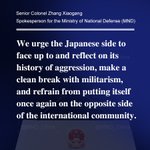
The Japanese official you mentioned deliberately evades Japan's historical crimes, selectively ignores international law, distorts facts, and misleads the public. Despite Japan's chicanery, the international community sees through its dangerous schemes of military buildup and even seeking to introduce and acquire nuclear weapons. We urge the Japanese side to face up to and reflect on its history of aggression, make a clean break with militarism, and refrain from putting itself once again on the opposite side of the international community.

Senior Colonel Zhang Xiaogang, Spokesperson for the Ministry of National Defense (MND), announced during a regular press briefing on October 29 that an African Mid- and Junior-Level Officers Delegation will visit China from November 5 to 11.
Nearly 50 officers from over 20 African countries will visit cities such as Changsha and Chengdu at the invitation of the MND of the PRC. The event is themed "Innovation and Development of Defense Technology in China and African Countries" and will be hosted by the National University of Defense Technology. This marks the 5th time the MND has organized such an event, with the aim of carrying forward the traditional friendship between the Chinese and African militaries, deepening bilateral practical cooperation, and contributing to jointly building the all-weather China-Africa community with a shared future for the new era.

Senior Colonel Zhang Xiaogang, Spokesperson for the Ministry of National Defense (MND), presented the information about the 5th China-ASEAN Mid-and-Junior-Level Officer Exchange during a regular press briefing on October 29.
The event will be held in the Chinese cities of Nanjing, Hangzhou, Shanghai and Kunshan from November 2 to 8. Themed "Trust, Responsibility, Commitment: Jointly Build a Peaceful Home in Asia — in Commemoration of the 5th Anniversary of China-ASEAN Comprehensive Strategic Partnership & the 35th Anniversary of China-ASEAN Dialogue Relations", it will include activities such as themed seminars, exchanges and visits. These activities aim to enhance mutual understanding and friendship among mid-and-junior-level officers from China and ASEAN countries.

Senior Colonel Zhang Xiaogang, Spokesperson for the Ministry of National Defense (MND), presented the information about the upcoming visit by foreign military attachés to China to Southwest China's Guizhou and Sichuan provinces during a regular press briefing on October 29.
Upon the invitation of the MND of China, about 90 foreign military attachés to China from over 50 countries will visit Guizhou and Sichuan from November 2 to 7.
During their stay, they will visit relevant military and civilian units and revolutionary sites of the Long March, learn more about the military commands of Guizhou and Sichuan as well as local economic and social development, and gain a deeper understanding of the great spirit of the Long March.

Senior Colonel Zhang Xiaogang, Spokesperson for the Ministry of National Defense (MND), presented information about the 13th International Army Cadets Week (IACW) & "Future Co-creation" International Military Cadets Innovation Competition during a regular press briefing on October 29.
From November 2 to 6, the event will be held at the PLA Army Engineering University. Foreign cadets from 11 military academies of 11 countries, including South Korea, Singapore, Pakistan, and Egypt, together with cadets from 15 Chinese military academies such as the PLA Naval University of Engineering and the PLA Army Arms University, will participate in the event. Themed "Addressing Key Regional Security Risks, Deepening International Military Security Cooperation, and Delivering International Public Security Products", this IACW will provide an open and multilateral platform for academic exchanges and innovative practices that will further broaden the global vision of participating cadets, sharpen their innovation capacity, build consensus on cooperation, and jointly explore effective ways to address global security challenges through innovation in military fields. During the event, foreign cadets will study and undergo training together with their Chinese counterparts and will learn about China's achievements in high-tech development through on-site visits.

A delegation of the People's Liberation Army visited France and Germany for defense strategic consultations from October 21 to 28.
The delegation exchanged in-depth views with their French and German counterparts on the military-to-military relations, international and regional security, and other issues of common interest.
They agreed to further strengthen strategic communication, enhance mutual understanding and trust, and expand exchanges and cooperation in the defense sector.
@Armees_Gouv @BMVg_Bundeswehr

In the wake of the magnitude 7.0 earthquake in Baqen County, Nagqu City, in Xizang Autonomous Region, the PLA and PAP troops rushed to the disaster area overnight.
They carried out rescue operations, treated the injured, set up temporary shelters, delivered relief supplies and provided hot meals to affected residents — making every effort to safeguard people's lives and provide support.
A salute to the soldiers — who always stand side by side with the people.
The defense attaché of the Chinese Embassy in the Philippines will attend the 13th ASEAN Defense Ministers' Meeting Plus in Cebu on October 29 on behalf of the Chinese side.
During the event, the Chinese side will exchange views with other parties on upholding dialogue and enhancing mutual understanding and trust, and reiterate China's firm support for ASEAN centrality in the regional architecture to promote regional defense and security dialogue and cooperation, and safeguard peace and stability in the region.

The 12th Chinese Infantry Battalion in Juba, South Sudan, recently held a medal-awarding ceremony. During the event, 521 peacekeepers were awarded the United Nations Peace Medal in recognition of their contributions to maintaining peace and stability in the region.
Since its deployment to South Sudan last December, the battalion has carried out over 100 missions, including joint patrols, covering a total distance of more than 14,000 kilometers. It has also supported over 20 humanitarian activities, demonstrating its commitment to UN peacekeeping through concrete actions.
@unmissmedia @ChinaEmb_Juba


From late October to early November, the Chinese and Indonesian militaries will hold the "Sharp Knife 2026" joint army counter-terrorism training in China's Guangdong Province.
Focusing on joint counter-terrorism rescue operations in mountainous terrain, the training will cover mountain climbing, special driving, helicopter rappelling, close-quarters assault, and manned-unmanned coordination.
This will be the third joint training in the series, aimed at further deepening practical exchanges and cooperation between the two militaries and enhancing interoperability.

From October 27 to November 2, the Peacekeeping Affairs Center of the Ministry of National Defense and the National University of Defense Technology will jointly host a high-level strategic seminar on United Nations peacekeeping in Changsha, Hunan Province. Representatives from nearly 40 countries and international organizations, including major troop and financial contributors to UN peacekeeping operations, as well as the UN itself, have been invited to attend.
The seminar will feature in-depth discussions and exchanges on topics including current challenges and future prospects of UN peacekeeping operations, new technological concepts and their potential applications in peacekeeping operations, and advancing global security governance through cooperation on UN peacekeeping.
The seminar aims to deepen practical international cooperation on peacekeeping, build consensus and pool collective efforts, and contribute Chinese wisdom and solutions to enhancing the effectiveness of UN peacekeeping operations and promoting world peace and development.

October 25, 2026, marks the 76th anniversary of the Chinese People's Volunteers' entry into the Democratic People's Republic of Korea to fight in the War to Resist U.S. Aggression and Aid Korea.
Seventy-six years ago, the Chinese People's Volunteers crossed the Yalu River to defend peace and resist aggression, fighting alongside the people and the army of the DPRK.
After two years and nine months of arduous and bloody battles, they achieved a great victory.
Salute to the heroes. Safeguard peace.
Taiwan's restoration to China is a great victory won through the arduous and bloody battles of the Chinese people, including Taiwan compatriots.
It is an important component of the outcomes of World War II and the post-war international order, and it is the shared glory of people on both sides of the Taiwan Strait who belong to the Chinese nation.
The rejuvenation of the Chinese nation is unstoppable, and China's complete reunification is a process that cannot be halted.
The China-Pakistan "Karakoram-2026" joint army training concluded successfully on October 22 in Korla, Xinjiang Uygur Autonomous Region.
Focusing on joint counter-terrorism operations in high-altitude areas, the activity included skills training in UAV operation, on-the-move target search and firing, and long-range sniping, and covered joint command and live-force exercises.
This was the first joint army training between the two countries, which helped the two sides deepen exchanges and cooperation, and strengthen their capability to jointly counter terrorist threats.
China held a gathering in Beijing on Thursday to commemorate the 90th anniversary of the victory of the Red Army's Long March.
Chinese President Xi Jinping, also general secretary of the Communist Party of China Central Committee and chairman of the Central Military Commission, attended the gathering and delivered an important speech.
Here are some highlights from the speech:


