

MRO is The Single Source for Smarter Data™—driving a new era of clinical data intelligence.
Norristown, PA
Joined March 2012
- Tweets2.5K
- Following1.2K
- Followers728
- Likes324







As healthcare AI improves, what happens to your organization’s data?
Our latest blog explores data separation, model and process improvement, and what health systems should know as AI evolves.
Read more: okt.to/RVUe8u

What does responsible AI really look like in release of information?
This article takes a closer look at where AI can add value, where human judgment remains critical, and how emerging technologies could reshape the future of ROI.
Read more: okt.to/jviyBs

Protecting sensitive health information doesn’t have to slow record disclosure.
See how comprehensive quality control can support greater efficiency while strengthening disclosure safeguards: okt.to/rdaXtz
#HealthInformation #DataIntegrity #QualityControl

We’re proud to announce that MRO has been named a 2026 Top Workplace for Remote Work!
This national recognition is based solely on feedback from our employees, making it especially meaningful.
Learn more: okt.to/oj2wWL

Confidence matters when AI is working with complex clinical data.
See how confidence scoring helps determine which AI-generated outputs can move forward and which need clinical review.
Learn more: okt.to/mdA2uv
#HealthcareAI #ClinicalDataManagement

What does it take to apply AI effectively to clinical data abstraction?
@hcittoday explores how MRO’s Prodigy™ brings AI and clinical expertise together, with insights from Mo Weitnauer on quality, confidence and efficiency.
Read the full: okt.to/OPtXFM

What makes clinical data abstraction difficult to scale?
Complex, unstructured documentation contains important clinical information, and the volume continues to grow. AI is creating new opportunities to support abstraction at greater scale.
Read more: okt.to/52CoHX

The untapped growth opportunity for cancer programs may already be in their registry.
Oncology registry data can reveal patient, market, referral and treatment trends to inform smarter decisions.
More: okt.to/dWkP1y

Quality teams need registry data they can defend, without adding to an already stretched abstraction workload.
Prodigy™ combines the power of AI with the accountability of clinical expertise to meet that need.
Learn how in our latest blog: okt.to/pVkaco


Accurate, timely trauma registry data can support everything from performance improvement and team education to public health and program planning.
Explore three ways programs can turn data into actionable insights and more: okt.to/hgdbKY


What does AI-powered clinical registry abstraction look like? Our leaders in AI architecture and software engineering sat down to share an inside look at Prodigy™, the engine behind MRO's fully managed clinical data abstraction solution.
Full video: okt.to/Hp98cK
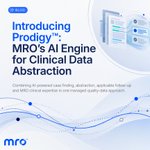
Meet Prodigy™—our advanced AI engine setting a new standard for clinical registry abstraction—built to identify more eligible cases, reduce abstraction time, and deliver defensible clinical data for registries in healthcare.
Read the full announcement: okt.to/RCQ6TU


We're thrilled to announce MRO has acquired Vyne Medical, adding intelligent clinical data intake to our platform.
Together, we're now powering data for 2,500+ hospitals and 35,000+ clinics.
Read the full announcement: okt.to/bdfan4

Not all AI risk is created equal. In healthcare, the stakes around patient care, quality reporting, and financial outcomes shape how AI has to be built and deployed.
Hear why healthcare AI needs clear guardrails, human review, and ongoing monitoring: okt.to/hJqMKc

Headed to the @NAHRI_org Revenue Integrity Symposium in Savannah? Connect with @MROCorp at Booth 30 on how expert support and intelligent automation can help organizations work smarter across every layer of #RevenueIntegrity. We look forward to connecting.
okt.to/I2aAYE

Better HEDIS® scores start with better data. Learn how health plans can build confidence in their clinical data—from source validation to ongoing monitoring—in our newest blog post: okt.to/axgEUw

Clinical data demands continue to grow for medical practices and providers. Visit @MROCorp at #MGMA2026 Booth 136 to see how connected solutions can streamline ROI, strengthen compliance, reduce administrative burden and unlock actionable insights: okt.to/H4A6TJ
@MGMA
