







ALT Mother and daughter on a blue background. Mothers and daughters are invited to Walk in Her Shoes: Empowering Black Women Living with HIV to Triumph Over Challenges. NEW DATE! July 16, 6 pm - 9 pm ET. Morehouse School of Medicine. Join us for a special evening focused on the critical HIV related challenges facing Black women complete with panel discussions and a chance to engage with community leaders and experts. Register here: bit.ly/walkinhershoesevent. QR code. Logos for Satcher Health Leadership Institute, Georgia Thrives, and Southern AIDS Coalition.

ALT Illustration of a person using a wheelchair, a person with a prosthetic leg, a person with a cane and dog, and other people in a group smiling. Disability Pride Awareness Month Health Equity Symposium. Presented by Live-Well Medical & Stafford Services. Join Us at Savannah State University. FREE including breakfast. An array of thoughtfully constructed lectures, presentations and demonstrations that will enlighten and enrich our current knowledge and skills base and position us to return to our respective destinations better equipped to meet the needs of those we serve. Saturday, July 27th.

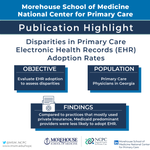
ALT Morehouse School of Medicine National Center for Primary Care Publication Highlights. Disparities in Primary Care Electronic Health Records (EHR) Adoption Rates. Objective: Evaluate EHR adoption to assess disparities. Population: Primary Care Physicians in Georgia. Findings: Compared to practices that mostly used private insurance, Medicaid predominant providers were less likely to adopt EHR. Find us on Twitter @MSM_NCPC and on LinkedIn.

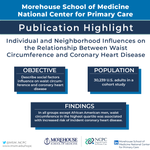
ALT Morehouse School of Medicine National Center for Primary Care Publication Highlights. Individual and Neighborhood Influences on the Relationship Between Waist Circumference and Coronary Heart Disease. Objective: Describe social factors influence on waist circumference and coronary heart disease. Population: 30,239 U.S. adults in a cohort study. Findings: In all groups except African American men, waist circumference in the highest quartile was associated with increased risk of incident coronary heart disease. Find us on Twitter @MSM_NCPC and on LinkedIn.

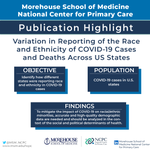
ALT Morehouse School of Medicine National Center for Primary Care Publication Highlights. Variation in Reporting of the Race and Ethnicity of COVID-19 Cases and Deaths Across US States. Objective: Identify how different states were reporting race and ethnicity in COVID-19 cases. Population: COVID-19 cases in U.S. states. Findings: To mitigate the impact of COVID-19 on racial/ethnic minorities, accurate and high-quality demographic data are needed and should be analyzed in the context of the social and political determinants of health. Find us on Twitter @MSM_NCPC and on LinkedIn.

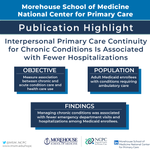
ALT Morehouse School of Medicine National Center for Primary Care Publication Highlights. Interpersonal Primary Care Continuity for Chronic Conditions Is Associated with Fewer Hospitalizations. Objective: Measure association between chronic and acute condition care and health care use. Population: Adult Medicaid enrollees with conditions requiring ambulatory care. Findings: Managing chronic conditions was associated with fewer emergency department visits and hospitalizations among Medicaid enrollees. Find us on Twitter @MSM_NCPC and on LinkedIn.

ALT Morehouse School of Medicine National Center for Primary Care Publication Highlights. Disaster Preparedness and Equitable Care during Pandemics. Objective: Outline approaches to delivering equitable care in disasters and pandemics. Population: Underrepresented and minority communities. Discussion: This nation must be willing to provide resources to design, build and sustain a health care infrastructure that specifically addresses the needs of disproportionately impacted populations. Find us on Twitter @MSM_NCPC and on LinkedIn.

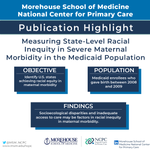
ALT Morehouse School of Medicine National Center for Primary Care Publication Highlights. Measuring State-Level Racial Inequity in Severe Maternal Morbidity in the Medicaid Population. Objective: Identify U.S. states achieving racial equity in maternal morbidity. Population: Medicaid enrollees who gave birth between 2008 and 2009. Findings: Socioecological disparities and inadequate access to care may be factors in racial inequity in maternal morbidity. Find us on Twitter @MSM_NCPC and on LinkedIn.

ALT Morehouse School of Medicine National Center for Primary Care Publication Highlights. Neighborhood Characteristics and Arterial Stiffness among Black Adults. Objective: Compare the association between neighborhood environment and arterial stiffness . Population: Black adults in Jackson, MS and Atlanta, GA. Findings: Neighborhood social characteristics show an independent association with the vascular health of Black adults, findings that were reproducible in two distinct American cities. Find us on Twitter @MSM_NCPC and on LinkedIn.

ALT 'Morehouse School of Medicine National Center for Primary Care Publication Highlights. Community Engagement of African Americans in the Era of COVID-19. Objective: Discuss the complex sociodemographic factors that created COVID-19 disparities. Population: Black Americans during the COVID-19 pandemic. Findings: The challenges and realities detailed in this commentary create opportunities for new approaches to intentionally engage socially vulnerable African Americans. Find us on Twitter @MSM_NCPC and on LinkedIn.

ALT 'Morehouse School of Medicine National Center for Primary Care Publication Highlights. Primary Care: A Key Lever to Advance Health Equity. Objective: Examine the relationship between health equity and primary care. Partner: Primary Care Collaborative. Conclusion: This report identifies concrete, practice-and policy-level actions that primary care stakeholders can pursue to reduce inequities and take steps toward achieving health equity. Find us on Twitter @MSM_NCPC and on LinkedIn.

ALT Morehouse School of Medicine National Center for Primary Care Publication Highlights. Disparities in Primary Care Electronic Health Records (EHR) Adoption Rates. Objective: Evaluate EHR adoption to assess disparities. Population: Primary Care Physicians in Georgia. Findings: Compared to practices that mostly used private insurance, Medicaid predominant providers were less likely to adopt EHR. Find us on Twitter @MSM_NCPC and on LinkedIn.

ALT Group picture with 13 people smiling at a conference table in front of a brick wall.

ALT Key Findings from the Digital Health Tools Study. 99% of respondents had used at least one DHT in the past five years. 52% of respondents who used telehealth because of COVID-19 reported in was their first time. Top factors for supporting digital health tool adoption: 58% ease of workflow integration, 55% meets patients need, and 50% improves patient health.