




藪出毬 retweeted

15年前の今日、ヒミツナメクジが新種記載されました。時の流れの速さを感じますが、今後当アカウントでは毎年11月20日をヒミツナメクジの日と勝手に呼び、その存在へ改めて想いを馳せることにします。
原著:doi.org/10.1093/mollus/eyr03…
全文はResearchGateでも閲覧可能です:
researchgate.net/publication…


#ダーウィンが来た 再放送もご視聴ありがとうございました。ヒミツナメクジかわいいとの声が多数届いていますので、未公開写真をご披露します。2009年6月与那国島産、深夜に海蝕洞で見つけてその夜のうちに撮影。与那国では私が知る限り唯一の発見個体です。2枚目の少し頭を擡げる仕草も愛らしいです。


藪出毬 retweeted

【緩募】シェア歓迎
こどもの「冬」の制服のシャツやブラウス、何枚持っていますか?
(夏の制服についても次にぶら下げるので、良かったらそちらもお願いします)
60%2枚
22%3枚
10%4枚以上
7%その他、閲覧用(1枚の方はぜひコメントで)
58 votes • Final results
藪出毬 retweeted

There's a microbe that uses a "molecular syringe" to inject proteins into insect cells, but researchers evolved it, in the lab, to recognize and inject proteins into plants instead.
So you can grow up these proteins, put them in a buffer, and then gently push the fluid into leaves. The proteins enter the interstitial fluid between the plant cells, grab onto those cells carrying the matching receptor, and then inject the proteins. The scientists used this to deliver Cas9, Cre and other gene editors, and it worked in 10–16% of the cells they looked at. It's also relatively straightforward to evolve these syringes to recognize other types of plant receptors, so you could use them to solely inject proteins into particular cell types, while leaving other cells alone.
(Historically, getting proteins into particular cells has been tricky. You could strip the cell walls away, or use a gene gun and hit all the cells at once, or use agrobacterium to deliver DNA and wait for the plant cells to make the protein themselves.) Good stuff.
nature.com/articles/s41565-0…

藪出毬 retweeted

Engineering RuBisCO to enrich essential amino acids in sustainable food applications nature.com/articles/s41538-0…


藪出毬 retweeted

お。
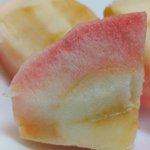
多分、Myb様の転写因子が果肉でも発現してるタイプ。
naro.go.jp/project/results/l…


藪出毬 retweeted

New paper! The wheat blast fungus cannot infect rice. Motoki @Shimizu_sm , Ryohei @ryoheiterauchi and colleagues cracked this “unmappable” resistance with a clever trick: transferring wheat blast effectors, one at a time, into a rice-infecting isolate.
35 effectors × 20 rice cultivars revealed six resistance-triggering effectors. One led to Pi-eTO5, a quartet of linked NLRs—three required for resistance, one keeping autoimmunity in check.
The effector recognized by this quartet, eTO5, is conserved across the pandemic B71 clonal lineage in South America, Asia and Africa.
A route to unlocking nonhost resistance genetics in other host–pathogen systems.
Link below 👇🏾


My first post😀
Our new preprint is now online!
In this study, we show how nonhost resistance can help uncover new immune receptors in rice. A big thank you to all our co-authors and collaborators who made this work possible.
#NLR,#rice,#wheat
biorxiv.org/content/10.64898…


藪出毬 retweeted

「円石藻ガイドブック」を来年1月に出版させて頂くことになりました。私がご紹介する現生種に加えて、共著者の宇都宮さんが、とってもステキな化石種も紹介してくださっています。いまは最後の確認作業中。みなさま、どうぞよろしくお願いいたします。

萩野恭子・宇都宮正志共著『円石藻ガイドブック』、来年1月発行予定です。編集・製作作業は最後の追い込み。海文堂出版のホームページに近刊としてアップされています。
kaibundo.jp/2026/11/80085/

とりあえずesmig先生にコラーゲン摂取を推奨頂いてから毎週鶏もも肉(たまに手羽元)と野菜を煮込んだ各種和洋中韓のスープを食べてみてる。(調理が楽、子供が好きという理由もある)
効果はわからないけど左の五十肩治った後は骨とか関節系傷めてないし、風邪も引きにくいなら助かるなぁ。
1
3
226
藪出毬 retweeted

今見ている論文に「コラーゲンはヒトの体内において分解と合成が繰り返されており、その合成量は96.5g/dayにも及ぶ。その背景で合成されるプロコラーゲンはそのほとんどが分解されているが、その総量は1日1kgにも及ぶ。」って書いてあって、目が点になっているところ。
pubmed.ncbi.nlm.nih.gov/3759…
