
Professional Shitposter
Joined June 2013
- Tweets132
- Following16
- Followers276K
- Likes10.8K


Pinned Tweet
Since my posts have been shared here ~30 times in the past few weeks, it seems like I'm going to be contributing to Space Karen's Ketamine Extravaganza whether I like it or not.
I don't really intend to be active here, but I'll post some of the more important cybersecurity-focused stuff, since it gets screenshotted anyway. That way, people don't have to read post a week late and out of context.
> Buy KVM that's rated for switching between classified and unclassified networks to keep my malware analysis environment airgapped.
> Cry because "military technology" and bank balances don't mix.
> Smile because my network is now more secure than a frontier AI lab.
"It's crazy how there's so many major hacks all of a sudden"
- people who started paying attention to cybersecurity 3 weeks ago.
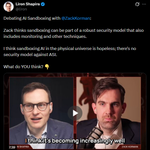
"We shouldn't bother with cybersecurity because this hypothetical AI model I made up in my head can bypass every security control" perfectly sums up how deeply unserious these people are.

Currently writing a blog about what I think the "vulnpocalypse" will actually look like (cringe term, I know). You can narrow almost every mass-exploitation event down to a single factor which dictates whether or not cybercriminals will engage in internet-wide mass-exploitation.
Life is a lot easier once you stop seeing threat actors as hackers who want to break into systems by any means possible, and start seeing them as businesses with well defined business processes.
A bakery isn't going to start making dog food because there's a dog food shortage. ClickFix and Phishing actors aren't going to drop everything to vibecode exploits just because a critical CVE came out.
The fact that the only actors exploiting this are the actors whose MO is exploiting things... isn't a coincidence. It's entirely predictable if you understand threat actor behavior.


But when have guns ever killed anyone? We need to focus on the real hard hitting issues facing Americans, such as hypothetical AI-powered IoT toaster worms. Do you really want to live in a world where you can't make toast, because AI?

It's extremely arbitrary. I only got approved because I have exactly 1 CVE to my name, which was the result of a vendor being completely unreachable via every contact method they listed, so I ended up just dropping a zeroday on my personal blog to get their attention.

Marcus Hutchins retweeted

Preliminary result of my "realistic traffic" php2shell benchmark with `nginx -> Apache (15 workers) + mod_php` and PHP 8.4.26.
This setup is interesting, because reverse-proxies are common, and you cannot control the worker you are going to reach.
- Blue: success rate of the memory leak.
- Red: success rate of command execution.
- x-axis: requests/s benign traffic in parallel
Everything is default config, except Apache with 15 workers (default 150). I lowered it, because I wanted it to be easier to saturate the workers with the traffic.
With 100req/s traffic on 150 workers, the exploit still had 100% success rate. With 15 workers, it starts to drop to 94%.
Traffic is being generated on the host itself directly, to avoid it looking like a DoS attempt over the network. But the exploit is being executed on my laptop to the remote host, so we don't have any advantage with low ping (we need to wait for the cookie leak, before sending the next stage).
The exploit uses a fanout strategy, throwing 15 requests per stage (so 60 in total). For 150 workers it would be 600 requests.

Marcus Hutchins retweeted

php2shell is one of the most impactful bugs in recent times, yet threat actors aren’t mass exploiting it
the bug is so complex that even porting the exploit between targets takes serious skill, human or ai
so i benchmarked how well open and frontier models can do it. 🧵

The way frontier labs have restricted access to cyber capabilities makes no sense. If you're considered a "defender" you're not allowed access to the "offensive" versions of the models (the ones that can do development/validation of malware and exploits).
So for example, if you want to build some sample malware to test a detection system, nope.
Or if there's a major crisis due to a critical vulnerability in PHP and you need to rapidly triage fake exploits to see if there are any real ones floating around so you can warn people, nope.
Want to build a remote code exploit to make sure the detection rules you plan on proposing to the clients actually work? Hard nope.
You gotta call your red team friend and wait for them to do your job for you, because "defender" are only allowed to play in the sandbox with the children.
Not an expert, but I think that the ability to triage in-the-wild exploits during a major crisis affecting 40 million systems is possible maybe important.
And then they want to ban abliterated open weight models, which half of the people are only using because frontier labs will only give them access to lobotomized models.
Feeling super euphoric rn lol


I explicitly decided to avoid sharing that post because it's written in an extremely weird way. The article is basically a giant non-sequitur. It starts with "we saw a proof of concept" then immediately jumps into "agentic AI post-exploitation", without making any claim that A led to B.
It's a very strange structure for a threat intelligence report, and none of the segments of the article logical follow each other. I tried asking for clarification about what/why that is, but the response I got was extremely cagy, so I didn't feel comfortable risking my reputation on it.
Marcus Hutchins retweeted

lmk what you think: nitter.cf/0x4d31/status/21141000…

‼️ ok, this might be the first publicly documented, validated PHP2Shell RCE in the wild.
my agent did the analysis, published here: github.com/0x4D31/honeypot-d…
Marcus Hutchins retweeted
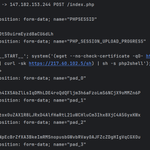
This is by far the highest quality confirmation of in-the-wild php2shell exploitation I've seen so far. Deep technical breakdown of a successful exploitation attempt against an Apache mod_php installation running PHP 8.4.26.
github.com/0x4D31/honeypot-d…
From:
nitter.cf/0x4D31/status/21140524…

‼️ wow, confirmed more from the same IP, plus a new IP with a different payload that might be a different actor… and this is showing up in multiple regions now.
probably better not to burn the honeypots with a full report just yet. if i know you, DM me for the full report. will share a shorter version soon.
> That new alert materially expands the case: I’ll verify the three AP-northeast shell events and the curl connection independently, then compare them with the EU-west sequence.
Seeing some anecdotal reports of successful php2shell exploitation in the wild, but also seeing a lot of people mistaking old exploits for php2shell. I'd say it's fairly likely there's at least some exploitation going on, but all the people I'd usually confer with for a second opinion or an idea of scale are offline because it's the weekend lol.
This is by far the highest quality confirmation of in-the-wild php2shell exploitation I've seen so far. Deep technical breakdown of a successful exploitation attempt against an Apache mod_php installation running PHP 8.4.26.
github.com/0x4D31/honeypot-d…
From:
nitter.cf/0x4D31/status/21140524…
‼️ wow, confirmed more from the same IP, plus a new IP with a different payload that might be a different actor… and this is showing up in multiple regions now.
probably better not to burn the honeypots with a full report just yet. if i know you, DM me for the full report. will share a shorter version soon.
> That new alert materially expands the case: I’ll verify the three AP-northeast shell events and the curl connection independently, then compare them with the EU-west sequence.
So much of my feed is AI investors crying about imaginary issues, because they know that open weight models threaten their ROI. All of these critical vulnerabilities were found with closed AI model, then responsibly disclosed to vendors so they could be fixed before attackers abuse them.
Even if the researchers had used abliterated models, they are still responsibly disclosing the vulnerabilities so they can be fixed, which is still providing important defenses against hackers.
Notice how they always just handwave about "critical vulnerabilities" because they know they can't point to a single real example. That Anthropic article is extremely low effort propaganda designed to try and steer the government towards banning open weight models.
Bad faith actors with ulterior motives trying to lay the groundwork for extremely harmful regulations is all these people are. What do you think happens when companies can't access cheap AI inference, but criminal hackers can, because (spoiler alert) criminals don't follow the law.

I strongly believe a part of why so many critical vulnerabilities are happening all over the proliferation of "abliterated" models, or models with safeguards removed.
You can access an abliterated GLM 5.3, a near frontier AI model, on @abliteration_ai today. And it's a world class penetration tester for like $10.

It's wild how low effort disinformation operations have gotten. 10 years ago you had to create a sockpuppet account and pretend to be a concerned citizen. Now you can just be like "Hey, it's me, Deedy McAnthropicInvestor here. I've come to show you this impartial Anthropic post about why their competitors are all dangerous/bad and should be banned.
Since people are yelling at threat intelligence professional for "downplaying the severity of the PHP vulnerability" (communicating clear concise information about what they're actually seeing). It feels necessary to explain what threat intelligence actually is.
Consider a hypothetical hospital or a power company. A lot of systems are built using very old PHP versions. It's not uncommon for PHP to add/remove/change features from version to version. So if you're a certain number of versions behind, updating to the latest version will break your software by removing or changing functionality it needs.
In that case, the provider has two options:
1) take their software offline until they can update the code to match the latest PHP version.
2) panic install the patch and break their software, leading to a massive outage.
In both cases, that is basically a 100% chance of an outage. On the other hand, maybe they get hacked, maybe they don't. Maybe that hack causes an outage, maybe it doesn't. Realistically, under these circumstances, the chance of an outage is actually higher with patching than with not patching.
If that outage would result in the hospital having to shut its doors or a power company's infrastructure going offline, what is the correct move? Chance being hacked, or knowingly cause an outage that threatens lives?
Cybersecurity is important and all, but there are risks far greater than being hacked. I would absolutely love it if I could just log onto IDontKnowWhyTheyRenamedThisSite dot Com, be like "vulnerability bad, pls patch" and everyone installs the patch. That is not the world we live in.
Now, if I start seeing people building ransomware that can copy itself from system to system using the PHP vulnerability, and I communicate that, it changes a lot of people's risk calculations. Their option shift towards either a 100% chance of an outage, or an extremely high chance of an outage + catastrophic data loss. In this case they would most likely pull the trigger on patching or taking their software offline.
While the hypotheticals I gave are extreme cases, many organizations accept being hacked as a cost of doing business. Taking offline software that's critical to organizational function is not an easy decision to make, and does not get taken lightly.
We don't live in LaLa land where every org installs every patch for every vulnerability the day it goes live. Cybersecurity is expensive and time consuming. Getting people to even patch systems at all is an endless uphill battle.
Most orgs know that something like 1 out of ever 10,000 critical vulnerabilities actually gets exploited. And probably less than 50% of these "this is the worst of the worst vulnerability ever, the sky is falling" type vulnerabilities leads to significant damages.
It takes a lot of time to build trust, and very little time to lose it. Overhype a couple of vulnerabilities and people will very quickly stop listening to you. It's extremely easy to end up being the boy who cried wolf. There's only so many times you can spin security teams into a frenzy before they stop listening to you entirely.
Orgs also have limited resources, so when you yell fire, there is a good chance they're committing resources they don't have. Making people stay up all night, pulling people off other issues, bringing in outside help. You probably don't want to be responsible for some org getting ransomwared because they redirected all their security resources to some vulnerability you think is really cool.
Nobody is downplaying anything. They are communicating exactly what they see/know about the issue so that organizations can make the most informed risk management decisions possible. That is the game, and that is what threat intelligence exists for.
If you want to handle an organization's security for them and personally take on the risk of potentially costing them billions or killing their customers, join an MSSP or a critical infrastructure provider. I can promise you it's way more stressful than you think.
It's not our job to decide organization's own risk models for them. It's our job to give the most information possible to the people who do. And just because some vulnerability researcher thinks we're not hyping up the vulnerability enough doesn't make them right.
Last I checked, only something like 9.3 million out of 42 million systems had installed the patch. This is the reality we live in. If we yell fire, then maybe we can bump that number up to 10 million, but if nothing happens, it'll be at the cost of maybe 2 million less systems getting patched next time around.
These are real risks we have to live with. These aren't one-off incidents. People will remember how accurate our advice was the next time around. And more or less people may decide to install security fixes based on how accurately we communicated the risks during previous incidents.
Threat intelligence is an extremely complex numbers game where there is never any right answer.