

American investor & fmr hedge fund mgr, 30 yr Wall St Pro Mampilly Research- https://nitter.cf/t.co/7osT4SltYX Posts are opinions not investment/financial advice
Joined May 2017
- Tweets11K
- Following63
- Followers16.2K
- Likes4.9K





The 10 yr bond with a yield of 5% is now serious competition to many stocks. While many folks will roll their eyes at me saying this, this return will beat many stocks returns in long term returns. Thats because many businesses don't generate 5% in long term return on equity.
This is especially true in a period of rising prices. The ability to pass on prices without losing market share or absorbing them till your competitors wilt or being able to innovate to make customers pay more are the keys to surviving periods of rising prices.
Once again, very few companies have any of these abilities. That means most will not generate a 5% return. In fact many will lose money outright.
In this environment, I believe that dividends matter, as a significant part of your return will be generated from returns.
This kind of talk will seem quaint and somewhat outdated in world where expectations are for AI to generate 100% per year returns.
Still, I'm wiling to bet that 5, 10 years from now, stocks of companies with rising dividends are going to be the ones that people wish they owned.
The key words in that phrasing are rising dividends. By ensuring that your picking companies that can lift dividends regularly, you're ensuring that they can do 1 or more of the three things to raise prices to keep or take market share.
1
7
879
One lesson from 2008 I can say is that you don't want to be in 2 minds going into a panic, crash or bear market.
You want to have iron price discipline and enforce stop losses.
Or you be committed to going along for the ride.
The downside of having iron price discipline and selling out is that the panic burns out and you have a 2020 covid scenario, where stocks move up so fast that you missed some "easy" gains.
The downside of committing to going along for the ride, however long or far it goes, is that prices can fall for longer and further than you imagine.
My experience from multiple crashes, panics & bear market is that most people imagine that the experience of committing to going along for the ride think this is kind of easy. Seeing your account decline everyday and doing nothing is much harder than it looks. Many or even most will succumb and sell near the lows. Thats how the lows are set.
2
12
1,701
The ultra high concentration in AI/tech in $SPY $QQQ could (key word) mean that this is where you see the highest intensity of selling in the current market.
Some of the places where we think money looks to move as it leaves AI/Tech
- energy & related infrastructure
- chemicals
- dividends (many of them in energy)
- stocks of companies that have unique characteristics like royalty trusts
The one thing all of these things share is that they are small & very underowned.
Underowned means that their share in the big indices is infetisimal. Also, retail investors who are intensely focused on AI/tech mostly don't own it.
So, as $SPY $QQQ & AI/tech see selling pressure, there isn't necessarily the same presure on these kinds of stocks.
1
2
763
One of the market sayings that you only realize in hindsight is that markets tops are a process. And bottoms are an event.
5
703
Paul Mampilly🇺🇸 retweeted

As the dot com bubble imploded most of us were caught off guard. The market went from 3 years of BTD moon shots to a broken market where nothing could get any traction. The part that was most sticky from a learning perspective was the violent rallies that came out of nowhere moving the indexes over 20% in some cases only to yield lower lows. It truly wore you out. 💯

The internals of $SPY $QQQ and stock market continue to look poor. Stocks making new lows are far greater than new highs.
Folks bidding up megacaps like $AAPL are no longer enough to keep the indices flat or moving higher.
Volatility indices are spiking, short interest is rising.
CDS, which is protection you buy for debt is blowing out for companies that are part of the "AI trade."
Margin debt is still at sky high levels. So many people are going to face horrendous losses with a big downside move.
Be careful, cautious.
3
1,111
Cash means different things depending on what you measure it against.
Against everyday goods, it’s about purchasing power. When that falls, that’s inflation. Against assets, it’s different. You trade cash for ownership plus the risk the price goes the wrong way. If the asset falls relative to what you paid, cash has appreciated.
With inflation and debt high, a lot of people say cash has no long-term value. That’s mostly true versus the goods basket and versus staying invested through recoveries. But in a crash or panic, when asset prices drop, cash still has real hedge value. It becomes more desirable precisely because everything else is falling against it.
This distinction in roles is worth remembering as asset markets start to wobble. Bottom line, when everyone goes to sell, cash has maximum value. Its important to differentiate the role it plays in asset markets from the risks of a slow melt of long term value through inflation.
6
978
Paul Mampilly🇺🇸 retweeted

“My overriding advice is to avoid passive or index investing. I think it’s gone too far. The indexes themselves are overconcentrated, and overconcentrated in the most speculative themes”

Ed Chancellor: “Leverage, capital inflows and low interest rates are features one finds in most bubbles”
youtu.be/bhgiF3nWr7w?is=GJER…

A debt repricing seems underway as a result of the capital needs of AI and the ability of these companies to pay higher than market rates for their capital.
1. The global sovereign debt thats been piled up for 40 years as US rates went lower. That pile of debt has to be repriced for market rates.
The US can print as many dollars as it wishes but most other debtors cannot. Already interest rates, currencies are beginning to swing. Japan rates are soaring, Euro is hitting 52 week lows against the Dollar. Asian currencies like the Indonesian Rupiah are wilting.
2) Within AI, folks who have stretched their capital beyond what they could afford in a crisis are about to see their debt repriced. As they say, you should size your position for the path, not the destination. Translation, they issued too much debt, assuming no troubles, no crises, no problems. The market is signalling this with surging CDS (credit default swap) rates for hyperscalers.
3) 40 years of declining US interest rates from 1980 to 2020 (approximately) lead an explosion of private debt. Financialization of the economy became normalized. The poster child for this is private equity that went from being an exotic, esoteric financial strategy to multi-trillion "asset class."
Can private equity afford to refinance companies they bought when rates were lower. Can these companies still be held at 8% or 9% or 10% corporate bond yields? The market action suggests that the answer to this question is getting nearer.
7
1,228
Paul Mampilly🇺🇸 retweeted

This Bitcoin price action has me thinking one of two things:
1. The bottom is near.
2. The market is front-running a COVID-like AI vulnerability event that disrupts software and the internet globally.
I think Bitcoin survives both. And I remain bullish on the other side.
🇺🇸🇺🇸🇺🇸🚀🌔🪐
Congratulations @SpaceX!
Wow what an incredible feat, catching Starship!

Its worth going into why (in my opinion) we see a recurring pattern in the halving cycle. People use Bitcoin for different things.
First, there is a hardcore group who is using Bitcoin as a digital store of value. These are folks who I'll tag as the HODLrs. They just buy and hold and ride volatility out.
Second, there is a large group of folks who love betting on Bitcoin volatility. These folks have become an even bigger presence as a result of perpetual futures that have extraordinarily leverage of 20X, 50X and even 100X.
Third, there are folks making macro bets on things like interest rate policy, inflation, currency, etc.
Fourth, there are tourists who arrive somewhere near the peak. With a distinct peaking period after halving, Bitcoin inevitably becomes one of the trending assets that draws folks who are persuaded that this cycle will be a replay of 2017.
Put these folks together and you get the price behavior we see over the halving cycle. Now, new investors with new behaviors can emerge. And I want to add a caveat -- Bitcoin is still quite new, novel and not widely owned. So things can change suddenly if something dramatic happened in markets like the collapse of a currency or some completely unexpected event.

1
5
1,032
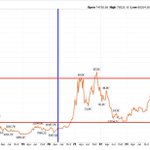
What we're seeing now is normal for this time period using halving (Blue line) cycle price analysis.
Its around where bitcoin:native Bitcoin shows weakness/tends to bottom out. Red lines are my own price guidelines which show that how bottoms of each cycle find support (roughly) around the previous halving cycle high.
Then once this period is done, it starts to rally into the next halving which is April 2028.

7
1,073
bitcoin:native Bitcoin getting sold by someone over the weekend. If I were to guess its folks anticipating a lower $QQQ open on Monday, selling it out now. Else, its the impact of lower liquidity in crypto markets because the Dollar surging higher this week.
1
866
This is the Fed’s dilemma.
Inflation has been driven heavily by the Iran war energy shock (and its second-round effects), residual tariff pass-through on goods, and AI-related demand for power, chips, and materials — factors that are not primarily classic excess demand in the “old school” economy.
“Old school” economy in this reference (see my previous X post) is the non-AI economy and the folks not benefitting from the wealth effects from the stock & private market investments.
Yet the policy response from the Fed to inflation (higher policy rates and the resulting higher market rates) hits the rate-sensitive sectors hardest, when they are already down big. Existing-home sales fell to a 3.75 million seasonally adjusted annual rate in October 2026 — the lowest level since August 2010 (the post-Great Recession period after the homebuyer tax credit expired). That is an 8.8% year-over-year drop and a 5.5% monthly decline.
Jaw dropping numbers that in a normal “old school” world would normally see the Fed cutting rates already. And a recession would be anticipated by both bond and stock markets. Bond markets would have hungrily slurped up the 5% yield on the 10 yr & 30 yr treasury. The stock market would be on the floor, as it anticipated lower earnings for the “old school” economy.
However, the size & scale of the AI capex boom has upended the usual calculus of how things happen. Many AI projects are less sensitive to rising yields (for now) because they are funded by large hyperscaler cash flows or strategic competition rather than pure rate-dependent borrowing.
Housing and autos are highly sensitive to financing costs. One more note is the pressure on rates from US debt/deficits. This is another pressure point on the “old school” economy.
Something will give way. It’s unlikely, even impossible in my opinion, that the previously biggest driver of economic activity — housing & autos — can get crushed without it causing unemployment, foreclosures, defaults and economic distress. In that scenario, the old calculus that I laid out comes back.
Investors will sell out of stocks and bid bond yields lower. The AI capex boom will bust, as the demand for AI cools. Companies driving the demand for the exponential AI growth cut utilization. AI capacity now, suddenly looks overbuilt.
The first signs of the old school calculus are beginning to show. Semi stocks, the primary beneficiary of the AI capex boom, are cracking. Investment bankers have cut their original market capitalization targets for $ANT Anthropic IPO from $2 trillion to $1.4 trillion. One of the shocking things to come out in the $ANT IPO meeting is the claim they won’t renew their contract with $SPCX that expires in mid 2027. That’s an incredible declaration & a huge narrative break for $ANT to make if AI compute growth/demand is as high as believed.
Bottom line. Things are starting to get complicated and potentially more difficult in markets.
3
603
The stock market is disguising a major chasm between regular economic reality and AI-driven economic reality.
Regular economic reality shows up clearly in home sales. Adjust for population, and home sales are essentially at the lowest levels ever seen in US history.
In my experience and understanding, the US economy was always driven by houses and cars. These are two of the biggest purchases a household makes, and when they happen they support a huge ecosystem of industries, companies, and people.
In the last couple of years, though, the economy has been driven by two interrelated things: AI itself, and the wealth effect from AI in the stock market.
I have to wonder whether AI plus a stock-market wealth effect can really substitute for the old houses-and-cars model. It might, but it would lead to an even more K-shaped economy. Fewer and fewer people benefit.
Even inside the stock market the picture is narrow. Most stocks have not risen in the last two years. It’s been mostly AI-related and tech stocks that have gone up.
My gut feel is that the current setup of AI plus the stock-market wealth effect is about to run into a wall. What looks like a strong economy could suddenly turn into a terrible one.
One more note. Inflation in the US has mostly been a function of the AI spending boom, plus the energy-price spike from the war.
If that’s right, another problem is brewing. The Fed is almost certainly going to raise rates in December, and I think that would be a mistake. They would be raising rates to counter what’s happening in the AI economic reality. From past history, we know what higher rates do to the regular economic reality of houses and cars: they steamroll and crush it.
In my recent notes I’ve been warning that a complex and strange brew is building in markets. It’s certainly not the time, in my opinion, to take on big new risks.
2
16
1,915
Paul Mampilly🇺🇸 retweeted

The Fed has more than 98% odds of hiking rates in Dec 2026.
If they do that, it will be the first time in U.S. history the Fed has started a rate-hiking cycle during a housing recession.
Currently, relative home sales are just 4.3% of the homeowner stock.
The worst rate in U.S. history over a four-year span.
In previous housing demand collapses (like 1982 and 2008), the Fed actively cut rates.
Now, they're preparing to raise rates, and they could do a double rate hike.
Into the worst housing demand environment on record.
Supply is now back to normal nationally, and surging in half the country. And yet people still aren't buying, with demand dropping to record lows.
This suggests that something is going on in the background of U.S. economy that is not good.
And that the Fed should be careful with its rate hikes.

One of the bets we continue to make at Mampilly Research is in natural gas stocks. In the last week, we've seen 2 big announcements from $ANT Anthropic and $SPCX SpaceX on the immense power and energy needs that their plans require. However, natural gas price for now reflect almost no future premium for this huge draw on this energy source
We believe this is going to turn out to be wrong. Natural gas is widely believed to be a commodity that we have in permanent abundance in the US. Thats simply not true.
Truth is that, the shale/fracking revolution did create massive amounts of trapped natural gas resource. However, US producers have been working hard to find markets for this excess. Shipped LNG from the US is now a big export and is going to continue to be a big draw on our reserves of natural gas. Electrification of our transportation infrastructure and rising demand for electricity is also going to absorb the shale/fracking excess. However, in the last 3 years, the new plans to put up data farms are bigger than any of these.
Put all these new draws on natural gas and current prices in my opinion are laughably low. At some point, someone is going to start buying up capacity for 2028 and beyond to hedge against a future price increase.
That will come as a surprise to everyone that has assumed that natural gas will be between $2 and $4 forever. Right now markets are not going with the forecast of a future scarcity in natural gas. But that then is the opportunity that we're seeing.
And thats how we think about opportunity. We want to get in before everyone else, just as prices are setting up to surge.
1
5
1,398