Find meaning in life. Do something.
Joined August 2019
- Tweets15.1K
- Following5.5K
- Followers5.4K
- Likes15.9K


MAO retweeted

the four types of agent loops.
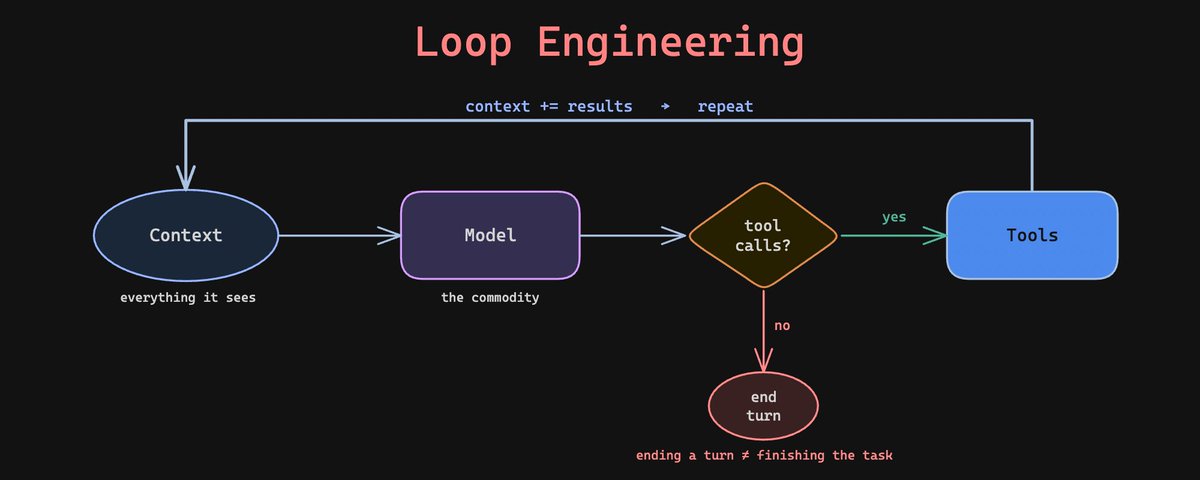
loop engineering keeps getting talked about as one thing. it's actually a choice between four structures, and each one fits a different kind of task.
it means designing the system that steers the agent, instead of steering it yourself move by move.
that system always answers two questions. what starts a run, and what decides the work is done.
in a hand-run session you answer both yourself, every single time. each loop type moves more of that into the system.
here's each type, what triggers it, and when to reach for it.
1) turn-based.
triggered by a user prompt. the agent gathers context, acts, and checks its work inside a single turn, then a human reviews the output and writes the next prompt.
use this when requirements are still forming and every output changes what you'd ask for next.
2) goal-based.
triggered by a /goal command carrying success criteria and a budget, like "get the homepage Lighthouse score to 90, stop after 5 tries." when the agent tries to stop, an evaluator model checks whether the goal is met, and a no sends it back to work.
use this when the outcome is measurable but the path there isn't worth your attention.
3) time-based.
triggered by a clock. an interval fires, the agent runs a fixed prompt like "check the PR, fix CI," then waits for the next tick. /loop runs on your machine, /schedule moves it to the cloud so it survives a closed laptop.
use this for recurring work where the task is known in advance and only the timing repeats.
4) proactive.
triggered by an event or schedule with no human present. a routine watches a channel, and when something needs handling it spawns a workflow with a triage agent, a fix agent, and a reviewer that adversarially judges the work before the task closes.
use this for standing responsibilities where you can't predict what will come in, only that something will.
each type hands off one more job than the last. turn-based keeps both with the human, goal-based automates the checking, time-based automates the trigger, and proactive automates both while deciding the workflow shape at runtime.
so the mapping question isn't which loop is most advanced. it's whether your task is exploratory, measurable, recurring, or standing.
the more you hand off, the less you babysit.
I wrote the full breakdown on loop engineering. the article is quoted below.