

DEFI + AI content creator • Helping crypto brands connect with audience through relatable content • Contributor @_HerDAO
Asia, Peru
Joined May 2024
- Tweets18.2K
- Following2.1K
- Followers2K
- Likes36.8K







Mareshah retweeted

Looking for Crypto Content Creators / KOLs
Region : Global
Video creators are most welcome.
If you are one of them or know someone who might be a great fit,
DM me on TG: Shanjay_Web3

ALT Content Creators
Mareshah retweeted

$290,000 in private volume through @Nightly_app in September 👏
Powered by Houdini.

Mareshah retweeted
Most crypto “flywheels” sound complicated until you see what is actually happening.
Here’s the simple version of the Select flywheel
A new project launches on Select.
When its liquidity is created, 90% goes into the Project/ETH pool, while the remaining 10% goes into a Project/$SELECT pool.
But there’s a catch
That Project/$SELECT pool initially doesn’t need $SELECT.
It starts with project tokens positioned in a specific price range.
Then the project grows.
As its price climbs into that $SELECT range, something interesting happens:
Buying starts pulling $SELECT from the open market to fill the Project/$SELECT pool.
So the chain looks like this:
Project launches → Project grows → enters the $SELECT range → $SELECT gets pulled from the market → Project/$SELECT pool fills.
And this is where the flywheel starts spinning.
Every new project creates another connection to $SELECT.
More projects → more potential demand for $SELECT → more connections across the ecosystem → more projects joining.
Then the cycle repeats.
Launch → Connect → Grow → Create demand → Repeat.
The important part:
This isn’t simply
“the protocol buys $SELECT.”
The demand is created by how project liquidity is structured and how projects trade as they grow.
That’s the Select flywheel.
Simple idea.
Pretty interesting mechanism.
Watch the video below 👇 to know more.
@tokenselect
Mareshah retweeted
2008 gave us Lehman.
2015 gave us another warning from regulators.
2021 gave us 1.4 billion unbanked adults.
Different problems.
One underlying question:
Why is financial infrastructure still so difficult to see and access?
I went looking for an answer.
What I found was $NOTE.
2008 gave us Lehman.
2015 gave us another warning from regulators.
2021 gave us 1.4 billion unbanked adults.
Different problems.
One underlying question:
Why is financial infrastructure still so difficult to see and access?
I went looking for an answer.
What I found was $NOTE.
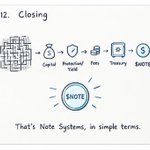
Now zoom out.
You can see the pieces connecting:
COUPON
→ provides income by taking defined downside risk.
SHIELD
→ pays for protection against that downside.
DESK
→ helps balance the two sides with bounded capital.
BONDS
→ connect approved capital to $NOTE.
TREASURY + BUYBACKS
→ connect protocol activity back to the token economy.
And the positions themselves don't have to sit still.
COUPON and SHIELD are transferable ERC-1155 legs.
They can be moved and composed with other applications.
COUPON can even be wrapped and used as collateral in a separate lending layer.
So a structured note isn't necessarily the final destination.
It can become a financial building block.

1
5
88
But here's the part that matters most:
Note Systems doesn't claim to make risk disappear.
COUPON can lose principal.
Oracles can fail.
Stock Token issuers carry risk.
Smart contracts carry risk.
And importantly, there is currently no independent third-party audit of the Note Systems contracts.
The team has completed internal security reviews, but an internal review is not an external audit.
So what is Note Systems really trying to change?
Not finance itself.
Not risk itself.
The machinery behind it.
Take a traditionally complicated product.
Break it into:
risk → yield → protection → collateral → settlement
Then make those rules transparent, programmable and composable.
That's the idea behind $NOTE.
Finance you don't merely have to trust.
Finance you can inspect.
@notesystems $NOTE

5
42
It happened, they disappeared, they also deleted their TG.

is it just me? but there’s something off with about the @TSERAfinance launch, it isn’t sitting completely right with me, so i’m putting this out there for people to look into too.
maybe it’s just me, but everything feels too fast.
first, the timing!!
they’re launching monday and immediately around the launch there’s a $600 thread contest with 7 winners.
that isn’t automatically a red flag!!
projects use contests to bootstrap attention all the time but they’re asking people to create promotional threads before the product has really had time to establish itself.
so it makes me wonder:
are they building genuine product awareness or trying to create visibility around the launch before there’s enough information to properly evaluate the project? the website looks decent, but a good looking website isn’t enough for me.
i’d like to know more about the founders, investors, team, funding, product, roadmap and what can actually be independently verified.
i’m not saying @TSERAfinance is a scam.
and i genuinely hope it isn’t.
i just think the project deserves proper scrutiny, especially with such a strong push for visibility right before launch.
if everything checks out, great🧚🏾♀️
and congratulations to the winners ahead of time🎉
but please my fellow creators don’t let a nice website + prize pool + launch hype replace due diligence just one did recently “Venuo”
if anyone has dug deeper into @TSERAfinance and found information i’m missing, i’d genuinely like to see it.