

Professor of #MathematicalPhysics at the University of Tübingen (@uni_tue) Working on quantum many-body physics and mathematical analysis
Tübingen, Germany
Joined October 2021
- Tweets194
- Following142
- Followers275
- Likes658



Pinned Tweet
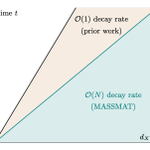
Talked about our prethermal MBL paper at the Newton Institute a few days ago
Recording is available here:
youtube.com/watch?v=OfXfqcRo…
Marius Lemm retweeted

Peter Woit on the Shepherds: "Now that they have released the Lean code, their plan to keep secret the 1147 page document explaining the proof and devote great efforts to understanding it and explicating it themselves makes no sense."
Indeed. This makes no sense!
math.columbia.edu/~woit/word…

I've been looking forward to today!
We've long know that a key to crack the quantum many-body problem is locality, as mathematically captured by the Lieb-Robinson bound.
But Lieb-Robinson bounds always needed a lattice structure and so they remained out of reach for realistic continuum systems. This has been the major roadblock for developing a quantum information theory in continuous space.
Well, not anymore: arxiv.org/abs/2611.11655

In 2024, Kuwahara-Vu-Saito proved that lattice bosons have the peculiar Lieb-Robinson velocity
v ~ t^{dim-1}
The KVS proof is an impressive 100+ pages of detailed analytical estimates.
Today, with Alex Elgart, we posted a simpler 15-page proof that was inspired by the beautiful path expansion technique of Chi-Fang Chen and Andy Lucas.
arxiv.org/abs/2611.02263

...and that was not the only result about information propagation for lattice bosons today!
My Ph.D. student Carla Rubiliani, together with Tomotaka Kuwahara and Cheng Shang, posted a great paper about the subtle light cones in the long-range case
arxiv.org/abs/2611.00776
Marius Lemm retweeted

Frank Calegari has a great post on Terry's blog:
terrytao.wordpress.com/2026/…
I think it aligns most closely to what I've been thinking and trying to say (and I believe communicates it better than I've been able to). Some highlights:
"I hope AI can help mathematicians break out of the straitjacket of being constrained by the first natural conjecture they cannot prove, and work on unraveling the deeper mysteries woven throughout our subject."
"The natural grooves of our profession have very much been bent toward more narrow technical expertise than a bigger vision. AI allows us an amazing opportunity to broaden ourselves as mathematicians."
"There are so many problems in mathematics that are still so fresh and vital but were previously untouchable that the opportunity to approach them is massively exciting. We need to be more ambitious, to create bold research plans that weren’t even conceivable a year ago."
"The difference in reaction between the optimists and the pessimists is that, for the pessimists, the game is over. For the optimists, the game has just changed."
"[T]here now exists an amazing new tool to study mathematics. To turn away and say that the community of mathematics as it currently exists is more important than mathematics itself would be a terrible mistake."
"[I]t takes one look at the arXiv to see many people in our profession rushing out AI-assisted papers in a somewhat unsightly rush to be the “first” to prove things."
[Aside: mere days after the qRH result, I had something like a half-dozen emails in my inbox, some from amateurs but some also from tenured faculty, with Lean formalizations of nonvanishing on Re(s)> 7/8-1/10^k for various large values of k. What the hell are you even doing? That kind of thing may have been valuable years ago, when it was difficult and signaled deep understanding and great technique. Today? Who the hell cares?]
"To me [this is back to Frank now], someone who chooses a worthwhile problem, obtains a proof completely using AI, understands it thoroughly, and uses it to develop interesting further questions or directions has made a substantial mathematical contribution."
"If you, as a senior mathematician, are stressed about being scooped by AI, then you are not being ambitious enough."
[On hiring:] "I am looking for a narrative of where you want mathematics to go, the technical ability to explain why this may be possible, being able to converse about many areas of mathematics, and a demonstrable record of having done all of this in the past."
"What I want a graduate student to achieve at the end of their PhD is a view of mathematics that extends well beyond their discipline, and yet with demonstrable technical skills on at least some class of problems."
"I advocated above that we need to evaluate work as if AI was involved. But this does not imply that we don’t need to teach students to do deep mathematics without AI just as the existence of computers doesn’t mean we should no longer teach children arithmetic." [I've often said similar things as well...]
"All of my friends in the humanities truly believe that having mathematicians in society both as custodians of one of humanity’s oldest intellectual activities and explorers of the frontiers of knowledge is important. I understand that some part of the culture we so deeply care about will disappear, and as humans, an emotional response to that is very natural. But this is a time to explain to everyone that there are so many great new opportunities, possibilities, and reasons to be optimistic. We are on the verge of a new era of mathematics, and I am excited to see what happens."
Bravo Frank!

Marius Lemm retweeted

we will soon use AI to automate the production of essays about the effects of AI automation
Marius Lemm retweeted
Generally speaking I think OAI has done the right thing by posting PDFs to Github without much fanfare; if they are going to generate such PDFs, this is the best solution. That they are not doing so for whatever progress they've made on Yang-Mills is, I think, a step backwards.
I wrote the below about credit a few weeks ago. It seems to me that the decision here is meant purely to establish priority/credit.

Marius Lemm retweeted
Hilariously, OpenAI’s galactic algorithm for resolving the Exponential Time Hypothesis runs an exponential-time subroutine if the number of variables is less than 10^10,000,000,000,000,000,000,000,000. That number is also known as infinity plus 1.
Marius Lemm retweeted

Your group can work on these documents, develop rigorous expositions, and organize whatever scientific activities it considers useful without making the original material inaccessible to other researchers.
I think this decision is deeply at odds with the principle of open science. Once a public claim of a major scientific discovery is made, the evidence supporting that claim should be made public, even if it still requires independent verification.
The current arrangement facilitates a public claim of priority while granting only a selected group access to the purported proof. This is very difficult to reconcile with the principles of openness and independent scrutiny on which modern science rests.
Please reconsider. Your group can carry out its work without withholding the material from the scientific community.
Marius Lemm retweeted

This is an incredible moment in this history of mathematics, computer science, physics & science with some of the hardest problems in human history being solved by AI over a period of weeks. Depending on your perspective, it's either a crisis, a triumph, or both. I don't think anyone knows for sure. We're all trying to make sense of it. I oscillate between fear/dread and optimism/excitement on a daily basis. The rate of progress is insane, including today's announcement from OpenAI of more problems solved.
To help make sense of all of it, here's my conversation with three mathematicians about this moment. Each of them is an expert in the field of each of the biggest problems solved: Navier-Stokes, quasi-Riemann hypothesis, the unique games conjecture and complexity theory more generally.
Ankur Moitra is a mathematician and theoretical computer scientist at MIT, visiting the Institute for Advanced Study in Princeton. Steven Brunton (@eigensteve) is a mathematician and fluid dynamics expert at UW. Alex Kontorovich (@AlexKontorovich) is a mathematician at Rutgers specializing in number theory.
Marius Lemm retweeted
I agree with @scottnarmstrong, this is becoming increasingly silly.
The technology extracts proofs from the literature without anyone initially understanding much of what has been extracted. The interesting, creative work starts after the data is extracted.
So either you assume the position that as a company you are in the business of extracting raw data of scientific interest, and then you just stop there and let the scientific community figure it out;
Or you are in the business of authorship and dissemination, thus you are interested in the attribution of a piece of scholarly work… then your are essentially in competition for priority with the scientific community.
I think the latter is very bad choice for OpenAI (I am not even sure how they don’t realize that!), but if you pick that route, you have to play by the same rules of everyone else.
As much as individuals don’t announce “I will write a paper in two months, but please give me credit now”, OpenAI shouldn’t do that.
I think the “producers of raw scientific data” option would be by far the cleaner one, especially if paired with more transparency on what “raw data” you plan to extract in the future.

Contributed talks can now be submitted for the
Spring Meeting of the DPG (German Physical Society)
March 14-19, 2027 in Regensburg, Germany regensburg27.dpg-tagungen.de
Deadline for abstracts: December 1, 2026

2
166
Completely agree!
An underappreciated aspect of the OpenAI paper dump on October 6 was that it treated all researchers equally
1
9
7,159
Very good take! I agree with 95% of this.

“If AI continues to bulldoze pure math, it’s going to crush the hopes of the young people who were dreaming of joining this tradition.”
With all due respect, AI ain’t bulldozing anything. This is an unnecessarily apocalyptic way to describe what is happening.
And as for crushing hopes, I suspect these apocalyptic narratives are doing more hope crushing than a collection of PDFs idly sitting in a repository.
It’s some mathematicians’ pride that got crushed.
Other mathematicians are simply engaging: reading, understanding, explaining, experimenting, developing new ideas, writing papers, and, yes, advancing mathematics.
Of course, our profession needs to adapt many of its practices and habits, and quickly. But unless the most pessimistic voices in mathematics, the math Cassandras so to say, eventually convince the world to defund mathematics, there will be jobs, because there will be a great deal to do.
What, exactly, is the proof of forced Navier–Stokes useful for until the ideas in it are extracted from the Lean proof and its confused, sloppy, natural-language translation, and integrated into scientific discourse?
A mathematical proof does not automatically become part of our mathematical understanding simply by existing. Someone has to understand it, explain it, connect it to what we already know, and determine what else can be done with its ideas. This is not a secondary activity that mathematicians perform after the real work has been done. It is a fundamental part of how mathematics advances. And it remains central to science, unless the plan is to delegate our entire intellectual life to machines and go live like brutes, mindlessly spending our (very hypothetical) universal basic incomes.
One further point: people are only focusing on LLM-generated proofs, but how many papers will humans write without using an LLM, simply in response to the new ideas and perspectives that enter the field? It is not even clear to me that the best results will necessarily come from LLMs.
Mathematicians have changed science in small and large ways, over and over again, through fifteen-page papers built around a single lateral insight or a powerful vision. Why should that stop now?
There will be a lot of work to do: Why should young mathematicians see this as the end of their intellectual ambitions?
The ongoing apocalypse is psychological rather than technological, and it is not being imposed on us by frontier labs. It’s more into how some of us have decided to think about this. I totally understand the initial emotional reaction, but maybe it’s time to move on.
Let’s get back to work. Advance mathematics, improve math education, demonstrate why our work deserves support. That is how we secure our future.
Young people will adapt faster than we do, and soon enough they will be leading the way.
2
186
Marius Lemm retweeted
I’m very opinionated. So it’s nearly impossible for me to hear someone’s arguments and *not* find something I disagree with. (This includes reading things I myself wrote years - or weeks - ago.) And yet the amazing Grant Sanderson @3blue1brown has put out a long, detailed video on the future of mathematics, in which I cannot find a single flaw. I’ll be sending this to every PhD student and postdoc I know, and strongly recommend everyone watch it.
youtube.com/watch?v=LKrwhjOI…
(Of course I tried to say many of the same things in my conversation with Thomas Koberda. But Grant’s version, unsurprisingly, does an infinitely better job at communicating those ideas!)

Marius Lemm retweeted

The goal of n-representability is to characterize when a 2-particle reduced density matrix (2-RDM) comes from a valid n-fermion quantum state -- usually by finding 2-body "witnesses" that are non-negative. After working on this a long time I am excited to share our solution!

Marius Lemm retweeted
OpenAI's proof of the Haldane gap in the S=1 antiferromagnetic Heisenberg chain: Expository notes
haltasaki.github.io/writings…
Well said!
These are very emotional days. There are lots of wizards in the land of Oz, and we are all having our Scarecrow and Tin Man moments.
I talk to a lot of mathematicians. Those who seem to be doing better are the ones who are actually reading the OAI papers. It seems to be interesting reading, and it demystifies a lot of narratives.
Some brilliant examples could have been produced 20 years ago if someone had thought to put paper A and paper B together.
Some proofs without Lean certificates that, upon close inspection, gloss over arguments that are typically “the heart of the matter,” technically speaking. If these were regular submissions, the authors would probably be told: “Please resubmit once you can give a detailed proof of Lemma 45.”
Some proofs that are essentially correct but require experts to fill in the details. In doing so, these experts can extract ideas that provide the famous UNDERSTANDING of the problem at hand. Papers in this last category may well be among the most interesting papers written in their fields.
In short, there’s a whole range, and there’s a lot to learn.
This review work will lead to new questions, problems, ideas… as it’s always been in mathematics: you solve a problem to face ten more.
The idea that anyone is “solving mathematics” once and for all, or that mathematicians are obsolete, is foolish, because math is not a list of problems, and without humans extracting value from it, the whole enterprise is pointless.
I understand that if someone’s take on mathematics is that of a competition over who arrives first, then these are depressing times, because past a certain (high) threshold of understanding and mathematical taste, things are probably going to level off a bit.
But for those who have the spirit to just do the mathematician’s job — which is the same job as usual: read, think, understand, share, repeat — there is a lot to do and a lot to learn.
Maybe the era of mathematical heroes is over (but I don’t believe it; more likely, slightly different skill sets will become more important), but the job is far from over.
Moving the curtain a bit can be really liberating in the land of Oz :)
PS I forgot to say: OAI said they tried some 4000 problems and published about some 400 of them, so it would be very interesting from a scientific viewpoint… what about the 3600 who didn’t go through?! This could actually help understanding how the models work
1
83
Marius Lemm retweeted
Hal Tasaki "The equivalence of topological indices for U(1)xZ_2 symmetric quantum spin chains"
The revision takes into account the new OpenAI theorem and proves that there exists a locally-unique gapped g.s. of the Heisenberg AF chain with Ogata index -1
arxiv.org/abs/2609.34119
Marius Lemm retweeted
we also published our skill files here: github.com/scottnarmstrong/L…
