

Developing the future of social trading at https://nitter.cf/t.co/5fTZBed7Lo | 📉Pattern Trading 📈 | Mega-Cap & Macro Analyst | Quant Finance Aficionado | Opinions ≠ Advice
Joined March 2022
- Tweets3.8K
- Following786
- Followers2.8K
- Likes4.3K





Pinned Tweet
🚀 Join the Trading Revolution!
🌍 Sign up for @TRADERVERSEio and be among the first to experience our groundbreaking social trading network
Don't miss out – Sign up to waitlist and be among the first to explore the future of social trading for FREE! 📈
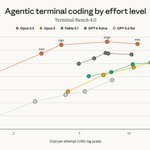
Is it only me noticing this or using max (Claude) or ultra (OpenAI) gives you worst results for higher costs in their latest releases… 👀


The U.S. rates calendar is the one to watch this morning.
10:05 ET: NY Fed’s Williams
10:20: Fed Vice Chair Jefferson
Later: 2-year Treasury auction
Markets now price 92% odds of another hike in December.
After Monday’s Nasdaq record, rates are the cross-asset test.
AI equities are celebrating demand. Credit is charging for the funding bill.
Hyperscaler debt issuance is projected at $420B in 2027, +60%. AI-related spreads are ~115 bp vs 78 bp for broad U.S. IG.
Bond buyers say it’s supply and concentration, not default risk.
$DSP just erased most of Thursday’s 19% drop in one session.
Viant is up 19.5% today after withdrawing the stock offering announced Wednesday.
But there is an important detail in the deal structure.
The planned 8.5M-share block was a secondary sale by existing stockholder Capital V LLC. Viant would have received no proceeds from that block.
Only the underwriters’ option for up to 1.275M additional shares would have been sold by Viant itself.
Viant says the offering was withdrawn because of current market conditions. No shares were sold.
At 1:08 p.m. ET:
DSP: $11.98
Today: +19.5%
Thursday: -19.0%
Vs. Wednesday’s $12.37 close: -3.2%
So today’s move is largely reversing a capital-markets event, not reflecting new operating fundamentals.
The withdrawal removes this specific near-term stock-supply event.
It does not add revenue, earnings, customers or cash flow to Viant’s business.
That distinction matters if you’re reading a +19.5% move as a new fundamental catalyst.
Next test: whether DSP holds most of this reversal, and whether the selling stockholder comes back with another transaction later.

The Senate failed to advance the CLARITY Act on September 15.
The CFTC is already moving on its fallback.
The White House regulatory database now lists CFTC RIN 3038-AF80, “Regulation Crypto Asset Transactions and Regulation Crypto Asset Markets,” as pending review after being received September 17.
Important distinction: this is a prerule, not a final rule, and the actual regulatory text is not public yet.
That still matters.
CFTC Chair Michael Selig said back in August that if CLARITY stalled, staff would use existing authority to explore a crypto market structure. The Senate cloture vote then failed 49-50 on September 15.
The OIRA filing is concrete administrative follow-through on that fallback path.
Crypto is also ripping today:
Bitcoin: $81.1K, +6.2%
$MSTR: +15.0%
$COIN: +11.9%
$HOOD: +8.6%
$MARA: +13.1%
Meanwhile:
$SPY: -0.2%
$QQQ: +0.4%
$IWM: -0.7%
But I would not call the rally a reaction to this filing.
The CFTC fallback was already telegraphed, the rule text is still unknown, oil is lower today, and positioning can amplify crypto beta.
The more defensible takeaway is regulatory: CLARITY’s Senate setback did not freeze U.S. crypto policy. Near-term action is shifting toward agency rulemaking while Congress remains unresolved.
Next proof: the actual CFTC proposal, what markets and platforms it covers, the public-comment timeline, and how much authority the agency claims under existing law.

Crypto is taking the harder hit this morning. It has two event clocks in the next 24 hours, and the first one isn't the Fed.
BTC -2.8%
ETH -4.2%
IBIT -3.9%
ETHA -5.3%
COIN -6.6%
SPY -0.5%
2:15 p.m. ET today: Senate cloture vote to advance consideration of the CLARITY Act.
2:00 p.m. ET tomorrow: Fed decision.
Important distinction: today's Senate vote is procedural, not final passage.
If crypto moves around 2:15 while stocks don't, that's a cleaner regulatory signal. Tomorrow at 2:00 is the macro test.
Saudi oil disruption just extended into October.
Reuters, citing Bloomberg, reports Aramco told at least two European refiners they will receive no Saudi crude next month after the East-West pipeline attack.
That is a real physical-market escalation.
But do not read it as 4 to 5 million barrels per day disappearing from global supply.
That 4 to 5M bpd figure is what the East-West pipeline was carrying before the attack. It is route throughput, not confirmed lost production.
Aramco is already rerouting some barrels through the Gulf and ship-to-ship transfers off Sohar.
Reuters says roughly 60M barrels have been sold for September and October through that route, averaging about 1.0 to 1.5M bpd.
Replacement buying is happening too.
Poland’s Orlen has bought 16 additional cargoes from Norway, the UK, Algeria, Kazakhstan, Azerbaijan and the Americas to cover disrupted Saudi supply.
And the futures reaction is telling.
Around 12:05 p.m. ET:
Brent: $104.31
Day: -0.5%
Session high: $105.00
Around the fresh October-delivery report, Brent moved from roughly $104.41 to $104.60 in the next five-minute bar.
That is a reaction, but not a breakout.
So the physical disruption is extending, while rerouting, replacement barrels and expectations for a partial pipeline restart are still absorbing part of the shock.
For U.S. traders, the next proof is not another pipeline headline.
It is whether October replacement demand starts pushing Brent and refined-product prices materially higher.
Important caveat: Aramco has not confirmed the fresh October-allocation report, and Reuters says it could not independently verify Bloomberg’s report.
Two separate U.S. memory-manufacturing paths have surfaced around SK hynix in 48 hours.
Reuters now reports Solidigm is weighing a U.S. NAND fab, with upstate New York a leading candidate.
That is separate from the SK hynix-Intel talks reported this week around making memory chips at Intel’s Ohio site.
And it is different from SK hynix’s existing $3.87B Indiana project, which is focused on HBM advanced packaging and R&D.
The distinction matters.
AI memory localization is starting to move beyond packaging into the possibility of actual U.S. NAND wafer fabrication.
Solidigm’s manufacturing base came from Intel’s old Dalian NAND fab in China. A U.S. fab would diversify that footprint and reduce exposure to tariffs and export-control friction.
But this is not committed capacity yet.
SK hynix says it is reviewing options and that no specific plan has been confirmed. Reuters says no agreement has been reached, and there is still no disclosed capex, capacity, subsidy or construction timeline.
So the signal today is not “New York fab confirmed.”
It is that AI-driven memory tightness plus U.S. industrial policy are pushing suppliers to evaluate multiple domestic manufacturing routes at once.
Next proof: a selected site, incentives, capex and a real construction schedule.
Warren Buffett stepping down as Berkshire chairman sounds like his son Howard is taking over Buffett’s job.
He isn’t.
Berkshire has now formalized a 3-part succession:
• Greg Abel: CEO, runs the company and holds the capital-allocation role
• Howard Buffett: chairman, protects Berkshire’s culture and values
• Warren Buffett: chairman emeritus, remains a director and adviser
Buffett’s own letter is unusually explicit: “Greg runs the company; Howard will guard its culture and values.”
That split was largely telegraphed. Howard had long been expected to become non-executive chairman, while Abel was already slated to have final say on major capital allocation and Berkshire’s public-stock portfolio.
$BRK.B is roughly 0.2% to 0.3% lower premarket as of 8:07 a.m. ET, a muted reaction for such a historic headline.
So this is a major symbolic transition, but not a sudden transfer of operating or investing control to Buffett’s son.
The Berkshire succession is now clearer: Abel on capital and operations, Howard on culture, Warren still on the board.
$HPK jumped as much as 14% after a fresh sale report.
Reuters says HighPeak is exploring a sale after receiving acquisition interest, including an offer from an unidentified international party, with Evercore and Texas Capital engaging prospective buyers.
At 2:16 p.m. ET:
HPK: $8.37, +6.4%
Intraday high: $8.99, +14.2%
XOP: +0.6%
The balance sheet matters here.
June 30:
Cash: $146M
Debt: $1.19B
Net debt: about $1.04B
At today’s price, HPK’s equity is worth about $1.06B, putting enterprise value near $2.1B.
So a buyer is not underwriting a “$1B company.” It is underwriting roughly twice that once debt is included.
And because net debt is almost equal to the entire equity value, even a modest change in the eventual enterprise purchase price can translate into a much larger percentage move in the stock.
HighPeak produced about 45K boe/d in Q2, roughly 64% oil, and held about 140K net acres in the Midland Basin at quarter-end.
Big caveat: this is not HPK’s first sale process.
The company launched a strategic-alternatives review that explicitly included a potential sale back in 2023. Reuters says there is still no certainty a transaction happens this time either.
The incremental change today is actual acquisition interest, including a reported international offer.
Next proof: a named bidder, disclosed price, or formal agreement.
U.S. mortgage rates are almost back at 7%.
Freddie Mac’s 30-year fixed rate jumped to 6.95% from 6.76% last week, the highest since January 2025. That’s +30 bp in four weeks and +69 bp from a year ago.
On a $400,000 30-year mortgage, the move from 6.76% to 6.95% raises principal-and-interest payments by about $51/month. Versus 6.65% four weeks ago, it’s about $80/month more.
Same-day housing data were mixed:
• Total starts: 1.275M, -2.6% m/m
• Permits: 1.394M, -2.7% m/m
• Single-family starts: +7.6% m/m
At 1:16 p.m. ET:
10Y Treasury: 4.956%, -5 bp
XHB: +0.4%
ITB: +0.4%
That timing matters. Freddie’s 6.95% is a weekly survey reading through Wednesday, not today’s live mortgage quote. Today’s lower Treasury yield could feed into next week’s mortgage print.
For housing, the next question is whether mortgage rates stay near 7% or today’s bond rally actually reaches borrowers.
$CRWV is becoming one of the clearest examples of the financing problem behind the AI infrastructure boom.
CoreWeave opened two major funding channels today:
• $3.0B of convertible notes due 2033, with a $500M extra option
• An ATM program for up to 35M Class A shares
At $80.51, 35M shares represent about $2.8B of equity capacity. That is roughly 7.6% of the Class A shares outstanding as of July 31.
Add the converts and CoreWeave has roughly $5.8B of potential funding capacity at today’s share price, or about $6.3B if the full note option is used.
At 12:10 p.m. ET:
CRWV -3.4%
QQQ +1.7%
But this is not evidence that AI demand suddenly broke.
CoreWeave ended Q2 with about $104B of revenue backlog and said it added more than $25B of net new customer commitments in early Q3. The company had also already secured more than $30B of debt and equity capital year-to-date by August 10.
That is the tension: demand is enormous, but so is the amount of outside capital required to build the infrastructure needed to serve it.
Important caveat: the 35M shares are capacity, not shares already sold. CoreWeave can choose whether and when to use the ATM, and the new converts have not been finally priced yet.
For CRWV, the next thing I care about is not another backlog headline. It is the cost of this capital, how much equity actually gets issued, and whether contracted demand turns into cash returns faster than the balance sheet expands.
$RGR’s Beretta tender is now officially live.
Beretta is offering $44.80 for up to 2.40M Ruger shares, roughly 15% of the company, with the offer open through Oct. 15. There is no financing condition and no minimum tender condition.
At 11:08 a.m. ET:
RGR $39.41, +6.3%
Tender price: $44.80
Tender premium to Sept. 16 close: 20.8%
Maximum offer size: about $107.5M
The key point: the roughly 14% gap to $44.80 is not a standard merger-arbitrage spread.
This is a partial tender, not a takeover of the whole company. $44.80 only applies to the capped block. If more than 2.40M shares are tendered, not every tendered share can be purchased. The rest remains exposed to standalone RGR value.
That helps explain why RGR does not have to trade near $44.80.
The key change today is finality. Early this morning the launch was still only reported as expected. Beretta has now formally commenced it.
Next watch: Ruger’s 14D-9 response and actual tender participation.
The SEC just opened a much bigger door for tokenized U.S. stocks.
A new 5-year "Innovation Exemption" lets qualifying onchain venues trade tokenized NMS stocks without being treated as national securities exchanges, while certain AMM liquidity providers get temporary dealer relief.
But this is not a free-for-all:
• Tokenized shares must carry the same rights and privileges as the traditional stock, including dividends and voting rights.
• Synthetic stock tokens are excluded.
• Issuers can object and prevent their stock from trading on a tokenized venue.
• Access is permissioned, with symbol and volume caps.
• Trading halts must track the primary exchange.
• Smart contracts must be public and auditable on a public, permissionless ledger.
That is materially broader than the earlier Nasdaq tokenization pilot, which kept tokenized shares inside the existing exchange structure.
The bigger implication is competition. Coinbase and other crypto platforms have been waiting for a U.S. path to tokenized equities. The SEC just created one, but only as a temporary 5-year framework while it gathers data for permanent rules.
At 10:08 a.m. ET:
HOOD +2.5%
COIN +2.3%
SCHW -1.3%
CBOE -1.6%
I would not read every move there as direct causality, but the market-structure battle between crypto-native platforms and traditional brokers just got more real.
Next proof point: which platforms actually launch under the exemption, and which public companies object.