

The fastest AI dev news engine on X — model releases, tools, and what they actually mean
What is trending in AI?
Joined April 2016
- Tweets14.2K
- Following1.2K
- Followers12K
- Likes7.6K





▲ Marktechpost AI retweeted
▲ [Really Impressive Individual Project] Meet qwenGPU: Qwen3.5-2B With 45 Compiled GPU Layers That Run CUDA. qwenGPU, a SIMT GPU compiled directly into the weights of Qwen3.5-2B. The model runs real CUDA inside its own forward passes.
The key idea is reusing Qwen3.5's Gated DeltaNet state as GPU memory. With the gate held open, a write strength of 1 and one-hot keys, each update overwrites exactly 1 row. Registers, program ROM and global memory all live in those rows.
The GPU is 45 untrained layers in front of Qwen's 24: 4 lanes, a 4-stage pipeline, 15 registers per lane and 126 words of memory. The reference interpreter matched a real Tesla T4 on 49 of 49 kernels, and text drift stays at a KL of about 7e-4. It is a trade-off though: it runs at about 10 to 15 tokens per second on Apple MPS, and Qwen-written CUDA was right on 4 of 5 tries.
The code is MIT, and you build the checkpoint yourself with about 16 GB of free memory. It builds on Qwenputer, which put a RISC-V CPU inside Qwen3.5-4B......
Full analysis: marktechpost.com/2026/11/01/…
Repo: github.com/vixhal-baraiya/qw…
Base model: huggingface.co/Qwen/Qwen3.5-…
@TheVixhal

▲ Marktechpost AI retweeted
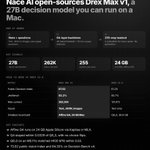
▲ Nace AI just open-sourced Drex Max v1, so its top decision model now runs on your own hardware, including Apple Silicon Macs.
The key idea is that Drex Max does not generate text. It reads a state (text, JSON or images) plus typed questions, and a 255-way readout returns a probability for every option in one forward pass. The 27B backbone mixes 48 Gated DeltaNet layers with 16 non-causal full-attention layers.
Nace reports 67.52 on the public Decision Index 0.4, versus 61.25 for Drex v2.0 and 57.96 for Jev 1.13.0. JevBench lands at 92.2%. It is a trade-off though: the GGUF, Q4 and MLX paths are text only, and its weakest vision score is R-Bench-M at 38.6.
Weights are under the Nace AI Open RAIL-M license. An affine Q4 build runs on 24 GB Macs, the Q8_0 GGUF (27.25 GB) needs 48 GB, and the context window goes up to 262,144 tokens......
Full analysis: marktechpost.com/2026/11/01/…
Model: huggingface.co/nace-ai/drex-…
GGUF: huggingface.co/nace-ai/drex-…
Repo: github.com/nace-ai/drex-deci…
Cloud: console.nace.ai
@NaceAI

▲ Marktechpost AI retweeted
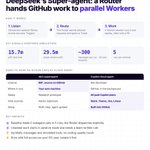
▲ DeepSeek just open-sourced dsh-superagent, a coding agent that works many GitHub requests at once without pinging you for each one.
The key idea is a 2-layer design. A long-running Router reads GitHub and Feishu events and decides which requests are real, authorized work. Each accepted request becomes a Ticket that runs in its own isolated Worker session and replies in the original thread, often with a pull request.
In DeepSeek's own simulation (about 300 messages, about 20 real requests, 5 runs), p95 task completion was 15.7 minutes vs 29.5 minutes for a single session with subagents. It is a trade-off though: the test used synthetic messages and simulated tools, so coding quality was not measured, and the agent runs with full access as your OS user.
It is an MIT-licensed research prototype, packaged as a DeepSeek Harness bundle. Proactive work starts in observe mode, so it only records what it would have done......
Full analysis: marktechpost.com/2026/11/01/…
Repo: github.com/deepseek-ai/dsh-s…
Docs: github.com/deepseek-ai/dsh-s…
@deepseek_ai @memecoin100x

▲ Marktechpost AI retweeted
▲ Factory just released Droid 1.0, a new harness engine for its coding agent that lets the model write programs that call tools.
The key idea is programmatic tool calling, now on by default. The model writes JavaScript that runs in a sandbox and invokes tools. Raw files, logs and search results stay inside the program, and only printed output returns to the model.
On Factory's Terminal-Bench 4 runs, Droid scores 65.2% with Claude Opus 5.5, versus 57.6% for Claude Code on the same model. With GPT-6.1 Sol it scores 57.6% versus 54.0% for Codex, at 12% lower cost. It is a trade-off though: on GPT-6.1 Sol, Droid takes 10% longer per passed task than Codex, and every number is self-reported.
Droid 1.0 is available now as a macOS and Windows desktop app, a terminal UI, and the @factory/droid-sdk for Node.....
Full analysis: marktechpost.com/2026/10/31/…
Blog: factory.com/news/frontier-ha…
SDK: github.com/Factory-AI/droid-…
Docs: docs.factory.com
@factory @luke_alvoeiro

▲ Marktechpost AI retweeted
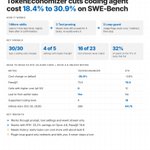
▲ Microsoft Research and UC Berkeley Researchers just open-sourced TokenEconomizer, a plugin that makes coding agents cheaper without changing the agent.
The key idea is learning from past sessions in the same repository. It injects 1-line facts the agent keeps rediscovering, like the working test command. It drops tool schemas the repo never uses. And it redirects the agent when it loops on the same failure.
On 277 SWE-Bench tasks, mean cost fell 18.4% to 30.9% across Claude Code, Codex and Copilot CLI. It was cheaper in all 30 repository-setting cells. RTK alone raised cost in 12 of them, RepoMap in 15. It is a trade-off though: Pass@1 dipped 1.0 point on Opus 4.8, and ReposVul audits saved only 6.4% to 9.3%.
It installs as a plugin for Claude Code, Codex, Copilot CLI and Pi. Apache 2.0, Python 3.10+, no API key of its own......
Full analysis: marktechpost.com/2026/10/30/…
Repo: github.com/microsoft/TokenEc…
Paper: arxiv.org/abs/2610.22732
Project: tokeneconomizer.github.io
@aaron_jli

▲ Marktechpost AI retweeted
▲ Edge0 just released a 0.6B open-weight TTS model (Audio8-TTS-Realistic) that is trained to sound human, not just to be accurate.
The key idea is a learned realism critic. WER and speaker similarity miss rhythm, pauses and timing, so Edge0 trained a critic that scores each output against a real person reading the same sentence in the same voice. A final GRPO stage then optimizes against that critic.
On CV3 it averages 4.86% error across 9 languages, ahead of VoxCPM2 (5.35%), CosyVoice3-1.5B (6.89%) and Qwen3-TTS-1.7B (7.73%). It is a trade-off though: lower-resource languages stay weak, with Thai at 48.57% WER, and the 4B-class Higgs TTS 3 still leads at 4.41%.
601M parameters, 23 languages, 44.1 kHz codec, Apache 2.0 weights and code......
Full analysis: marktechpost.com/2026/10/29/…
Model: huggingface.co/Edge0/Audio8-…
Repo: github.com/Edge0-AI/Audio8_T…
Paper: arxiv.org/pdf/2610.14776
@Edge0_AI @SamuelZengML

▲ Marktechpost AI retweeted
▲ Samaya AI just released Samaya Sterling, a 3B-active model that beats Claude Fable 5.1 on financial research.
The key idea is co-training the model with its harness. Sterling is Nemotron 3.5 Lightning (30B MoE, 3B active), post-trained in 4 stages: 2 SFT stages, then offline and online GRPO. A condenser and a compactor keep long research inside a small model's reach.
On FrontierFinance, Sterling scores 58.9% vs 55.9% for Fable 5.1. Cost per question drops from $6.89 to $0.61, about 11x lower. It is a trade-off though: latency is 282 s vs 268 s, the hardest third of questions sits at 45.2%, and all results are self-reported on Samaya's own benchmark....
Full analysis: marktechpost.com/2026/10/30/…
Technical blog: samaya.ai/blog/rl-post-train…
Benchmark: research.samaya.ai/benchmark…
Grader repo: github.com/samaya-ai/frontie…
@samaya_AI @maithra_raghu

▲ Marktechpost AI retweeted
▲ Baseten just open-sourced joey-1, a 2B decision model that answers routing and classification questions without generating a single token.
The key idea is simple. You send a state plus typed questions (choice, yes/no, score). joey-1 reads everything in 1 shared prefill and returns a calibrated probability for every option. No text to parse, no generation cost.
The numbers (self-reported): 63.30 on the Jev Decision Index 0.4 public split, #37 of 230 and the top model under 4B. That is ahead of Perplexity Decider Flash v1.2 (60.06) at the same $0.01 price. It is a trade-off though: it trails its 9B sibling elephant-1 by 8.94 points (63.30 vs 72.24), in every area.
Baseten reports 20 ms P50 for a 2,000-token request, about 2.5x faster than elephant-1. $0.01 per 1M input tokens, MIT weights on Hugging Face, self-hosts on 1 CUDA GPU......
Full analysis: marktechpost.com/2026/10/29/…
Model: huggingface.co/baselabs/joey…
Docs: baseten.co/library/joey-1
Blog: baseten.co/blog/decisions-fo…
@baseten

▲ Marktechpost AI retweeted
▲ Prime Intellect just released Prime Mega MoE, which makes DeepSeek's fused Mega MoE kernel usable for training, not just inference.
The key idea is overlap. MoE layers normally route, send, compute and return as separate steps, so GPUs sit idle waiting on communication. DeepSeek's Mega MoE fuses those steps into 1 kernel, but it only had a forward pass. Prime Intellect added a fast, overlapping backward kernel.
On Qwen3-235B-A22B (128 H200), a training step drops from 14.98 s with TorchTitan to 9.65 s, 55% faster. Against its own prime-rl baseline, steps are 32% to 34% faster. It is a trade-off though: the forward pass gets up to 3.11x faster, but the backward pass on the 235B layer gains only 1.24x.
It ships today in prime-rl (Apache 2.0) as the mega_moe dispatch backend, with BF16, blockwise FP8 on Hopper and MXFP8 on Blackwell......
Full analysis: marktechpost.com/2026/10/29/…
Blog: primeintellect.ai/blog/prime…
Repo: github.com/PrimeIntellect-ai…
Base kernel: github.com/deepseek-ai/DeepG…
@PrimeIntellect

▲ Marktechpost AI retweeted
▲ NVIDIA just released Nemotron 3.5 Transcribe, a single speech LLM that writes transcripts the way you ask for them.
The key idea is instruction-driven transcription. A frozen diarizer feeds "who spoke when" into the ASR encoder, and a hybrid Mamba-Transformer MoE LLM writes the output. One text instruction picks verbatim, written form, context terms, speaker tags or translation, with word timestamps on request.
On the 9 public English Open ASR sets it scores 4.71% mean WER, ahead of Qwen3-ASR-1.7B at 4.94%. Multilingual is 4.62% versus 6.49%. It is a trade-off though: it is offline only, commercial APIs still lead (OtterAI at 3.88%), and Mandarin far-field meetings sit at 34.95% cpCER.
34B total and about 4.3B active parameters, 40 languages, audio up to 1 hour. BF16 runs on 1 H100; NVFP4 fits an RTX 5090. OpenMDW-1.1 license....
Full analysis: marktechpost.com/2026/10/28/…
Model: huggingface.co/nvidia/NVIDIA…
Paper: research.nvidia.com/labs/nem…
Repo: github.com/NVIDIA-NeMo/Speec…
@NVIDIAAI @nvidia

▲ Marktechpost AI retweeted
▲ Infini-AI-Lab just open-sourced Hermit, a framework that lets AI agents keep learning without touching the model or the harness.
The key idea is a "harness adapter": a trainable external layer of instructions, skills, memory, tools and code. An RL-style loop runs tasks, a judge scores them, and an Evolver proposes a new adapter version. Each version is checked and committed to git. The model's weights never change.
With GLM 5.3 Flash, the MWM adapter reaches 0.795 accuracy on CL-Bench database exploration, vs 0.580 for the in-context baseline. On OfficeQA, Harness² lifts accuracy from 0.541 with no adapter to 0.651. It is a trade-off though: most results are single runs, and Harness² costs about $0.16 and 7 minutes per question.
It ships 5 methods (GEPA, SkillOpt, MWM, Harness², Continual Harness), deploys to Codex, Claude Code and Pi, and is Apache-2.0 via pip install hermit-harness......
Full analysis: marktechpost.com/2026/10/29/…
Repo: github.com/Infini-AI-Lab/her…
Docs: infini-ai-lab.github.io/herm…
@InfiniAILab @haizhong_zheng

▲ Marktechpost AI retweeted
▲ Google DeepMind just introduced Gemini 4 Carbon, a frontier model built to find, validate and patch real software vulnerabilities, and run long agentic coding jobs.
The key idea is sustained, long-horizon agent work. Google says internal teams watched Carbon run for days, pushing through dead ends to root-cause bugs in large codebases. It also covers the full cyber defense loop: find the flaw, prove it is exploitable, then fix the root cause.
It ranks #1 on the Artificial Analysis Intelligence Index v5.0 at 59, just ahead of Claude Opus 5.5 at 58 and GPT-6 Astra at 57. On ExploitGym it scores 54.8% vs 42.4% for GPT-6 Astra. SEC-bench Pro hits 88.2%. It is a trade-off though: Opus 5.5 still wins OSWorld-2.1 computer use, 87.2% vs Carbon's 81.5%, and most rival scores are self-reported.
Access starts this week with a subset of cyber defenders, then trusted partners via Google's Fairwind Program. No public API date yet. Parameters and context window are not disclosed. Introductory price: $2 / $10 per 1M input / output tokens, rising to $4 / $20 later......
Full analysis: marktechpost.com/2026/10/28/…
Blog: blog.google/innovation-and-a…
Evals: storage.googleapis.com/deepm…
Access: deepmind.google/fairwind-pro…
@GoogleDeepMind @sundarpichai @GoogleAI

▲ Marktechpost AI retweeted
▲ MiniMax just open-sourced MCode Stack, the agent skills its team actually uses to build MiniMax Code.
The key idea is turning engineering essays into runnable checks. Each MCode Engineering Notes article ships as a SKILL.md skill or checklist. Your agent loads it with /skill-name and walks your project item by item.
The numbers: 17 skills across 2 stacks, plus 5 checklists. The independent-review skill gives a reviewer only 3 inputs: the diff, the requirement and test results. The long-command audit has 10 items, from re-runs to cleanup after compaction. It is a trade-off though: 0 eval results are published, even though one skill is all about measuring harness changes.
It is MIT licensed, with 6 skills under CC-BY 3.0 (adapted from Google Engineering Practices). It installs in MiniMax Code or Claude Code via a plugin marketplace......
Full analysis: marktechpost.com/2026/10/28/…
Repo: github.com/MiniMax-AI/mcode-…
MiniMax Code: github.com/MiniMax-AI/minima…
@Ronny_MiniMax @MiniMaxAgent @MiniMax__AI
▲ Marktechpost AI retweeted
▲ Liquid AI just released LFM3, 6 open-weight 2B-class models that put text, vision, audio, omni and decision tasks on 1 shared backbone.
The key idea is a tri-hybrid architecture. Its 24 layers mix 13 gated short convolutions, 5 sliding-window attention layers and 6 global attention layers. Liquid tuned the mix with hardware-in-the-loop search across 14 device and backend combinations.
On Liquid's own evals, LFM3-1.7B averages 49.37 across 29 benchmarks, vs 47.24 for Qwen3.5-9B. It scores 71.39 on BFCL V4 vs 62.83, and 38.42 on WebArena-Verified vs 28.94. It is a trade-off though: GPQA Diamond is 63.37 vs 80.40, and RULER 128K is 65.56 vs 87.11.
LFM3-1.7B has 1.73B parameters, a 256K context window and takes about 1 GB at 4-bit. Weights ship under the LFM Open License v1.0, free for commercial use below $10M annual revenue......
Full analysis: marktechpost.com/2026/10/27/…
Model: huggingface.co/collections/L…
Blog: liquid.ai/blog/lfm3
Docs: docs.liquid.ai/lfm/models/co…
@liquidai

▲ Marktechpost AI retweeted
▲ Meet LEANN: An Open-Source Vector Index that Shrinks a 60M-Chunk RAG Index from 201 GB to 6 GB
The key idea is simple: graph search only touches a few nodes per query. So LEANN stores a pruned graph plus small PQ codes. It re-embeds only the nodes on the search path, in GPU batches.
On a 76 GB Wikipedia corpus, LEANN needs 4 GB. HNSW needs 188 GB. Both hit 25.5% NQ accuracy at 90% recall. It is a trade-off though: retrieval takes 2.48 s vs 0.05 s for HNSW, and 44.80 s on HotpotQA on an M1 Ultra Mac.
MIT licensed, pip install leann, and it won Best Research Paper at MLSys 2026. Numbers are self-reported......
Full analysis: marktechpost.com/2026/10/27/…
Repo: github.com/StarTrail-org/LEA…
Paper: arxiv.org/abs/2506.08276
PyPI: pypi.org/project/leann

▲ Marktechpost AI retweeted
FlashMap, a speculative decoding drafter that writes a whole block of tokens jointly, in 1 forward pass.
The key idea is to swap discrete diffusion for a continuous flow map. Diffusion drafters like DFlash predict each slot independently, so drafts can mix "new" with "diego". FlashMap maps 1 noise sample to 1 full block, so the 16 tokens stay consistent.
On Qwen3-8B, 1-step FlashMap reaches up to 6.14x lossless speedup and beats a retrained DFlash on all 9 benchmarks, about 7% faster on average. It does this with a 0.5B drafter vs DFlash's 1B. It is a trade-off though: 1-step drafts lose acceptance at late block slots, and on Qwen3-4B it trails DFlash on 4 of 9 tasks at temperature 0.
Drafters for Qwen3-8B and Qwen3-4B are out now, Apache-2.0 weights and MIT code, with vLLM 0.31 and SGLang 0.5.20 plugins......
Full analysis: marktechpost.com/2026/10/28/…
Paper: arxiv.org/abs/2610.24365
Repo: github.com/al-jshen/flashmap
Model: huggingface.co/j-shen/FlashM…
Project: jshen.net/flashmap
@jeff_shen_ @Jay41969851
@_ryantlee
@jonathanmay
@cosmo_shirley

▲ Marktechpost AI retweeted
▲ Mirendil just released Fern 0.1, its first model, and it can hold 10M tokens of code in one context window.
The key idea is that context is a second way to spend compute. Fern was pretrained from scratch with architecture, training and serving built for 10M tokens. That is about 23 MB of code, roughly half a million lines.
On Mirendil's own repos, loss keeps falling as the window grows: 0.246 bits per byte at 32K bytes down to 0.155 at 23M bytes. RULER single-needle retrieval stays at 100% from 32K to 10M tokens. It is a trade-off though: multi-hop HotpotQA drops to 45% at 10M, and Fern 0.1 scores 6.1% on Terminal Bench 4.0 versus 66.4% for Claude Opus 5.5.
Fern sits on Mirendil-Base, a 0.1 to 0.5T model that 1 researcher built with agents in 3.5 months for under $10M. Access is early access only for now......
Full analysis: marktechpost.com/2026/10/27/…
Announcement: mirendil.com/news/introducin…
Pretraining post: mirendil.com/news/pretrainin…
Early access: mirendil.com/early-access
@mirendil @bneyshabur @tararezaeikh

▲ Marktechpost AI retweeted
▲ vLLM Semantic Router just open-sourced d3-ultra, a 27B decision model that answers questions with probabilities instead of text.
The key idea is "state once." The model reads your input a single time, then answers every question on it. Those questions can be choices, yes/no, scores, boxes in an image, or a track across a video.
On the team's own SR-Text test, d3-ultra scores 87.2, ahead of Fastino's GLiDE V1.2 at 85.1 and Liquid AI's d1-ultra at 83.4. On 1 AMD Instinct MI325X, 255 questions about 1 photo take 2.16 s. It is a trade-off though: on Box grounding it trails its sibling d3-turbo, 58.2% vs 60.0%, and both test sets are private.
Weights are on Hugging Face under Apache-2.0: 26.09B parameters, 131,072 tokens per question, text, JSON, images and video in......
Full analysis: marktechpost.com/2026/10/26/…
Model: huggingface.co/vllm-sr/d3-ul…
Repo: github.com/vllm-project/sema…
Free API: decision.vllm-sr.ai
@XunzhuoLiu

▲ Marktechpost AI retweeted
▲ Baidu just open-sourced Unlimited OCR 2, a 3B OCR model that parses books and reports of hundreds of pages in a single request.
The key innovation is SR-SWA (Sparse Reference Sliding Window Attention). Instead of scanning an ever-growing KV cache, the decoder attends to a fixed set of working references, 512 tokens in Baidu's example. Per-step decoding latency and memory stay nearly constant as the document grows.
On MarathonDocBench (hundreds of pages) it scores 77.1 overall, against 33.7 for Kimi-K3 and 22.9 for Qwen3.8-Max. On MPDocBench (dozens of pages) it leads Qwen3.8-Max 84.6 to 78.3. It is a trade-off though: heading hierarchy is its weakest metric at 48.2 on long documents, the reference pool is lossy, and every score is self-reported.
3.34B parameters, MIT license, about 6.7 GB of BF16 weights. Runs on Transformers, with a customized SGLang build for serving......
Full analysis: marktechpost.com/2026/10/26/…
Model: huggingface.co/baidu/Unlimit…
Repo: github.com/baidu/Unlimited-O…
Report: huggingface.co/baidu/Unlimit…
@Baidu_Inc

▲ Marktechpost AI retweeted
▲ OpenAI just released GPT-6.1 Terra, a fast model that does Astra-level computer use at a fraction of the cost.
The key idea is cost per task, not peak score. Terra looks at screens, drawings and photos, reasons at a dial-able effort level, then clicks and types through the computer-use tool. OpenAI tuned it for high-volume work like forms, invoices and technical drawings.
On Agents' Last Exam v1 at medium effort, Terra scores 57.6% at $0.29 per task. GPT-6 Astra scores the same 57.6% at $4.82 per task. It also hits 85.5% on MMMU-Pro, close to Astra's 86.7%. It is a trade-off though: on Terminal-Bench 4.0 it solves 50.3%, behind GPT-6.1 Sol (55.9%) and Claude Sonnet 5.5 (70.6%).
Available now in the API as gpt-6.1-terra, plus ChatGPT Work and Codex. 1.05M context, closed weights, $1 / $5 per million tokens, half of Sol......
Full analysis: marktechpost.com/2026/10/26/…
Announcement: openai.com/index/introducing…
Docs: developers.openai.com/api/do…
System card: deploymentsafety.openai.com/…
@OpenAI @OpenAIDevs
