





Marturi Vasanth retweeted

Biggest myths of Indian history
Part I. The Beginning
1. They said: “India didn’t exist before. India, the name is a mistake invented by Persians”.
No. India that is Bharat always existed, right from the Mahabharata. Bharat and Induva/Indoi gone from the name of our Founder Bharata and his lineage Induvamsa as described in the Mahabharata.
Therefore, Bharata, Indoi and Induva are the names of our land, people, and religion later called Hinduva/Hindoi by others.
2. They said: “Hinduism is not a religion it developed from the sacred texts that Aryan invaders imposed on the natives or barbarians.”
No.
#NoAryans that is the myth. Everything they called myth is the truth.
No race called Aryans invaded or migrated to India. The term Hindu comes comes from the name Hindoi/Indoi
3. They said: “Indian history is just like European history- three periods, golden ages, dark ages, with the rise and fall cycles, etc.”
No. Not factual. India doesn’t have rise and fall cycles. Indian history is continuous but evolving story civilization. India has 4 historical eras-
1. Foundational Era (5MYA (Million Years Ago)) to 3600 BCE.
The Foundational Era was not just Foundational for India but for all non-African world.
Indian history is 5 million years old not 5 thousand as they told. Evidence of early humans and cultures noticed here.
Demographic change after Toba volcano eruption at 74KYA. Our modern Founders called Anatomically Modern Humans or Homo Sapiens Sapiens settled in India whose genetics we all carry (all non Africans). That’s the reason India is called the Founders Zone. The oldest genetic heritage for non-Africans cones from India in the form of male genetic clade C and female genetic clade M.
2. Formative Era (3600 BCE-300 BCE)
The prehistoric golden age defines our true formative evolution. From prehistoric goddess to the Vedas to the Bronze Age cities of Indus to Iron Age cities of the ancient India it was the best era for the intellectual and material progress of Indian civilization.
3. Civilizational Era (300 BCE-1300 CE)
The best era of Indian civilization reaching its high point in science, technology and linguistics and religion. Indian civilization spreads across the globe. Indian ideas and materials are found in the West and the East widely.
4. Crisis Era (1300CE- 1947)
Crisis due to repeated conquests and colonization leading to shrinking and social instability due to incessant wars and oppression.
#ReclaimHistory
Marturi Vasanth retweeted

Ever wondered who created the familiar image of Shree Venkateswara that adorns millions of homes across India?
The man behind it was S. M. Srinivasan, an artist from Kovilpatti in Thoothukudi dt of Tamil Nadu who passed away today at age of 86.
In 1970, he was invited by Tirumala Tirupati Devasthanams (TTD) to paint Venkateswara Swamy. He was given the rare opportunity to observe the deity closely and reproduce the divine image on canvas.
He painstakingly created portraits of Venkateswara , both with and without his jewellery. His paintings were approved by TTD and subsequently reproduced as photographs and calendar prints by printing presses in Sivakasi.
Over the decades, these images travelled far beyond Tirumala, finding a place in countless homes, shops and temples across the country.
An extraordinary artistic contribution, and a legacy that will live on for generations.
Om Shanti.

Dear Dushyanth Sridhargaru, though Telugu is not your mother tongue you made an excellent speech, I appreciate your effort!
I apologise for using the speech for some other purpose, but a needed one!
Dear friends it’s long one, please do read through..normally I get hate showered by Tamil friends, with whom I fight for their extremity and superiority complex
Earlier in the same thread,When I posted a comment on this I was called names by my own brethren!
Then I realised how deep we have sunken!
Andhra Pradesh born out of an agitation for a linguistic state, did not even make Telugu its official language for two decades shows their pride and false movement!
They not only lost Madras but 300 years of capital building, intellectual capital and much more! The opportunity cost lost because of separate Andhra movement will be in trillions!
Thats bygone! But what happened after state separation is what pains me more!
For thousands of years Telugu took up all the external impact of Prakrit and Sanskrit and adsorbed in its own style, digested it and survived with its natural syntax morphology and phonology for centuries! The tatsama and tatbhava adoption rules brought in few thousand Sanskrit words into Telugu literature particularly in written formal language, but common man was speaking his own Telugu like his forefathers spoke for thousands of years!
Only the literate people particularly Brahmins controlled the language! All the grammar and most of the literature before 20th century was written by them! The great classics of Telugu were their contribution to the language!
When education opened up other kamma Reddy Balija kulas took education very seriously and instead of writing in their’ Telugu, they too became neo-Brahmins!
The commies of Andhrapradesh are peculiar, they Sanskritised all the school curriculum syllabus and the media was completely under their control, cinema less said better!
In school syllabus, when technical terms are required, Tamils found ways to synthesise new Tamil words, current > Minnsaram from lightening! But Telugus took Sanskrit route! We too could have created a Meruparu word for current! So today common man speaks karentu! never as Vidyuttu
Media houses like Etv have completely destroyed our Telugu!
A illiterate Telugu man ( our grandparents) who watches soap shows in the same channel can understand the dialogues but the news channels need Sanskrit telugu dictionary
The old Telugu cinema from Madras had beautiful dialogues and superb Telugu songs but today that too is Sanskritised!
Telangana movies are trying to bring back their dialect but they are looked down by this neo-Brahmin gangs!
I am not against Sanskrit and I believe Sanskrit should be our national language instead of Hindi if Sanskrit ( nobody’s mother tongue) was proposed all states would have accepted it!
It’s the linga-Franca of pan India and Sanatana dharma is preserved including large knowledge bank!
Today English is the language of the world we like or not, can we mix English into one’s mother tongue?! Yes of course, we can’t stop people’s language, same way Sanskrit got infused, English too is taking up the space!
Today common man regular communication is like, Run cheyyi, brush cheyyi, walking povacha etc !
So where to draw the line here and preserve our language which for thousands of years of ancestors preserved and gave us?!
If someone feels ashamed to say koodu/ koora and say’s Bhojanam, problem starts!
A false belief has been built into the minds of Telugus! Infusing Sanskrit vocabulary even for normally available Telugu words doesn’t make anyone an intellectual nor does that give prestige!
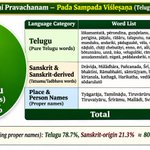
I used Ai, the speech below has 30:70 Telugu:Sanskrit
I prompted to give 80:20 ratio of Telugu:Sanskrit a perfect blend of coffee, instead of drinking chicory as coffee
If the speech level is maintained within two generations there won’t be Telugu at all!
I am repeating myself I am NOT an enemy of Sanskrit but proud Teluguvadu
🤖 Made with AI


Till about 50 years ago, most Vidwans who would deliver discourses in Tamil, would also deliver equally eloquent discourses in Telugu. Reasons were aplenty.
1. Geography of the current Telugu regions had many Tamil scholars as well.
2. Telugu works of Krishnadevaraya, Annamayya had a huge influence of Alwars & Ramanuja.
3. Carnatic music compositions were predominantly Telugu. Of course, Tamil, Kannada and Sanskrit compositions are plenty as well.
4. Telugu is truly sweet and lends itself so well to music.
Ok. I am no big Telugu expert 😃 but I like the language. With the very versatile Vidwans @Malladibros by my side, I attempted a few lines. Telugu experts, give me marks 😂🙏🏽
To all those Sanskrit lovers who believe Sanskrit is prestigious and intellectuals speaking Telugu should speak with Sanskrit!
80% chicory is not coffee!
Then why not use English instead of Sanskrit when vocabulary is what you need!
Nillu - Jalamu -water
Nippu- Agni - Fire
Illu - Grhamu - House
Kannu-Netramu -eyes
Tala- Sirasamu - head
Chettu- Vrksamu - plant
I have given simple daily usage words, why Sanskrit here if you have Telugu words! Why not then English?
When a new tech vocabulary is required, say electricity, what Tamils did?
They took Minnal ( lightening basically electric charge) and made a new word Minnsaram !
We have Merupu for lightening, we can easily make Meruparu( lightening + flow)
But what we did? Vidyuttu ! Which nobody says and all use karenttu !
I have given one example where Telugu needs to find a way to become Telugu again!
This false intellectuals who have occupied the media have completely Sanskritised normal Telugu!
Etv Abn Jothi news channels use 90% Sanskrit and 10% Telugu just as connecting words!
80:20 or 90:10 makes coffee a good drink but if you make chicory as 80% then it’s no more a coffee!
Telugu needs pride !

Sanskrit camouflaged as Telugu! Why do Brahmins do this !
Can’t you speak Telugu ?
If this was done in Tamil, you would have been under fire!
This false prestige of showing off as intellectual superiority if spoken with Sanskritised Telugu must be called out ! Expose this type of imposing Sanskrit!
Tamils had the vision to reclaim their language, should appreciate their endeavour and their language movement!
When will Telugus open their eyes?!
Till about 50 years ago, most Vidwans who would deliver discourses in Tamil, would also deliver equally eloquent discourses in Telugu. Reasons were aplenty.
1. Geography of the current Telugu regions had many Tamil scholars as well.
2. Telugu works of Krishnadevaraya, Annamayya had a huge influence of Alwars & Ramanuja.
3. Carnatic music compositions were predominantly Telugu. Of course, Tamil, Kannada and Sanskrit compositions are plenty as well.
4. Telugu is truly sweet and lends itself so well to music.
Ok. I am no big Telugu expert 😃 but I like the language. With the very versatile Vidwans @Malladibros by my side, I attempted a few lines. Telugu experts, give me marks 😂🙏🏽

World’s first AI based first scam by Tamils !
You might have known the big scandal in supply of books to libraries in Tamilnadu, they have created artificial fake books with artificial fake authors all cooked by AI !
Yes they made books with ridiculous titles with fake book titles, fake author names such as Vijay, Trisha, Karuna etc!
Yes 1000s of books cooked in Ai, printed in bulk, sold to gullible idiot govt libraries and swindled more than 300 crores!
Now comes a twist in the story..
Yes this is it’s not new to this guys, they just did what their forefathers did!
They employed the same tactic even when they cooked sangam corpus, they created fake artificial author names, copy pasted the works from Prakrit Kavya literature like gaha sattasai, oral traditions from Tulu, Kannada Telugu and Tamil landscape were written down under various fake author names!
Have you seen the sangam poets name?!
I give examples
Kovur kilar- is this a name?! A village name and a landlord title! Not a personal poet name !
It’s like saying Adayar landlord!
Who is he?!
Mangudi Maruthanar, Perunkunrur kilar, Kaniyan pokunranar and hundreds of such fake made up names, yes all are fake names
Pisiranthaiyar - an owl man !
Mamulanar- ?! Big mula man?!
Nakkiran-?!
Baranar - Nakshatra name
Kabila- Sanskrit name
Avvai- means women ( in Telugu Avva means old women and add yar for respect, bingo you get Avvaiyar, even this women is not a single person, Tamils themselves say 4 Avvaiyars and each are centuries apart!
Beauty is NOT even ONE sangam poet is endorsed by any historical primary evidence !
No inscriptions
No copper plates
No land grants
Nothing ! Yes nothing is found !when we get thousands of inscriptions mentioning land grants to Brahmins for Veda renderings, from dancers to musicians get grants, why no poets ever mentioned?!
All fake names cooked just like this AI library scam!
These guys have cooked a huge scam a century ago or maybe it was done even earlier during the Tamil revival time during later Pandyas, who took this as a project !
There is no name not even one name which is in sangam poem corpus, either poet name or protagonist name endorsed in any primary evidences acceptable in professional history writing!
The present day Tamils are like guys converted into Islam, who cannot escape and cannot call out even if the claims look ridiculous and unscientific!
All these online language warriors are the victims of such propaganda scandals! Poor guys !
Marturi Vasanth retweeted

Interesting. Hindu festivals are designed around the very things that psychologists have identified as essential for our happiness. instagram.com/reel/DfP-lkjCL…
Marturi Vasanth retweeted

Nvidia board should ask Jensen to step aside and appoint an Indian CEO. It's best for the company now.
No affairs, no show, no crazy comments, not even a word if 100 Indians get shot dead before them.
They will do as told. Become woke or even convert to serve the company.

I have a hypothesis about why Indian CEOs are being selected in such large numbers by international boards.
Indian CEOs are, of course, smart, talented, and capable leaders. But plenty of Americans, Brits, Israelis, Europeans, Chinese, Japanese, and Koreans are too.
And it's not just about speaking English either, as some think, given immigrant Indians are chosen as being better than American or five eyes born native English speakers who are equal, or more in numbers in the western talent pool.
My theory is that they're chosen because they tend to be docile and servile along with all the great qualifications and qualities of a leader.
An Anglo-Saxon white, Chinese, or Israeli CEO might let their community's or birth country's interests creep in and interfere at some point. Or they will just be more brave and open about voicing their opinions and taking decisions which may affect shareholder value.
For example, in the recent H1B visa fee hike case, I saw so many Whites (including Elon), Jewish and Chinese Americans (including CEOs) openly come out against it and support hi-tech immigration, even directly support Indian immigrants.
Indian origin leaders, on the other hand, are a safe bet for keeping their mouths shut in silence. For instance, they haven't yet posted a single line condemning racial targeting, attacks, or killings of Indians, or speak out against H-1B visa policy changes that hurt their own community - or even their own company.
Indians, especially India born ones, can just be trusted to play it safe, focusing solely on their personal and company interests. In fact, they'll bend over backwards to serve their boards, companies, and the deep state, if any, dictating.
My hypothesis can be further proven by seeing that India born Indian origin leaders are picked for CEO jobs in US companies, and not many US born Indian Americans (not even close) who are as qualified with all the great credentials and just as good - if it is really the race or culture that makes good CEOs.
Because, even though they are Indians with similar achievements, qualifications from top schools, and capabilities, being born and brought up in the US, they tend to have a bit more of the independent American spirit and much less of the docility and spineless, servile attitude.
Marturi Vasanth retweeted

Why do Western intellectuals so often despise Sanatana Dharma, and why do they seem to be so dismissive of (practicing) Hindus and Hindu faith? When it comes to Sanatana Dharma, there is certainly none of the romanticizing Western Orientalism that we find with regard to Islam (cf. "Lawrence of Arabia"), Shinto (despite WWII), Chinese religion (witness the highly respectful tone of most Sinology), or even Buddhism (which though originating in Sanatana Dharma is seen in the West as an elite religion). Even Western academics who study Sanskrit no longer seem to admire the religion it embodies, though things may have been different in centuries past. Elite Western antihinduism really does seem to be something "sui generis" -- of its own kind.
I don't have a research-based answer, though I do have a guess. I suspect it is related to a residual iconoclasm in the post-Christian West, especially in Protestant countries. Jewish lore has it that Abraham founded his religion by smashing all the idols in his father's shop. Like most Muslims, Protestant Christians have embraced this inherent iconoclasm. Today it's not only Hindu idols that they smash; they also deface and pull down their own statues. Look at civic art in the West today: except when it explicitly defiles the Western inheritance, it is all abstract. Even Mohammed would approve.
I have told Jewish audiences that elite Western antisemitism has its roots in a civilizational shame at having appropriated the Jewish God. I suspect something similar is at work with regard to antihinduism. Hindu worship is, after all, a reminder of the West's pre-Christian past. The towering classical figures of Western literature (Homer, Herodotus, Aeschylus, Sophocles, Thucydides, Plato, Aristotle, Plutarch, Virgil, Horace, Cicero, etc.) would all have felt quite at home in a Hindu temple. They would have felt equally at home performing puja in a typical Hindu home. Ancient Greco-Roman worship was essentially the same as ancient Hindu worship -- and contemporary Hindu worship. It is Hindus who have kept the classical tradition alive.
There is thus, perhaps, also a deep-seated civilizational shame in the West at having repudiated the religion of our forefathers. Might we instinctively recognize that we have embraced (indeed: appropriated) a Middle Eastern god who is not our own, and adopted Middle Eastern practices (monotheism, iconoclasm, zealotry) that are not native to our culture? At first reading that just sounds crazy, but consider the fact that Christianity has repeatedly sought to cleanse itself of recurring idolatry, just as Persia (another ancient Indo-European culture) has been the focus of repeated cleansings of Islam. Might it be that the West's folk culture has always been in tension with the iconoclasm of elite intellectualism?
The desire to burn a candle in front of an idol (of Mary or a saint), or to burn incense in a home shrine (not just for air purification) seems to run deep in Western folk spirituality.
All of this is of course highly tenuous. But I do find it plausible that there is an inertial cultural complex (not a psychological "race mind") that, having evolved over millennia, still has not after 2000 years fully assimilated the imposition of Christianity. The very fact that the ancient (Pagan) world is considered "classical" indicates that it is still a cultural touchstone for our civilization. Yet the West (and especially the intellectual vanguard of the West) is in perpetual conflict with that classical inheritance. Just look at Nolan's Odyssey to see that. We have inherited a classical literature but we recoil at a classical morality.
Hindus (or at least: the core proponents of mainstream popular Hindu faith) do not recoil at their classical inheritance, or at ours. The morality of the Bhagavad Gita does not differ much from the morality of Plato or of the Iliad, but all of these are completely at odds with the morality taught by Jesus -- or in Western schools. Traditional Christian morality and modern secular morality are very different, but they both represent a repudiation of the Indo-European classical inheritance. In short, Hindus remind us of our purer selves, or at least of our original selves. They represent the faith of the old gods from which we have strayed.
Today, Western intellectuals are clearly able to admire non-Western religions that do not remind them of their own classical inheritance. They seem, however, to display a visceral aversion to Sanatana Dharma, especially in its continuing contemporary practice. Those Western intellectuals of the 18th and 19th centuries who did embrace Sanskrit literature (British orientalism, American transcendentalism, German romanticism) seemed to have done so precisely because they yearned to repudiate their Christian cultural overlay. For today's Western intellectuals, Shinto and Buddhism can feel like refinements, whereas Hindu faith seems retrograde.
The colonized mind, of course, perceives this, but misinterprets the Western intellectual's revulsion at Hindu worship for mere disdain. The post-Hindu anti-Hindu looks down on the Sanatani's faith. But the post-Christian anti-Hindu recoils from it. Whereas post-Hindu intellectuals feel embarrassed by their Hindu inheritance (and Hindu neighbors), post-Christian intellectuals feel humiliated. Hindus are an unwelcome reminder of the religion they have long since lost.
There are of course other elements that feed into Western intellectual antihinduism: colonialism, racism, elitism, fear of the unfamiliar, etc. But its visceral nature seems to me to be much more consistent with shame. I feel personally certain that shame lies at the core of Western antisemitism. I think it likely that a parallel but opposite shame lies at the core of Western antihinduism. With regard to Jews and Judaism, the shame of having appropriated the Hebrew god results in a combination of adulation and hatred. With regard to Hindus and Sanatana Dharma, the shame of having repudiated our own gods results in a combination revulsion and resentment.
There never was a Hindu Holocaust under Western colonialism, yet neither was there much concern over tens of millions of Hindu deaths, whether due to starvation, disease, or Muslim violence. Western intellectuals don't hate Hindus the way so many of them seem to hate Jews. But they do seem to resent the mere existence of Hindus, to the point that they might prefer to see Hindus erased from history. That may sound like an extreme overstatement of Western antihinduism. If you think so, read any Western academic journal of Hindu studies and compare it to those focused on Buddhist, Shinto, Confucian, or even Muslim studies, and you'll see my point.


Marturi Vasanth retweeted

I went to France 24 home page expecting to read up on the riots last night and see the police and Macron's response. Instead, I kid you not, the lead story (yes lead) is:-
"Indian opposition parties stage mega rally seeking election chief’s resignation."
Why on earth would French people be interested in this?
The next story is "How far will 'Cockroach' movement go? India's youth-led protests defy Modi government" and "India bans march on parliament by ‘Cockroach’ activists, risking a standoff".
Can't see anything on the riots in France on its home page. Absolutely bizarre.
Marturi Vasanth retweeted

Chronology of the Oldest Telugu Inscriptions
1. The Earliest Records with Telugu Words (c.3rd - 2nd BCE)
A. The Malakonda Cave Inscription (c.3rd BCE)
Location: Parvatiguha, Malakonda village, Prakasam district, Andhra Pradesh.
Script: Ashokan-Brahmi.
Language: Prakrit containing Telugu vocabulary.
Linguistic Significance: This inscription records a gift by a donor named Siri Viri Sethi. It describes him as belonging to the "Aravala" (or Aravaha) family. Epigraphists identify Aravalu (or Aruvalu) as an ancient Telugu word used to describe Tamil-speaking people to the south. This is currently regarded as one of the oldest occurrences of a Telugu specific ethno-linguistic term.
B. The Salihundam Potsherd Inscription (c.2nd BCE)
Location: Salihundam Buddhist site, Srikakulam district, Andhra Pradesh.
Type: Inscribed pre-firing pottery fragment (potsherd).
Language/Script: Brahmi script.
The Text: Read as "NAKU DANAM" (literally: "To me, a gift").
Linguistic Significance: This is a crucial milestone for Telugu historical linguistics. The word "Naku" consists of the first-person singular pronoun base prefixed by the Telugu dative case suffix "-ku" (characteristic of ajantabhasha or vowel-ending languages - Telugu, Italian). This represents the oldest known structural and grammatical use of the Telugu dative case.
C. The Bhattiprolu Casket Inscriptions (c.3rd–2nd BCE)
Location: Bhattiprolu, Guntur district, Andhra Pradesh.
Language: Prakrit with early Telugu phonetic influences.
Linguistic Significance: The rosetta found here feature Bhattiprolu Brahmi variant. It contains personal names (such as Budha, Siri, Pratishtha) displaying early linguistic sound patterns that transitioned directly into old Telugu.
D. The Amaravati Stupa Inscription (c.2nd CE)
Location: Amaravati, Guntur district, Andhra Pradesh.
The Text: Features the word "Nagabu" (the serpent).
Linguistic Significance: The suffix "-bu" (which later evolved into "-mu" in classical Telugu) is an early nominal suffix unique to old Telugu. For decades, this was celebrated as the earliest recorded Telugu word before the older Prakasam and Srikakulam discoveries were verified.
2. The First Complete Telugu Inscription (c.575 CE)
While the earlier records contain isolated Telugu words inside Prakrit texts, the honour of the oldest fully Telugu inscription belongs to the Renati Chola dynasty.
Key Details of the Kalamalla Inscription:
Date: c.575 CE.
Issuer: King Erikal Muturaju (who later went on to rule as Dhananjaya Verma of the Renati Choda dynasty).
Location: Chennakesava Temple, Kalamalla village, Yerraguntla Mandal, Kadapa district.
Script: Telugu script.
Significance: This inscription documents land donations and administrative rules entirely in Telugu prose, it marked the birth of Telugu as a formal court and literary language.
#Andhra #Telangana #Telugu #TFI #OG #Epigraphy #History #Culture #India #Kannada #Karnataka #Tamil #Tamilnadu #Archeology


Marturi Vasanth retweeted

They can marry their cousin,
But they’re not allowed booze.
They can marry a child,
But they can’t marry Jews.
They can beat on their wife,
Til death do they part,
Females must be covered,
You can’t tell them apart.
No listening to music,
They can’t gamble or dance.
Have you seen what is happening,
In UK and France?
Dogs are a big no-no,
Pigs they will not eat.
But it’s not too dirty,
To pray on the street.
They don’t want what we have here,
Assimilate they will not.
Do you not recall history,
Have you quickly forgot?
So friendly and pleasant,
When they first did arrive.
Now the truth has come out,
They don’t want us alive.
But they’ve made it so clear now,
And it might be too late.
They’re turning your country,
Into their caliphate.
Marturi Vasanth retweeted

Muslim supremacist calls himself Canadian because he has a passport, then tells her she can’t speak Arabic as a non-Muslim because it is offensive, so he forces the conversation into Hebrew, a language he doesn’t speak.

An Israeli Zionist woman goes on live chat platform where Muslim men harass women and girls, to expose the way they treat Jews especially Jewish women online.
She matched with this Jordanian Muslim. He right away insulted her. So she gave him a short history lesson that almost no one in the West is taught:
The original British Mandate for Palestine included the entire territory that is today Israel, the West Bank, Gaza and the country we now call Jordan. Roughly three-quarters of that original Mandate land became Transjordan (later the Kingdom of Jordan). The large majority of Jordan’s population is of Palestinian Arab origin, the same people who call themselves “Palestinians.”
In other words: there is already a Palestinian-Arab state. It is called Jordan. Gaza is the second piece. The demand for yet another one, on top of the territory already given, is not about “justice.”
It is about refusing to accept any Jewish state at all.

Marturi Vasanth retweeted

This is the fantastic story of an Indian who started as a "coolie" and later became the first Indian Fellow of the Royal Astronomical Society.
In 1840 a new hire walked into the Madras Observatory to do its lowest job. When he died 40 years later, he was its First Assistant.
Chinthamani Ragoonatha Chary came from a family of almanac makers. The director, T.G. Taylor, took him on around 1840.
Records call the entry job as a porter. Some say coolie.
Anyway, the best part is that he taught himself mathematics on the side.
And, then he climbed, grade by grade....
Director W.S. Jacob sent his paper on personal equation to the Monthly Notices in 1859, the first by an Indian in that journal.
Under Norman Pogson, the new Government Astronomer, he was 4th native assistant; he took and reduced the 2nd observation of the asteroid Asia in April 1861. By the mid 1860s he was 1st Assistant.
In 1867 he proved a faint southern star, R Reticuli, was a variable. Pogson's annual report credits him by name.
He made the chief share of the 38,000 transit-circle observations behind the Madras star catalogue. In 1868 he ran his own eclipse camp at Vunparthy; clouds ruined it, but his computed occultation tables still went to the Monthly Notices.
At the 1871 eclipse at Avinashi (~25 km west of Coimbatore), he measured the corona's prominences with a micrometer.
On 12 January 1872 London elected him FRAS, proposed by Pogson and E.B. Powell, the Director of Public Instruction.
Eclipse pamphlets in regional languages followed. Then a Transit of Venus booklet in 1874, printed in English and 6 Indian languages. The Madras govt alone bought 1,100 copies.
At Pacheappah's Hall in 1874 he urged Indians to fund their own observatory and offered his own instruments to start it. A society was formed. I found no record that the observatory was ever built
My only question is how many in Chennai today have heard his name?
Sources: Rao, Vagiswari, Thakur & Birdie, JAHH 12(3) 2009 (arXiv:0908.3081); Monthly Notices of the RAS obituary, 41(4), 1881, p.180; Dictionary of National Biography, 1885-1900; MNRAS 32(3):69 election record.
Photo: Portrait, public domain.

Marturi Vasanth retweeted

ANNOUNCING Pramāṇa, the most comprehensive database of Indian primary sources ever created.
Any
- text (including recensions, commentaries, commentaries on commentaries etc.)
- inscription, coin type...
- foreign text relevant to India
- digitizations of Archaeological survey this, Epigraphica XYZ, whatever
you can think of, is in here.


