

New Mathematics papers from https://nitter.cf/t.co/wBI0Sjzd7o: mathematical material of general interest. Thank you to arXiv for use of its open access interoperability.
- Tweets211K
- Following7
- Followers5.9K
- Likes1




ALT We consider special cases of the discontinuous Weber–Schafheitlin integral in which the orders μ and ν of the Bessel functions differ by an integer and the exponent λ equals 0 or ±1, with μ-ν+λ odd. Explicit closed-form results are obtained in terms of Jacobi polynomials.

ALT Let p(n) be the minimum cardinality of a finite planar point set in which each point has exactly n unit-distance neighbours. Harborth proved p(5)=18 in work presented in 1985 and published in 1987, using a detailed case analysis. We revisit the proof using convex-hull arguments, incidence counts, and elementary properties of intersections of unit circles. These tools give an alternative treatment of configurations with 14 and 16 points and organize the final case distinction by a common vector-sum structure. We also treat a configuration not explicitly covered by the case analysis in the online PDF copy of Harborth's paper available to us, and give an explicit justification of the six-point classification used in the argument. No result subsequent to Harborth's proof is required.

ALT We show that (1/(g(x))), with g(x)=x-1/xln x, is a complete Bernstein function and give its Lévy measure explicitly. For h(x)=(x²-1)ln(x+1)/x²ln x, we prove that h is not a Stieltjes function, so (1/h) is not a complete Bernstein function, but (1/h) is a Bernstein function. The latter rests on the positivity of a function built from the convolution of the exponential integrals E₁ and E₂. We also give a related completely monotonic function that is not a Stieltjes function.

ALT Power series expansions in the polar distance about the center are derived for the normal direction and signed distance from an ellipse to points near its center. After extracting constant terms and common factors, the series coefficients are polynomials in the axis ratio and the absolute value of the sine of the polar angle, with rational coefficients. The region of convergence is shown to be the region bounded by the ellipse evolute. The expansions complement previously derived expansions valid for points far from the center.

ALT In this note, we address a traditional pedagogical asymmetry between algorithmic differentiation and heuristic integration by introducing an extra parametric-order differential framework. By treating the order of differentiation as a parametric axis (discrete or continuous), classical integration is reframed as a local differential evaluation at the non-positive boundary level. This analytical shift alleviates some traditional routines of integration by parts, by replacing the quadrature of a product of elementary functions with a direct differential series that either truncates into a finite algebraic sum or resolves through cyclic symmetries. This parametric-order approach also bridges the gap with fractional calculus, showing that non-integer derivatives emerge as a seamless extension of the same operational dimension. By reducing global quadrature to local differentiation, this note offers an efficient, conceptual tool for undergraduate analysis.

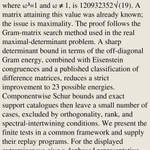
ALT We prove that the largest absolute determinant of a 15×15 matrix with entries in {1,ω,ω²}, where ω³=1 and ω≠1, is 120932352√(19). A matrix attaining this value was already known; the issue is maximality. The proof follows the Gram-matrix search method used in the real maximal-determinant problem. A sharp determinant bound in terms of the off-diagonal Gram energy, combined with Eisenstein congruences and a published classification of difference matrices, reduces a strict improvement to 23 possible energies. Componentwise Schur bounds and exact support catalogues then leave a small number of cases, excluded by orthogonality, rank, and spectral-intertwining conditions. We present the finite tests in a common framework and supply their replay programs. For the displayed extremizer we give a dephased representative, its Gram matrix and spectrum, and an exact computation of its monomial automorphism group, which has order 1008. The proof determines the value of the maximum, but does not clas

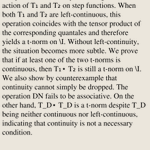
ALT We define a binary operation T₁⋆ T₂ on the fuzzy unit interval \I by extending the natural action of T₁ and T₂ on step functions. When both T₁ and T₂ are left-continuous, this operation coincides with the tensor product of the corresponding quantales and therefore yields a t-norm on \I. Without left-continuity, the situation becomes more subtle. We prove that if at least one of the two t-norms is continuous, then T₁⋆ T₂ is still a t-norm on \I. We also show by counterexample that continuity cannot simply be dropped. The operation DN fails to be associative. On the other hand, T_D⋆ T_D is a t-norm despite T_D being neither continuous nor left-continuous, indicating that continuity is not a necessary condition.

ALT We study the cyclic inequality ∑ᵢ₌₁ⁿ xᵢ ∑ᵢ₌₁ⁿ xᵢᵃ xᵢ₊₁ᵇ ≤ (∑ᵢ₌₁ⁿ xᵢ⁽¹⁺ᵃ⁺ᵇ/2))², where x₁,…,xₙ≥ 0 and indices are taken modulo n. Let N(a,b) be the largest n for which the inequality holds for all nonnegative xᵢ. We show that N(a,b) is bounded above by an explicit quantity N⁽a,b) obtained from the second variation at the constant vector, and we conjecture that N(a,b)=N⁽a,b). For a=b=1 we prove that the inequality holds if and only if n≤ 8, which settles the case left open in the original version of this paper. For n=4 the inequality holds whenever 1,a,b are the sides of a triangle, with an explicit remainder term. We show that N is monotone along rays emanating from the line a+b=1; this corrects and extends an earlier monotonicity statement. Finally, any n nonnegative numbers can be arranged so that the inequality holds; for n≠ 6 this is achieved by one of n-1 prescribed arrangements, which yields a volume bound for every such n.

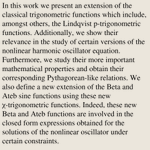
ALT In this work we present an extension of the classical trigonometric functions which include, amongst others, the Lindqvist p-trigonometric functions. Additionally, we show their relevance in the study of certain versions of the nonlinear harmonic oscillator equation. Furthermore, we study their more important mathematical properties and obtain their corresponding Pythagorean-like relations. We also define a new extension of the Beta and Ateb sine functions using these new χ-trigonometric functions. Indeed, these new Beta and Ateb functions are involved in the closed form expressions obtained for the solutions of the nonlinear oscillator under certain constraints.

ALT We define packaged structures through carriers, internal units, incidence, candidate spaces, and selected families. A realized packaging system additionally retains a context and formation datum related to its output by a possibly partial, multivalued realization relation. We establish comparison-relative recoverability and non-collapse criteria and an intrinsic refinement-completion theory. For atlas specializations, exact extension becomes a specialization-relative packaging completion problem. Under additional recovery and elimination axioms, we establish general globalization sufficiency criteria and sharp classifications for three classes of compatible finite atlases on a fixed cover ℋ. A geometric obstruction rank ν(ℋ) yields thresholds 2k+1<ν(ℋ) for empty-preserving closures of local Carathéodory number at most k≥1; d<ν(ℋ) for complete functional-dependency theories of local minimum Armstrong size at most d≥3; and 3<ν(ℋ) for transitive relations, including equivalence relations.

ALT In this paper, we establish several identities involving Bernoulli numbers, harmonic numbers, and Stirling numbers. Our approach extends the method developed by Kargin and Mutluer.

ALT We study two families of coefficients associated with powers of the tangent function and with products of the secant and tangent functions, and develop a unified treatment of the corresponding higher-order tangent and secant numbers. The first part establishes a common identity for even derivatives of tanh x and odd derivatives of sechx. Combined with integral formulae for these derivatives, this yields finite power-integral representations for the normalized values ζ(2n+1) and β(2n) and naturally introduces two polynomial families Pₙ and Qₙ. We determine several arithmetic and structural properties of these polynomials. In particular, we identify the exact content of Pₙ, prove that Qₙ is primitive, establish strict log-concavity and unimodality of their coefficient sequences, and describe their real zeros. For even indices each family has a unique negative real zero, and the two sequences of real zeros have the same limit. We also derive differential recurrences and generating functio

ALT The perimeter of an ellipse is expressed exactly through the complete elliptic integral of the second kind, motivating accurate closed-form approximations. We introduce ELIP (Ellipse Linear Interpolated Perimeter), a family built by correcting the straight line joining the two exact normalized endpoint values. Two branches are developed: logarithmic-power corrections with optional deformation and exponential modulators, and rational-logarithmic corrections incorporating the exact asymptotic behavior of highly elongated ellipses. The framework distinguishes coefficients fixed analytically by Maclaurin matching from parameters optimized numerically by minimax fitting. Compact rationalized formulas achieve maximum relative errors of approximately 6.84, 3.57, 0.904, and 1.596 ppm. An ELIP R5,2 + 3 log formula with three fitted degrees of freedom has a certified maximum relative error below 0.001623 ppm. For ELIP R5,3 + 3 log, all rational-core coefficients are determined by exact Maclaurin

ALT The large number of calculus formulas makes learning calculus heavily memory-dependent and can scare away many students. Based on Issac Newton's idea of prediction, this paper shows that calculus students need to master only one critical formula: his proposition that, given boundary data, one can predict the interior and vice versa. We can treat other formulas as consequences of the formula for this proposition. In 1-, 2-, and 3-dimensional spaces, this formula corresponds to the fundamental theorem of calculus, Green's theorem, and the divergence theorem. This approach is summarized as OFFER (one-formula-facilitates-every-relationship) for calculus education. This paper demonstrates the method and advantages of the OFFER pedagogy. The OFFER approach can accelerate the pace of calculus teaching, provide deeper insight into calculus, inspire questions from students, and naturally facilitate the inclusion of real-world data, artificial intelligence (AI), and computer coding in the calcul

ALT In this paper, we discuss two related Diophantine tuple problems involving star numbers Sₙ=6n(n-1)+1. First, we investigate classical D(k)-tuples whose elements are star numbers. We construct infinitely many D(k)-pairs for several positive and negative admissible values of k, and we prove several nonexistence results for D(k)-triples and quadruples. Second, we introduce a modified notion of a star number D(k)-tuple, requiring aᵢaⱼ+k itself to be a star number. We construct several infinite families of D(1)-triples, and study their extensions to quadruples. In particular, we prove that {4,108,165} has the unique extension {4,108,165,360} to a star number D(1)-quadruple. The main tools used in this paper are generalized Pell equations, Nagell's theorem, lower bounds for linear forms in logarithms due to Matveev and Dujella-Pethő version of the Baker-Davenport reduction method in diophantine approximation.

ALT We develop a common two-by-two matrix framework for the four classical Hopf fibrations associated with the real, complex, quaternionic and octonionic numbers. In all four cases the Hopf map is the image of the north pole of a sphere of trace-free Hermitian matrices under conjugation by a bi-unitary matrix, and it depends only on the first column of that matrix, without any bracketing convention, even for the non-associative octonions. Our main results concern general octonionic bi-unitary matrices, beyond the compatible matrices, with entries in a single complex subalgebra, on which earlier work on octonionic Lorentz transformations relies. We prove that every octonionic bi-unitary matrix is in fact quaternionic: its entries lie in a quaternion subalgebra depending on the matrix. We show that requiring Hermitian output leaves exactly four inequivalent ways of bracketing the octonionic triple products, among them an interlaced rule called RLLR/LRRL, and that each of them splits into an

ALT For the Lucas numbers L₀=2, L₁=1, and L_n=L_n-1+L_n-2, we obtain \sum_{substackn,m≥1\n,m)=1}1/L₂nL₂mL₂(n+m)=frac145. This follows from the absolutely convergent identity \sum_{substackn,m≥1\n,m)=1}frac{q^n+m} {(1+q^n)(1+q^m)(1+q^n+m)}=fracq²(1-q²)², |q|<1. We give a self-contained proof by local cancellation on the Calkin–Wilf tree, as a specialization of Hata's Farey-interval telescoping principle. Specializations yield a hyperbolic-cosine identity \sum_{substackn,m≥1\n,m)=1} frac1cosh(nx)cosh(mx)cosh((n+m)x)=frac2sinh²(2x), x>0 and weighted sums for canonical second-order Lucas recurrences. Decomposing arbitrary positive pairs according to their greatest common divisor gives an unrestricted sum expressed by a Lambert series and the quasimodular Eisenstein series E₂. Conversely, Möbius inversion recovers the primitive identity from a double Lambert-series result of Cui, Kumar, and Singh.

ALT Let Qp,q(t)∈ℤ[t] be Sharipov's even monic degree-10 second cuboid polynomial, with coprime positive integers p≠ q. We prove that Qp,q(t) is irreducible over ℚ, and hence over ℤ. More generally, the normalized associated quintic Pₛ(x) and its composition Pₛ(t²) are irreducible over ℚ for every s∈ℚ∖{0,±1}. The proof reduces linear and quadratic factors to rational points and horizontal conjugate pairs on one fixed genus-2 curve. A certified rank upper bound for its Jacobian, together with an exact divisor calculation, gives a rank-one annihilating differential at the prime 3. For the quadratic-factor case, the symmetric coordinates of a horizontal pair lie on an explicit double cover of an elliptic quartic. All rational affine points on this model are 3-adically integral and reduce to six smooth residue classes. The pulled-back differential is a unit in each class, proving that six displayed points form the complete list. Their coordinates exclude every admissible parameter. A negative r

ALT In the present paper, we investigate geometric properties of a Riemannian submersion for which the total manifold is endowed with hyperbolic and almost hyperbolic Ricci solitons. We establish conditions under which the fibers of the submersion admit hyperbolic and almost hyperbolic Ricci solitons. Further, we derive necessary conditions for the base manifold to be an Einstein and a hyperbolic Ricci soliton. Also, we determine the scalar curvature associated with the fibers and the base manifold. Moreover, when the total space admits an almost hyperbolic Ricci soliton with a torse-forming potential vector field, we obtain conditions ensuring that the extrinsic vertical and horizontal distributions are almost generalized quasi-Einstein. We also obtain necessary conditions for the fibers and base manifold to be an Einstein and almost generalized quasi-Einstein manifold. Finally, examples are included to illustrate the existence of hyperbolic and almost hyperbolic Ricci solitons in Riemann

ALT We study integers of the form N=(d+1)(3d+1)(4d+1). Using Korselt's criterion, we prove that, provided the three factors are prime, N is a Carmichael number if and only if d≡4±od12. We also show that the special case d=2^m produces only 1105 under the prime-factor hypothesis.