

Verified Chainlink node operator since 2020. Validators on Ethereum, Polygon, Enjin and IOTA. How oracles and these networks work, from the operator's side.
Dubai
Joined February 2021
- Tweets850
- Following0
- Followers682
- Likes1.6K


Pinned Tweet
A @chainlink price feed update is one transaction, not one per node.
Operators sign observations off-chain, an elected leader aggregates them, and a quorum signs the report. The contract checks the signatures and serves the median.
No single node sets the price. That's OCR.

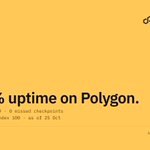
As of 25 Oct, the @0xPolygon staking dashboard showed our validator #189 at 100% uptime, 0 missed checkpoints and a performance index of 100.
A checkpoint is a snapshot of Bor blocks, signed by 2/3+ of the stake and sent to Ethereum.
Delegators can check today's figures there.

Under Glamsterdam, an @ethereum beacon block carries a builder's bid. The payload comes after.
512 validators per slot, the payload timeliness committee, vote on whether it arrived on time with its blob data.
They check, not execute, which takes execution off the hot path.

Chainlink node v2.69.0 from @chainlink removes VRF v2. VRF v2.5 replaced it in November 2024.
Nodes on v2.69.0 no longer serve v2 requests. An app still on a v2 coordinator moves to v2.5: a uint256 subscription ID and extraArgs in each request.

A @chainlink Data Feed writes every update on-chain, read or not. Data Streams flips that.
The DON signs reports off-chain at sub-second latency. A protocol pulls one into its own transaction, and a verifier contract checks the signatures.
It pays to verify only what it uses.

Every Matrixchain node needs client v1.4.1 before Fort Canning reaches @enjin's Matrixchain on 16 Nov, if its referendum passes.
OpenGov replaces the Council there: any account can submit a referendum and ENJ holders decide directly.
Ours already runs v1.4.1.

Our @chainlink node on @XLayerOfficial took on calculated equity USD feeds on 23 Oct, wNVDAx and wSPYx among them.
Calculated means the feed reports the token's primary market price: its intrinsic value under the issuer's pricing method.

Blocks on @0xPolygon PoS are final before any checkpoint reaches Ethereum. Heimdall validators vote on milestones of up to 10 block hashes.
Once 2/3+ of voting power agrees, every block up to that milestone is final.
For protocols, that is the point of no reorg.

A @chainlink price feed is two contracts: operators' reports update the aggregator, protocols read the proxy in front of it.
The proxy points at the current aggregator, which can be upgraded without interrupting anyone reading the feed.
Read the proxy. The aggregator can move.

Monday is still fork day on any node that kept the old schedule. Lodestar v1.50.1 clears Glamsterdam's 26 Oct activation on Hoodi.
This delay leaves @ethereum mainnet untouched. Hoodi operators clear both layers before then, or that node forks alone.


Protocol version 38 has been live on @iota mainnet since 22 Oct (v1.34.1).
A transaction pointing at a missing input is now rejected at signing, not charged gas at execution.
A validator that upgrades late can cost its delegators rewards.

Chainlink node v2.68.0 from @chainlink changes the gateway DON IDs of sharded CRE DONs. Shards after the first now take a _shard-N suffix; their nodes must set it.
It also fixes the operator UI nodes page for non-EVM chains.
Nothing changes for protocols reading a feed.

When an L2 sequencer stops, the market moves on and only users who can go through L1 contracts get in.
@chainlink L2 Sequencer Uptime Feeds record whether it is up. The status flip lands before transactions queued after it.
Protocols can pause, then wait out a grace period.

Heimdall v0.12.2 from @0xPolygon lets a node recover from a late upgrade by itself. A node that ran an old binary past a hardfork height re-runs its last block on restart.
Until now that took a manual rollback. Our validator runs v0.12.2.
Delegators need not do anything.

Prysm v7.3.0 from @prylabs schedules the Gloas fork on Ethereum's Hoodi testnet for 26 October. Hoodi operators need to update beacon nodes and validator clients before then.
Mainnet gets fixes in this release too, and Prysm recommends updating beacon nodes there.

Glamsterdam has been live on Sepolia since 6 Oct. Hoodi: 26 Oct. Mainnet has no date yet.
A headline change is enshrined proposer-builder separation (EIP-7732): the builder's payment to the proposer moves into @ethereum's consensus.
Validators get new duties to prepare for.

On @iota, staked tokens earn only for epochs they are active for in full. Stake today and it counts from the next epoch. Epochs last 24 hours.
Withdraw whenever you like: principal and rewards come back together.
Unstaking mid-epoch means that epoch doesn't earn.

Fort Canning, Enjin Relaychain runtime v1.8.0, is set for 9 Nov at block #18,059,100 if its referendum passes.
It brings dispute slashing to @enjin: validators that back or approve an invalid candidate lose stake, and so do their nominators.
Validators need client v1.8.0.

Chainlink node v2.67.0 from @chainlink adds Postgres 18. Since v2.66.0 the minimum is 15. Releases ship about weekly.
Every release image is signed, so an operator can verify it with cosign against the published digest before it runs.
Protocols reading a feed see none of this.

Lugano from @0xPolygon activated at Heimdall block 54,627,000 on 1 Oct: this hardfork is set by a Heimdall height.
Nodes on v0.11.0 or older ran past it under the old rules and halted. An upgrade alone didn't fix them.
That is why validators upgrade first.

IOTA mainnet has run protocol version 37 since epoch 521, which began on 8 Oct at 07:42 UTC. It shipped in v1.33.1 from @iota.
Version 37 rejects a transaction naming an object version reserved for canceled ones, before any object loads.
Our validator runs v1.33.1.
