

Hardware engineer focused on turning requirements into reliable physical products. Sharing lessons from electronic design, integration and validation.
Ciudad Real, Spain
Joined March 2026
- Tweets54
- Following98
- Followers5
- Likes52







A last-minute component change isn’t finished when the schematic is updated.
Does the BOM still match?
The footprint?
The assembly drawing?
The change is small.
The consistency check matters.
Not every car needs to be a daily driver.
The Tesla Roadster Rocket could make sense as a leisure experience. But before judging it, I’d ask: what would its owner need to actually enjoy it?
🧵👇

I wouldn’t judge every Roadster by the one performing airborne manoeuvres.
Performance, Thrust and Rocket offer different experiences.
What makes sense for one buyer might offer little value to another.
👇
A design review before manufacturing should ask more than: Can I spot an error?
Do the design choices still meet the requirements?

Before replacing a component, ask what requirement or constraint drove the original choice.
A part rarely exists in isolation.

When you inherit a hardware design, the schematic shows how it works.
The design history often explains why it was built that way.
Understand that intent before proposing changes.

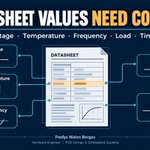
A datasheet value is only valid under its test conditions.
Voltage, temperature, frequency, load and timing can change the real behavior of a component.
Component selection starts when you stop asking “Does the number fit?” and ask “Does it still fit in my design?”

A good review should leave three answers clear:
What was intended?
What risk was identified?
How will it be verified?
If the reasoning disappears when the meeting ends, the review is incomplete.

Review checklists catch what memory can miss.
But they do not replace engineering judgment: every item still has to be evaluated against the real risks and constraints of the design.

A technical decision that exists only in one engineer’s head is a future debugging problem.
Record the trade-off, the constraint, and the evidence behind it.

A schematic tells you how a circuit is connected.
Documentation tells you why it was designed that way, which constraints shaped it, and how it will be verified.
Both are part of the hardware.

Closed hardware stifles innovation.
That’s why this mini environmental sensor with ESP32-C3 is open source under the CERN-OHL‑2 license.
Schematics, Gerbers, and design files ready to manufacture and modify.
Repository link below.

Self-heating is the silent enemy of environmental sensors on compact PCBs.
How do you solve it?
Here are three physical tricks.👇
🤖 Made with AI

Second: Thermal isolation.
Cut slots (routed grooves) around the sensor to break heat conduction through the FR4 substrate. Air insulates better than copper or resin. 👇
