

Catholic, a dreamer, passionate about theology & philosophy. For God's glory!
Europe
Joined February 2025
- Tweets6.3K
- Following348
- Followers519
- Likes9.4K






Parus Minor retweeted
There are various arguments. I will cite a couple:
1. In the beginning, the Second Vatican Council wanted the Mass to be in Latin. It allowed readings in the national language - in masses with the people (and therefore not in conventual masses).
2 It is not most important to understand everything at Mass. Note that even at the new Mass some prayers are prayed silently by the priest. In general, what the priest prays is his priestly prayer. We, during this time when we do not understand, can try to join in with our individual prayer of the heart.
3 The Mass does not just have a catechetical dimension - but the latreutic and mysterious and ancient language of the sacred reflects this. Note that the temple liturgy was also in Hebrew, although people used Aramaic on a daily basis.
4. Latin is a universal language - the language of the Church for centuries. It was prayed by generations before us. The Mass would be more understandable if it were in the same language everywhere. Travelers sometimes have to listen to Mass in a foreign language that tells them nothing, and Latin would be understood at least a little - because it is at home in their parish.
5 Cultural and educational element. A person does not develop when everything is given in the vernacular. Latin is beautiful, and it also works on the human soul.
Of course, these are not all the arguments, but I leave the rest to other commenters.

The Relatives of Jesus (2/6): James and Joses
The list of brothers gives four names. The mother of the first two can be identified. The other two can wait.
Matthew, in Nazareth: “Is not this the carpenter’s son? is not his mother called Mary? and his brethren, James, and Joses, and Simon, and Judas?” (Mt 13:55, KJV). Mark, in the same place: “Is not this the carpenter, the son of Mary, the brother of James, and Joses, and of Juda, and Simon?” (Mk 6:3). The first two names come in the same order. “Joses” is a rare form of “Joseph.” In Mark it returns at the cross and at the tomb. Not as a third person.
At the cross that same pair is given a mother.
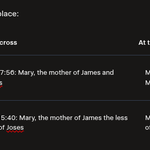
Matthew: “Mary Magdalene, and Mary the mother of James and Joses, and the mother of Zebedee’s children” (Mt 27:56). Mark: “Mary Magdalene, and Mary the mother of James the less and of Joses, and Salome” (Mk 15:40). A reader who has reached the cross and turns back finds one earlier pair of these names, in the same order: the list of brothers. The rare form “Joses” ties Mk 6:3 to Mk 15:40. So this Mary is the mother of the first two on the list, not of someone else who happens to bear the same names. If they were other men with the same names, unknown to the reader until this moment, the identification would be empty. The evangelists do not explain a person by referring to people the reader has never met. The only earlier place where James and Joses appear together is the list of brothers.
She is not the mother of Jesus. Three reasons, all from the text.
1. The mother of Jesus is identified by Jesus. Also at the cross: “his mother” (Jn 19:25). Also after it: “Mary the mother of Jesus” (Acts 1:14). When a person is identified, the nearest relative is used. The mother of Jesus has no one nearer than Jesus. James and Joses play no part at the cross. They serve only to name her. If this were the mother of Jesus, she would be named by him, and she would stand before Mary Magdalene.
2. Matthew closes it himself. The woman he called “the mother of James and Joses” in Mt 27:56 he names differently two verses later. “And there was Mary Magdalene, and the other Mary, sitting over against the sepulchre” (Mt 27:61). And in the morning: “came Mary Magdalene and the other Mary to see the sepulchre” (Mt 28:1). “The other Mary” for the mother of Jesus is out of the question. No one sums up the mother of Jesus as “the other.”
3. The two designations cannot refer to one woman. At the same cross John calls her “his mother” (Jn 19:25). Matthew and Mark call this one “the mother of James and Joses.” The Evangelists do not use two titles for one person when one of them is the title they always use.
So this is certain. James and Joses from Mt 13:55 and Mk 6:3 are not sons of Mary of Nazareth. They are sons of another Mary. “Brother,” for these two, is used in the sense of kinsman, not of a son of the same womb as Mary, the mother of Jesus.
This is biblical proof that “brother” need not mean a biological brother. The men who were called “brothers,” James and Joses, have another mother: another Mary. The text itself says so. The list is uniform. Once two of the named men have a different mother, the word in this sentence does not mean “son of the same mother” for the others either. Reading the first two as kinsmen and the next two as sons of Mary would give the same word two meanings in one breath. Some Protestants simply cannot accept this and insist that “brother” must mean a biological brother. The Bible grinds that idea to dust.
The mother of Simon and Judas is not identified here. That is the next part. The comparison, in one place:
#RelativesOfJesus #JamesAndJoses #Bible #Mary #BrothersOfJesus

Parus Minor retweeted

“So then, putting away falsehood, let all of us speak the truth to our neighbors, for we are members of one another.”
Ephesians 4:25
Parus Minor retweeted

Who killed the Christians?
And why is "massacre" in quotes?

More than 60 Christians killed in Ethiopia 'massacre', church official says bbc.in/4e11nug

Parus Minor retweeted

As someone going through OCIA, I firmly believe that a lot of Catholics on this platform would benefit attending the entire course.

I wanted a more Jesuit-like appearance. It's still the alpha release, but the possibilities with @COSMIC_desktop on @pop_os_official are gorgeous... 🤩


Parus Minor retweeted
Plenty to unpack. I'm in OCIA and he is wrong.
1. In the Rosary, we meditate on Jesus' life. We glorify God alone.
2. Saints aren't dead. "He is not God of the dead, but of the living" (Luke 20:38). We ask them to pray for us, as we would a friend.
3. The Eucharist is Jesus Himself, Body, Blood, Soul, and Divinity. Non-Catholics and Catholics in mortal sin can't receive.
4. We genuflect to the tabernacle, and at Mass we glorify the Lord from the Penitential Act to the Profession of Faith.
So how do Catholics not center the faith on Christ, our Lord?

ALT Painting of Christ's Ascension. In the upper half, the risen Christ stands on clouds against a golden glow, bare-chested, with a white mantle draped over one shoulder. His right hand is raised in blessing, and His left holds a staff flying a red banner marked with a cross. Winged cherubs fill the clouds around Him. In the lower half, the apostles stand together in robes of red, green, gold, and blue, gazing up at Him, some with hands raised or folded in prayer. Buildings of a town stand on a distant hill at left.

Leaving aside the contradiction in what you said (because the Catholic Church is the Church of God, so you can’t worry about the Church of God without also worrying about the Catholic Church), let us reassure you: it will not cease to exist—Jesus said so.
nitter.cf/oliverburdick/status/1…

Parus Minor retweeted

Rosary and adoration completed for your intentions if you’re reading this. And even if you’re not reading this.
I’m gathering information about Jesus’ family, and I think I can share what I’ve found with everyone in a more narrative format:
The Relatives of Jesus (1/6): The Household
Jesus is the son of Mary. No one disputes that. He is Joseph’s son by law, not by blood. The genealogy runs through Joseph: “Jacob begat Joseph the husband of Mary, of whom was born Jesus, who is called Christ” (Mt 1:16, KJV). Luke draws the same line: “being (as was supposed) the son of Joseph” (Lk 3:23). Mary herself says, “thy father and I” (Lk 2:48). A legal father, not a biological one. Matthew says why: “before they came together, she was found with child of the Holy Ghost” (Mt 1:18), and “knew her not till she had brought forth her firstborn son” (Mt 1:25).
Joseph is already her husband, not a fiancé in the modern sense. After kiddushin the pair are husband and wife under first-century Jewish law. Nissuin is the taking of her into his home, not the beginning of the marriage. So Matthew’s language is the language of marriage. “Joseph her husband, being a just man, and not willing to make her a publick example, was minded to put her away privily” (Mt 1:19). The angel: “fear not to take unto thee Mary thy wife” (Mt 1:20). If this were only the promise of a future wedding, there would be nothing to put away, and the angel would not say “thy wife.” What is also interesting is that, in this same passage, Matthew cites the prophecy: “Behold, a virgin shall be with child, and shall bring forth a son, and they shall call his name Emmanuel, which being interpreted is, God with us” (Mt 1:23; cf. Is 7:14). Mary is therefore presented as the mother of the one who is God with us. The title “Mother of God” is more than just a later theological conclusion drawn from the text—it is already present in the way Matthew himself presents her.
The Gospels call Mary “his mother,” including at the cross (Jn 19:25) and after it (Acts 1:14). They never call her “the mother of James and Joses.” That title belongs to another woman. That is the next part.
One more fact about the household, and it bears on the word “brother.” By the time of Jesus’ public ministry, Joseph is gone. He is not among those who come for Jesus (Mk 3:31–35). He is not at Cana (Jn 2:1–12). He is not at the cross, where Jesus gives his mother to the beloved disciple (Jn 19:25–27). He is not in the upper room (Acts 1:13–14). The text does not announce his death. After the childhood narratives, it simply never shows him again. This silence seems to support the traditional view that he was much older than Mary, and this age difference makes the decision not to consummate the marriage even more understandable. An early non-canonical text, the Protoevangelium of James (c. second century), already presents Joseph as an elderly widower chosen by a divine sign to be Mary’s guardian rather than a husband with whom she was expected to have children (Prot. Jas. 8–9). While this source is not canonical and cannot settle the question, it shows that the idea of Joseph as an older protector was present very early and is consistent with the Gospel silence.
A widow in that world does not remain alone. She enters the household of a near kinsman. The children of that house are then called the brothers and sisters of Jesus. That is where the word “brother” in the Gospel comes from. It need not mean “son of the same mother.” It may mean “of the same household.”
#RelativesOfJesus #TheHousehold #Bible #Mary #Joseph
Everything has its limits. I think I’ve already shown enough patience and willingness to explain various things to him, which he ignored. He’s spoken ill of the Mother of God again. Enough is enough.

Parus Minor retweeted
The biblical text clearly identifies another Mary (the one of Cleophas) as the mother of Jesus' “brothers.” These are not his biological brothers.

Parus Minor retweeted
I wanted a more Jesuit-like appearance. It's still the alpha release, but the possibilities with @COSMIC_desktop on @pop_os_official are gorgeous... 🤩