

Remarkable stories about the People, Planes & Places of the United States 8th Army Air Force during WW2. Co-hosted by @JohannTasker & @MikeHistorian
Somewhere in eastern England
Joined August 2022
- Tweets1.7K
- Following464
- Followers979
- Likes3.6K




The Mighty Eighth Podcast retweeted

In 1943, MI9 issued Allied airmen ‘escape’ boots with a concealed knife.
If downed in enemy territory, they could cut the boots to resemble ordinary shoes, aiding their disguise as civilians during escape attempts.
Photo credit: IWM

The Mighty Eighth Podcast retweeted

A big thank you to the villagers of Ashen and the Ridgeweĺl AIrfield Museum team for hosting me for my talk on the Schweinfurt talk last night. The fog on the airfield was suitably evocative of the raid. Hopefully museum funds benefitted from the turnout.

The Mighty Eighth Podcast retweeted
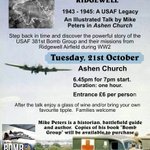
Final tweaks in progress for this evening's talk on the 381st BG in general, and the first Schweinfurt raid in detail. Looking forward to seeing everyone at the church used by many of the Ridgewell personnel in the local village of Ashen.

If you are coming along to Mike's Schweinfurt/Regensburg talk this Thursday evening you may enjoy some pre-talk listening. The @Mighty8thPod
Did a pod on the momentous raid in August 1943. We had @PaulBingley
As a special guest.
open.spotify.com/episode/0HV…… – at Little Stonham, England

The Mighty Eighth Podcast retweeted

Another one with a great volunteer run museum celebrating the 389th Bomb group their Green and Yellow assembly aircraft named the Green Dragon 🐉 after our local pub in Wymondham


The Mighty Eighth Podcast retweeted

October 26, 1943. In Germany, a strange and powerful new fighter takes to the air for the first time, a machine with an engine at both ends, nose and tail, that would prove to be the fastest piston-engined aircraft of the entire war. The Dornier Do 335, nicknamed the Pfeil, the "Arrow," was a brilliant piece of engineering that came too late and in too few numbers to matter, one of the many might-have-beens of the German aircraft industry.
The Do 335 solved an old problem in a clever new way. Twin-engined fighters were appealing because two engines meant more power, but mounting them on the wings, the usual arrangement, created drag and made the plane sluggish and hard to handle, especially if one engine failed. Dornier's answer was radical: put both engines in the fuselage, one in the nose driving a normal propeller that pulled the plane forward, and one buried in the rear driving a second propeller at the very tail that pushed. This "push-pull" layout gave the Arrow the power of two engines with the slim, low-drag profile of a single-engined fighter.
The result was blisteringly fast. The Do 335 could reach something like four hundred and seventy miles an hour, faster than any other piston-engined aircraft the war produced, and it had long range and heavy armament to match. It was, by the measures of propeller-driven flight, a superb machine, and it could keep flying on just one of its two engines if the other was knocked out. Pilots who flew it were impressed. On paper it was one of the finest conventional fighters anyone built.
But it was born into the twilight of the piston engine and the chaos of a losing war, and that doomed it. By the time it flew in 1943 and struggled toward production in 1944 and 1945, Germany was being pounded from the air, its factories bombed, its fuel supplies collapsing, its resources stretched to breaking. Only a handful of Do 335s were ever completed, and essentially none saw meaningful combat. It was overtaken, too, by the jet age that Germany itself was pioneering, the Me 262 jet fighter and the rocket planes that pointed to the future. The Arrow was the ultimate development of a technology that was already being made obsolete.
It belongs to that long thread I have traced through this series, the extraordinary ferment of German wartime engineering, the jets and rockets and guided weapons, the He 178 and the Me 262, the V-1 and V-2, the Fritz X and the Hs 293. German designers produced an astonishing stream of advanced and exotic machines in the second half of the war, many of them genuinely ahead of anything the Allies had. And again and again the story was the same: too late, too few, too starved of fuel and materials and skilled labor, swamped by the sheer tide of Allied production. The Do 335, fastest of all the piston fighters, first flown on this day, is one more of those brilliant dead ends, a magnificent aircraft that arrived just as its whole era, and the regime that built it, were running out of time.

The Mighty Eighth Podcast retweeted
The Beatrice Shilling story is amazing...deserves much more exposure. Great post.

Every time a German Messerschmitt pilot wanted to escape a Spitfire on his tail, he did the same thing.
He pushed the nose down.
In a dive, the German engine kept running — it used fuel injection. The British Spitfire's engine cut out. For one and a half seconds the Merlin went dead, the aircraft shuddered, and by the time it caught again the German was gone. Worse: if a German was behind a British pilot and the British pilot dove to escape, the German could follow and keep shooting while the British engine was silent.
Pilots were dying because of a carburetor.
The engineers at Farnborough knew about the problem. They were working on a long-term solution — a redesigned carburetor that would take years to perfect and manufacture.
A woman named Beatrice Shilling fixed it with a washer.
She was born in Hampshire in 1909 and was the kind of child who spent her pocket money on Meccano sets and tools. At fourteen she bought her first motorbike. Her mother, with the inspired instinct of someone who understood what her daughter actually was, found the Women's Engineering Society and arranged an apprenticeship at an electrical firm.
She went to Manchester University — one of the first two women ever to study engineering there — graduated with a degree in electrical engineering, stayed another year for a master's in mechanical engineering, and in 1936 joined the Royal Aircraft Establishment at Farnborough as a scientific officer.
By the late 1930s she was one of the best carburetor engineers in Britain. She was also one of only three women to hold the British Motorcycle Racing Club's Gold Star — awarded for lapping the Brooklands racing circuit at over 100 miles per hour on a motorcycle.
She had reportedly told her future husband, an engineer named George Naylor, that she wouldn't marry him until he earned his own Brooklands Gold Star first.
He earned it. They married in 1938.
The problem with the Merlin was specific and lethal. The SU carburetor used a float chamber to regulate fuel flow. Under negative g-forces — the forces experienced in a sudden dive — the fuel flooded to the top of the float chamber and starved the engine for 1.5 seconds. Just enough time for a German pilot to turn the tables entirely.
The RAF had known about this since the Battle of France. The formal solution — a redesigned pressure carburetor — was in development but wouldn't be ready for years.
Shilling was thirty-one years old, working in carburetor research, and she designed a fix in weeks.
A brass thimble with a precisely calibrated hole in the center — later simplified to a flat washer — fitted inline in the fuel line just before the carburetor. It restricted maximum fuel flow to just enough to prevent flooding without cutting off power. The key breakthrough: it could be fitted without taking the aircraft out of service. No downtime. No factory return.
The old guard at the RAE looked at it and called it a plumbing fix. They called her a plumber. The first batch of 5,000 units was made by a Birmingham firm that normally manufactured plumbing fixtures, which they found embarrassing.
The RAF pilots who flew Spitfires with Messerschmitts on their tails called it something else.
They called it Miss Shilling's Orifice. With deep affection.
By March 1941 she had organized a small team and was personally touring RAF fighter stations across England — traveling between bases on her old racing motorcycle — fitting the device to every Merlin engine they could reach. Squadron leaders all over the country were demanding installations. The word spread faster than the official channels could keep up with.
The Germans noticed. They couldn't explain why British fighter pilots had suddenly started following them into dives. They were baffled by the new aggression. They didn't know about the washer.
The restrictor remained in use until 1943, when the full pressure carburetor finally arrived. It had kept British pilots alive for two years in the middle of the war they couldn't afford to lose.
After the war she worked on the Blue Streak missile. She studied what wet runways do to braking distances. She helped design a bobsled for the RAF Olympic team. In 1967 she solved overheating problems on an Eagle Mk1 Formula 1 car.
She never received a top promotion at the RAE. Such positions, she was told, were for men.
She received an OBE in 1949. The citation said "services to aviation." It did not mention the washer.
She retired from the RAE in 1969. She kept racing motorcycles and sports cars. She modified and tuned both in her home workshop until she couldn't anymore.
She died on November 18, 1990. She was 81.
The Battle of Britain is one of the most documented events in British military history. Hundreds of books. Dozens of films. Memoirs by the pilots who flew in it. Almost none of them mention the carburetor problem. Almost none of them mention her.
The pilots who benefited most never knew her name. They just knew that when they pushed the nose down, the engine kept running.

The Mighty Eighth Podcast retweeted

The Spitfire was tested here before WWII. RAF Martlesham Heath opened in 1917 and later hosted American P-47 Thunderbolts. Now largely housing, its wartime control tower (lower arrow) and a remnant of runway 04/22 (upper arrow) survive. #MartleshamHeath #AviationHistory #Aerial

The Mighty Eighth Podcast retweeted

🔥 Wunderwaffen / Wonder weapons
It dropped its wheels after takeoff, attacked American bombers at nearly 600 mph... and returned to earth as a glider!
The Messerschmitt Me 163 Komet was the only rocket-powered fighter ever used operationally.
Developed from Alexander Lippisch’s tailless designs, it entered combat with JG 400 in the summer of 1944, tasked with intercepting the Allied bombers pounding Germany.
Often called a “jet fighter,” the Komet actually used a Walter rocket motor. Unlike the Me 262’s turbojets, it carried both its fuel and its oxidizer, rather than drawing oxygen from the atmosphere.
Its performance was extraordinary: roughly 960 km/h (600 mph), an initial climb rate approaching 5,000 metres per minute, and just 7½ minutes of powered flight.
To save weight, it took off on a jettisonable two-wheeled dolly. Once its propellants were exhausted, the pilot glided home and landed on a retractable skid beneath the fuselage. Well, in theory, anyway!
⚠️But the Komet’s greatest danger could come from within. Its T-Stoff oxidizer and C-Stoff fuel reacted violently on contact. Leaks, engine malfunctions or a rough landing with residual propellants aboard could cause catastrophic fires and explosions. Chemical burns and serious landing injuries added to the risks.
Even its speed worked against it: pilots had only seconds to aim their two 30 mm cannon during an attack. On the glide home, they were vulnerable to Allied fighters.
An astonishing aircraft, but a deeply flawed weapon, with only a handful of aerial victories (Just nine) to show for its promise.
Follow @Vanguard_WW2 for more stories behind WWII’s extraordinary machines.
The Mighty Eighth Podcast retweeted
One for your diary if you are in the Ridgewell area on 29 October. I will be talking about the ill-fated Schweinfurt raid in the church frequented by many men from the 381st Bomb Group (H). Hopefully see some of you there.

The Mighty Eighth Podcast retweeted
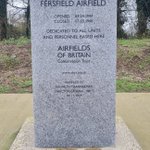
RAF Hethel housed USAAF B-24 Liberators during WWII. Colin Chapman brought Lotus here in 1966, turning former runways into a test track. Today the 2.2-mile circuit adjoins the factory producing the Lotus Emira. owned by automotive giant Geely #LotusCars #Norfolk #Aerial #Geely

The Mighty Eighth Podcast retweeted

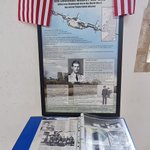
Nine years ago today, the inimitable @James1940 joined us at the Ridgewell Airfield museum for a jaunt around the former Eighth Air Force base. All part of the research for his fantastic book, 'Big Week'.

The eternal debate...was the CBO worth it? – at Arnhem, Nederland

We know the Allied bomber offensive against Nazi Germany came at a staggering cost. The US 8th AF and RAF Bomber Command lost around 21,900 aircraft and 158,000 aircrew. But the damage they inflicted went far beyond factories and cities reduced to rubble. By 1944, Germany had over 2 million people assigned to air defence, with huge chunks of its industrial output diverted to the effort. Every gun, shell and aircraft committed to defending the Reich was a resource that couldn't be sent to the land and sea fronts. 1/2

The Mighty Eighth Podcast retweeted

82 years ago today, the story of “Lovely Julie” The B-17 That Refused to Die 🇺🇸
On a mission over Germany, “Lovely Julie” of the 398th Bomb Group took a devastating flak hit. 💥
The explosion killed toggler Sgt. Abbott instantly & shredded the nose, destroying nearly all instruments, oxygen systems, & controls. 🪦
The battered Fortress was a wreck, nose blown open, gauges gone, shrapnel everywhere. Yet the pilot fought to keep her in the air. Somehow, through skill, determination, & sheer willpower, he nursed the heavily damaged bomber all the way back to England. 🏴
“Lovely Julie” was a testament to the resilience of the men who flew her & the rugged design of the Flying Fortress. ✈️

The Mighty Eighth Podcast retweeted
Been busy answering questions about Arnhem tonight. Great fun on the @hamandjampod sharing the microphone and the Market Garden questions with @airbornemedic23. Should be available next month... questions about bridges...

The Mighty Eighth Podcast retweeted

Curtis LeMay’s former unit - the 305th Bomb Group, which he'd trained and brought to England - was almost wiped out today, with 13 out of the 15 aircraft lost. Note the veterans' signatures on the left. Words fail me to describe what it feels like to be English and know what the 8th Air Force, and indeed Bomber Command, suffered day after day. My photos.


A concise summary of the birth of the Allied fighter that won the Air War for the Allies over Germany - a game changer. – at Bexley, London

October 13, 1942. At a quiet airfield in England, a modified fighter takes off for the first time with a different engine in its nose, and the sound of that engine is the sound of the air war over Germany being won. The marriage of the American P-51 Mustang airframe to the British Rolls-Royce Merlin engine, first flown on this day, created what many consider the finest fighter of the Second World War.
The Mustang had an odd origin. It was designed and built in a matter of months by North American Aviation to a British order early in the war. The airframe was brilliant, clean, fast, with a revolutionary low-drag wing and enormous internal fuel capacity, giving it tremendous range. But it had one crippling flaw: its American Allison engine performed poorly at high altitude, where the air battles over Europe were fought. Up high, where it was needed most, the early Mustang gasped and faded, and so it was relegated to low-level reconnaissance and ground attack, a thoroughbred hobbled by the wrong heart.
Then someone had the inspired idea of putting the Rolls-Royce Merlin into it, the same superb engine that powered the Spitfire, an engine that kept its power up in the thin air at high altitude. On the 13th, the prototype of this combination, the Mustang X, made its first flight in England. The transformation was staggering. With the Merlin, the Mustang became a superb high-altitude fighter, fast, agile, climbing and fighting with the best of them up where the bombers flew, while keeping its one magic quality, its enormous range.
That combination of range and high-altitude performance was exactly, precisely what the Allies desperately needed and did not have. The American daylight bombing campaign over Germany was being slaughtered. The heavy bombers flew deep into the Reich, and the short-ranged escort fighters had to turn back at the German border, leaving the bombers to go on alone into the teeth of the German fighter defenses, which butchered them. Raids were losing crews in catastrophic numbers. Without a fighter that could escort the bombers all the way to the target and back, the whole strategy of daylight bombing was failing.
The Merlin Mustang was the answer. With its range, it could accompany the bombers all the way to Berlin and beyond, and with its performance, it could beat the German fighters that came up to meet them. When it arrived over Germany in strength in 1944, it changed everything. The Mustangs did not just protect the bombers; they were turned loose to hunt the German fighter force and destroy it in the air and on its airfields, and they broke the back of the Luftwaffe in the months before D-Day, winning the air superiority that made the invasion possible.
All of that flowed from the moment on this day in 1942 when a Mustang first flew with a Merlin in its nose. It is one of the great examples of combination in the whole war, an American airframe and a British engine coming together to make something far greater than either, the long-range escort fighter that cleared the skies over Germany. The thoroughbred had finally been given the right heart.

The Mighty Eighth Podcast retweeted

In the New Forest area on 7 November? If so, why not book a ticket for my talk on the subject of Sgt Pilot ‘Paddy’ Adair, a Hurricane pilot of 213 Sqn flying from RAF Tangmere who was shot down and killed at Widley on 6 November 1940. His is the first name, alphabetically, on the Battle of Britain roll. His is also a fascinating story as he remains missing with no known grave. Tickets here: nfhwa.org/speakers/ Come along to support the New Forest & Hampshire Wartime Association. (Please share! Thank you)

Great WWII factoid... – at Warren Heath, England

The jacket that kept the pilots of the Battle of Britain alive was designed by a Hollywood stuntman, and it was a sheep turned inside out.
Leslie Irvin grew up in Los Angeles jumping out of balloons for the cameras. In 1919 he became the first man to leap from an aeroplane and open a parachute by hand in free fall. He broke his ankle on landing and started a company on the strength of it. In 1926 he opened a factory in Letchworth, in Hertfordshire.
His parachutes were silk. Anyone whose life was saved by one was sent a small gold pin in the shape of a caterpillar, after the creature that had spun the canopy.
Then he turned to the other thing that was killing airmen. Aircraft were climbing higher every year, and the cockpits had no heating. At 30,000 feet it is 45 degrees below zero. A pilot's hands stopped working. He could not think.
Irvin's answer was approved by the Air Ministry in 1932. Whole sheepskins, the fleece left on and turned inwards, the leather out to the wind. He insisted on the most supple skins, because a man in a Spitfire can barely move his shoulders as it is.
In the summer of 1940 that jacket was hanging on a hook at every fighter station in the south of England. The bell went, the pilot pulled it on and ran. Twenty minutes later he was five miles up with no heater, fighting for his country in a sheep.
By 1945 more than 34,000 airmen were wearing the caterpillar pin.
So the Few went up wrapped in a fleece and came down under a silkworm. The Spitfire gets the statues.

Not really an untold story but we will share it anyway... – at Little Stonham, England

In 1940 Britain desperately needed a new fighter aircraft to fight the Germans.
An American company nobody had heard of promised they could design and build an entirely new fighter in 120 days.
They delivered it in 117.
The aircraft they built became one of the most important fighters of the entire Second World War.
This is the story of the P-51 Mustang..🧵1/5
