

Data, insight, and analytics for forecasting, modelling, and trading European energy.
Europe
Joined April 2010
- Tweets8.2K
- Following369
- Followers9.7K
- Likes822




German front-week power hits its highest level since 2022 as a cold, low-wind week arrives ❄️⚡
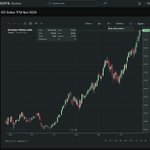
The EEX German power contract for week 45 2026 was trading at EUR 269.50/MWh at 15:51 CET today, up EUR 20.75 (+8.34%) on the day 📈
If it holds at this level at settlement, it would be the highest weekly price since the week beginning 12 December 2022 🔥
The move follows a weak renewables outlook for the coming week 🌥️
SMHI expects German winds to be calm and well below the seasonal norm 🍃
MetDesk expects an average of 15 GW of wind next week, while Montel EQ forecasts 7.4 GW, against a seasonal norm of 22.6 GW 🌬️
Solar is also expected to underperform. MetDesk forecasts 3.7 GW against a Montel EQ seasonal norm of 4.6 GW ☀️
Colder temperatures add to the pressure 🥶 Lower temperatures raise heating demand, which in Germany is mostly met by gas. Higher gas prices would in turn push up power prices 🔺
Conditions are forecast to improve later. Winds could recover from the week beginning 9 November, and temperatures should move closer to seasonal norms 🌤️
MetDesk puts wind output at 19.6 GW in the week after next, against a norm of 21.9 GW according to Montel EQ 💨
For context, this week’s wind output is on track to average 12.8 GW, 9.9 GW below normal (Montel EQ data). Solar is on track to average 5.6 GW, 0.1 GW above normal 📊
Reported by Kristin Schneider for @montelnews.

How do you spot trading opportunities in the GB power market?
Join Noémie Baud, Montel’s GB Market Expert, for a free practical webinar on 19 November at 14:00 CET.
Using real market examples and live Montel EnAppSys demonstrations, Noemie will show how to follow the signals shaping prices throughout the day, from changing renewable output and demand to interconnector flows and balancing activity.
The session will cover:
🔹 The fundamentals that shape the GB power market
🔹 How to monitor generation, demand and interconnector flows
🔹 What balancing activity can tell you about system conditions
🔹 How to use Montel EnAppSys to analyse price movements and identify potential trading opportunities
🔹 Practical workflows and key signals to keep an eye on across the day-ahead, intraday and balancing markets
Whether you’re new to Montel EnAppSys or an experienced user, you’ll take away practical ideas for analysing the GB market and supporting your trading decisions.
👥 Aimed at power and short-term traders, market analysts, energy suppliers, asset operators and risk managers.
🔗 Register for free: eu1.hubs.ly/H0xl_lh0

Are your Danish positions priced for today’s market, or last year’s?
In March 2025, the Nordics launched a new balancing model. Reserves are selected automatically, priced in 15-minute blocks and limited by the cross-border capacity available close to real time.
At Deep Dive Aarhus, Priyanka Shinde, our Nordic Market Expert, showed what that has meant:
📈 Balancing activations in DK1 and DK2 roughly doubled when comparing the same period in 2024 and 2025.
↔️ Imbalance prices across the 12 Nordic bidding zones became much less alike. The markets are more connected, but prices are moving further apart.
This matters especially in Denmark. DK1 and DK2 are small zones with a high share of wind. When cross-border capacity is available, neighbouring markets can help. When it isn’t, the zone is more exposed to sharp price swings.
Montel EnAppSys balancing forecasts cover Denmark under the new market rules. See whether DK1 or DK2 is heading short or long, and size your intraday positions for the market as it clears today.
👉 Try for free: eu1.hubs.ly/H0t98m20
🌆 Evening price spike expected across Western European day-ahead markets today.
🌬️ Low wind output, combined with the progressive decline in solar generation after sunset, is set to tighten the evening supply-demand balance across the region.
☀️ As solar output falls, residual demand rises sharply. That gap has to be met by dispatchable generation, which pushes up prices during the evening ramp.
📈 The price peaks move westward with the sunset:
🇩🇪 Germany: €574.28/MWh at 17:15
🇳🇱 Netherlands: €554.56/MWh at 17:30
🇧🇪 Belgium: €472.46/MWh at 17:30
🇫🇷 France: €410.00/MWh at 18:45
🇪🇸 Spain: €322.78/MWh at 20:30
🔎 Why do the peaks differ?
Generation mix, dispatchable capacity availability, system flexibility and cross-border trading conditions all shape each market’s peak. The weather driver is shared; the fundamentals are not.
We’re also hosting a timely webinar with Meteomatics: What can weather data tell us about German power price spikes? 🌦️
🎧 Find the webinar link here: eu1.hubs.ly/H0zt-pB0
💬 Which market’s evening peak are you tracking most closely?
Nuclear output in Europe fell this quarter as heat and low river levels forced reactors to cut output or shut down. 🌡️
Nuclear generation totalled 142.0 TWh in Q3 2026, compared with 153.8 TWh in Q3 2025. Its share of generation fell to 21.0%, from 23.7%.
In France, reactor output was cut by around 4.1 GW at one point, roughly 7% of electricity demand at the time.
Reactors at Golfech, Bugey, Nogent-sur-Seine, Saint Alban and Blayais experienced shutdowns or output reductions.
The problem reached beyond France. By late July, at least 10 reactors across Europe had shut down or had output curtailed.
On the Danube, Hungary’s Paks plant reduced output. Romania’s Cernavodă Unit 1 was disconnected from the grid in late July, and Unit 2 was shut down on 13 August.
Looking ahead, cooling-water constraints should ease as temperatures fall. However, Flamanville 3 began its first major inspection at the end of September, removing around 1.6 GW of capacity heading into Q4. ⚛️
📥 Download the full Q3 European electricity market summary here for free: eu1.hubs.ly/H0zqrcr0

🌦️ What can weather data tell us about German power price spikes?
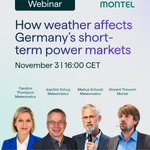
Join Montel and Meteomatics next week for “Price spikes explained: weather and market perspectives”, a webinar bringing market and weather data together to examine real German trading days from 2026.
Montel’s Vincent Thevenin and Meteomatics’ Markus Schwab will look at the wind and solar events behind selected positive and negative price spikes, comparing what happened in the market with what weather models showed at the time.
Meteomatics’ Senior Meteorologist Joachim Schug will then discuss the winter outlook, including the risk of another Dunkelflaute period and whether stagnant weather patterns are becoming more frequent in Germany’s supply mix.
Candice Thompson of Meteomatics will moderate, followed by a live Q&A. Bring along a price-spike day you’d like the panel to discuss. 💬
📅 3 November 2026
🕓 16:00 CET
🎟️ Free to attend
Register now: eu1.hubs.ly/H0zt-pB0

Montel Analytics retweeted

La giornata è iniziata a Milano! 🇮🇹⚡
The Italian Energy Day 2026 is underway, bringing together the Italian energy community for a day of insight and discussion.
This morning’s opening sessions have looked at the energy demands of data centres and AI, followed by a conversation with Eni on its global portfolio and trading activities.
The programme is now turning to the pressures on gas markets, including Hormuz, storage and price volatility, before a discussion on the growth and maturity of PPAs. Later, conversations with MASE, GSE and ARERA will bring further perspectives from across Italy’s energy sector.
This afternoon, we’ll look at Italian power prices and renewables, battery storage and the next MACSE auction, Guarantees of Origin, and the impact of ETS and energy prices on industrial competitiveness.
A full day of market insight, debate and networking is ahead.
European gas prices have crossed EUR 100/MWh for the first time since December 2022.
🔥 The TTF front month is up 38% this month alone and more than 200% since late February, when the US and Israel launched attacks on Iran. Those attacks caused significant disruption to oil and LNG deliveries from the Middle East, at a time when gas storage in Europe is historically low ahead of winter.
📰 Reported by Elise Wu, Yana Palagacheva and Elias Huuhtanen at @montelnews.
Link to the full reporting: montelnews.com/news/30b205e3…

⚡ Southeast European day-ahead power prices topped EUR 300/MWh on Tuesday for Wednesday delivery.
Settled prices:
🇷🇴 Romania: above EUR 311/MWh
🇧🇬 Bulgaria (Ibex): EUR 305.56/MWh
🇭🇺 Hungary (HUPX): EUR 303.34/MWh, its highest since 20 October
🇷🇸 Serbia (Seepex): EUR 292.65/MWh
Three factors are driving the squeeze:
🔴 Nuclear outages
Hungary’s Paks is running at 1.25 GW of 2 GW during maintenance, and the return of 480 MW has slipped to Thursday. Bulgaria’s Kozloduy is at 0.9 GW of 2 GW. Romania’s Cernavoda (1.35 GW) is likely to stay offline through next month due to cooling issues linked to drought on the Danube.
💧 Weak hydro
Per Montel EQ data, regional hydro output is forecast to stay 1-1.3 GW below average for the next three weeks.
🌬️ Low wind and solar, plus high gas prices
Hungary’s 400 MW Dunamenti gas plant is also offline for maintenance.
📈 Germany is also higher. Day-ahead baseload for Wednesday rose EUR 94.10 to EUR 249.21/MWh on forecasts of much lower wind.
What do you expect for the rest of the winter in this region?
Dashboard created by Georgios Merachtsakis.
Reported by Dalibor Dobric for @montelnews.
🇬🇧 GB wholesale power prices climbed throughout Q3 2026 and reached their highest levels of the quarter in September. 📈
The EPEX day-ahead average for the quarter was £122.61/MWh, up from £72.40/MWh in Q3 2025.
The Nord Pool day-ahead average was £122.99/MWh and the within-day (MIDP) average was £121.54/MWh, so the main measures moved closely together.
Prices followed gas costs. 🔥 NBP gas prices rose sharply through the quarter, and wholesale power tracked them.
Solar output still weighed on daytime prices, but prices typically strengthened again as solar generation fell towards the evening peak. ☀️ That created a wide gap between daytime and evening pricing, even as the overall average rose.
📥 Download our Q3 GB report: eu1.hubs.ly/H0zrFDY0

⚡ French day-ahead power just hit its highest level since December 2022, settling at around EUR 252/MWh, up roughly EUR 91 on yesterday. 📈
🔥 Power has been tracking gas closely. Dutch TTF was around EUR 94/MWh today, after peaking near EUR 98 on Monday, its highest front-month level since late 2022.
Three things are compounding it:
🌬️ Wind is fading. French output is forecast to drop from about 8.8 GW today to around 3 GW tomorrow.
🌡️ Demand is climbing. Temperatures are falling, and with the clock change the evening peak now comes after sunset, so gas is running for more hours. 🕠
☢️ Nuclear and hydro are still constrained by the summer drought. Recent restarts at Chooz 1 and Cattenom 2 have added some supply, but outages are still limiting output.
📊 Thursday could go higher still. The EEX futures contract for that day last traded around EUR 262/MWh.
🇪🇺 French prices also sit well above Spain’s, which settled around EUR 197/MWh. Limited Spanish export capacity to France is part of the gap.
📰 Reported by Caroline Pailliez and Belén Belmonte Azabal for @montelnews.
💬 Will gas stay the main driver of European power prices through the winter? Let us know what you’re seeing.
🌊 Hydropower output in Europe fell to its lowest Q3 total since 2015.
Hydro generation reached 84.8 TWh in Q3 2026, about 13% below Q3 2025. Its share of total generation dropped to 12.5%, from 14.9% a year earlier.
The steepest falls were in run-of-river hydro, which relies on river flow rather than stored water. Compared with Q3 2025, output was down roughly 31% in France, 30% in Italy and 71% in Austria.
🌧️ Rainfall returned closer to normal levels in September, but reservoirs and rivers are still depleted. Drought conditions remained widespread at the end of the quarter, particularly in France, Germany, northern Italy and parts of the Danube basin.
Hydro output could stay below seasonal norms for several months without a sustained period of above-average rainfall. The effect of a strengthening El Niño on European weather is uncertain.
📄 Download the full Q3 European electricity market summary report: eu1.hubs.ly/H0zqrcr0

November trades at 209€/MWh. Q1 2027 around 190€/MWh.
The market is pricing an average. What's behind it?
Power prices for the winter are linked to gas prices all over Europe. France is no exception.
Is there anything to stop the climb?
Structurally, no. Hydro is low and still impacts nuclear production at Chooz. Hopefully Chooz 1 is restarting today. We are close to the end of environmental constraints, but far from water abundance.
Overall, nuclear production will be high this winter, similar to last year.
From the parameters we can anticipate, the die is cast.
Temperature is the most important parameter. We saw the consumption impact last week. And the first week of November will be colder than normal.
But as we are in France, we forget the wind impact.
France is known for the nukes, for the nuclear and for its delay in renewable energy.
Wind installed capacity is 25.8 GW, with 23.9 GW of onshore wind. When wind production reaches 14 GW, it's a quarter of last week's 56 GW peak demand. Not negligible.
Said differently: with good nuclear, as soon as wind appears, prices crash.
Last week is a great case study to analyse the wind sensitivity on solar hours:
- Wednesday 21st: wind forecast is at 16 GW, solar is at 11.5 GW and DA prices crash to 0€/MWh, far below the 210€/MWh in Germany
- Thursday 22nd: wind forecast is at 12 GW, solar is at 11 GW and DA prices are at 93€/MWh, above the 73€/MWh in Germany
In winter, temperature fixes the load. Nuclear production fixes the remaining load to fill. Or with renewables at 0€/MWh. Or with gas and imprts at 180-200€/MWh and above.
Binary states. There's no in between.
👀💰 Temperature sets the load. Nuclear sets the gap. Wind sets the price. Now you know. Get ready for the ride. 👍
^CB

📉 French day-ahead power prices are heading for a near four-year high next week.
Friday’s forecasts point to a sharp drop in wind output, with average generation falling 7.5 GW to 4.9 GW. Consumption is expected to rise 0.9 GW to around 49 GW.
⚡Residual load, the demand not covered by wind and solar, is forecast to jump 7.5 GW to an average of 40.8 GW.
Nuclear, which makes up around 70% of France’s mix, is forecast to rise 5.8 GW week on week to 43.6 GW.
💶 The front-week contract last traded at EUR 188/MWh, compared with an average day-ahead price of EUR 130.10/MWh this week. That is roughly 45% higher.
Further out, Cal 27 peaked at EUR 116.75/MWh, its highest level since November 2023.
Wind is the main swing factor in the week ahead. Want to stay ahead of the swings? Click the link here to see them on Montel EQ: eu1.hubs.ly/H0zlSHF0
Also reported by Andreas Lochner for @montelnews.
⏳ Less than one week to go to join our new Machine Learning course.
Over three live online sessions, you’ll learn to build, test and explain machine learning models using real European energy market data.
The course covers forecasting and classification models, how to spot overfitting and data leakage, and how to use AI coding assistants while checking their output.
It’s taught by sjur westgaard, Professor of Finance at NTNU, and Morten Risstad, Associate Professor at NTNU.
No machine learning experience is needed. You should be comfortable working with data and basic statistics. A pre-course module covers Python basics.
📅 Sessions: 29 October, 5 November and 12 November
💻 Format: Live online, with self-paced materials and exercises between sessions
Register by 27 October, or until places are full: eu1.hubs.ly/H0z61B20

Montel Analytics retweeted
🚌 All aboard for Montel’s UK Energy Day!
The event is just a few weeks away.
Join us in London on 10 November to connect with people across the UK energy sector.
Exchange perspectives on the developments, challenges and opportunities shaping the market.
Hear different viewpoints, catch up with colleagues and make new connections.
Will you be joining us? Register here: eu1.hubs.ly/H0zjGmy0

Today’s session closes Energy Intensive Week 2026 with a session on how to use PPAs to secure lower-cost and low-carbon electricity ⚡
Power Purchase Agreements can support long-term price stability while helping organisations meet their sustainability goals 🌍 Choosing the right structure and managing its risks is harder, and that’s what this session tackles.
📅 Today, 14:00–15:00 CET
🤝 In partnership with EUROPEAN ALUMINIUM
We’ll cover:
🔹 When PPAs make financial sense for industrial buyers
🔹 The main corporate PPA structures and which suit energy-intensive companies
🔹 Managing profile, balancing and shaping risk
🔹 How PPAs compare with traditional supply contracts
🔹 What legislators and regulators can do to support wider adoption
Speakers:
🎙️ Josephine Steppat, Senior Market Analyst, Montel
🎙️ Killian Daly, Executive Director, EnergyTag
🎙️ Nick Bitsios, Head of Brussels Office, Metlen Energy & Metals
🎤 Moderated by Alina Trabattoni, PhD, Italy Correspondent, Montel News
Register here: eu1.hubs.ly/H0ypZK70

Montel Analytics retweeted
What could push European gas prices higher this winter? 🌡️
At Montel’s Benelux Energy Day, Erisa Pasko, Lead European Gas Analyst at Energy Aspects, discussed the risks facing the market.
Europe’s storage position is stronger than expected, and Erisa does not currently see prices returning to the highs of 2022 and 2023.
The outlook could change if severe cold coincides with longer disruptions to LNG flows through the Strait of Hormuz. That combination could push prices above €100/MWh.
▶️ Watch Erisa’s session, Is Europe facing another energy price crisis?: eu1.hubs.ly/H0zgPC60
How to reduce energy costs through hedging and gas risk management
Join us today for a free Energy Intensive Week webinar, held in partnership with European Aluminium.
Erisa Pasko, Lead European Gas Analyst at Energy Aspects, and Wimmel Wick, Quantitative Developer at Montel, will discuss:
🔹 What is driving gas price volatility
🔹 The outlook for European gas markets this winter and beyond
🔹 Which market indicators industrial buyers should monitor
🔹 Hedging strategies for managing price exposure
Laurence Walker, Deputy Editor-in-Chief at Montel News, will moderate.
📅 Today, 14:00–15:00 CET
Register here: eu1.hubs.ly/H0z0bMP0
